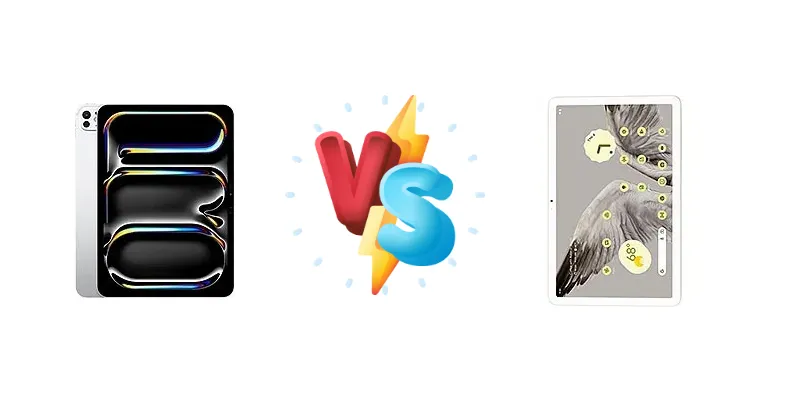
Apple’s latest iPad Pro 11 (2024) arrives with the groundbreaking M4 chip, promising a leap in mobile performance. However, Google’s Pixel Tablet carves a unique niche as a versatile tablet and smart home hub. This comparison dissects the core differences, helping you determine which device best suits your needs and workflow.
🏆 Quick Verdict
For users prioritizing raw power and professional workflows, the Apple iPad Pro 11 (2024) is the clear winner, thanks to the M4 chip and superior display. However, the Google Pixel Tablet offers a more affordable entry point with a focus on smart home integration and casual use.
| Network |
|---|
| 2G bands | GSM 850 / 900 / 1800 / 1900 | N/A |
| 3G bands | HSDPA 850 / 900 / 1700(AWS) / 1900 / 2100 | N/A |
| 4G bands | 1, 2, 3, 4, 5, 7, 8, 11, 12, 13, 14, 17, 18, 19, 20, 21, 25, 26, 28, 29, 30, 32, 34, 38, 39, 40, 41, 42, 48, 66, 71 - A2837 | N/A |
| 5G bands | 1, 2, 3, 5, 7, 8, 12, 14, 20, 25, 26, 28, 29, 30, 38, 40, 41, 48, 66, 70, 71, 75, 76, 77, 78, 79 SA/NSA - A2837, A3006 | - |
| EDGE | - | No |
| GPRS | - | No |
| Speed | HSPA, LTE, 5G | - |
| Technology | GSM / HSPA / LTE / 5G | No cellular connectivity |
| Launch |
|---|
| Announced | 2024, May 07 | 2023, May 10 |
| Status | Available. Released 2024, May 15 | Available. Released 2023, June 20 |
| Body |
|---|
| Build | Glass front, aluminum back, aluminum frame | Glass front, aluminum frame, aluminum back |
| Dimensions | 249.7 x 177.5 x 5.3 mm (9.83 x 6.99 x 0.21 in) | 258 x 169 x 8.1 mm (10.16 x 6.65 x 0.32 in) |
| SIM | eSIM | No |
| Weight | 444 g (Wi-Fi), 446 g (5G) (1.03 lb) | 493 g (1.09 lb) |
| | - | Stylus support |
| Display |
|---|
| Protection | Scratch-resistant glass, oleophobic coating, Mohs level 4 | - |
| Resolution | 1668 x 2420 pixels, 3:2 ratio (~264 ppi density) | 1600 x 2560 pixels, 16:10 ratio (~276 ppi density) |
| Size | 11.0 inches, 373.1 cm2 (~84.2% screen-to-body ratio) | 10.95 inches, 347.7 cm2 (~79.7% screen-to-body ratio) |
| Type | Ultra Retina Tandem OLED, 120Hz, HDR10, Dolby Vision, 1000 nits (HBM), 1600 nits (peak) | IPS LCD |
| Platform |
|---|
| CPU | 9-core 4.4 GHz (3 performance cores, 6 efficiency cores) - 256/512GB models10-core 4.4 GHz (4 performance cores, 6 efficiency cores) - 1/2TB models | Octa-core (2x2.85 GHz Cortex-X1 & 2x2.35 GHz Cortex-A78 & 4x1.80 GHz Cortex-A55) |
| Chipset | Apple M4 | Google Tensor G2 (5 nm) |
| GPU | Apple GPU (10-core graphics) | Mali-G710 MP7 |
| OS | iPadOS 17.5.1, upgradable to iPadOS 26.1 | Android 13, upgradable to Android 15 |
| Memory |
|---|
| Card slot | No | No |
| Internal | 256GB 8GB RAM, 512GB 8GB RAM, 1TB 16GB RAM, 2TB 16GB RAM | 128GB 8GB RAM, 256GB 8GB RAM |
| | - | UFS 3.1 |
| Main Camera |
|---|
| Features | Quad-LED dual-tone flash, HDR | HDR, panorama |
| Single | 12 MP, f/1.8, (wide), dual pixel PDAF
TOF 3D LiDAR scanner (depth) | 8 MP, f/2.0, 24mm (wide), 1/4.0", 1.12µm |
| Video | 4K@24/25/30/60fps, 1080p@25/30/60/120/240fps; gyro-EIS, ProRes (4K, 1080p) | 1080p@30fps |
| Selfie camera |
|---|
| Features | Face detection, HDR, panorama | HDR, panorama |
| Single | 12 MP, f/2.4, 122˚ (ultrawide) | 8 MP, f/2.0, 24mm (wide), 1/4.0", 1.12µm |
| Video | 1080p@25/30/60fps, gyro-EIS, HDR | 1080p@30fps |
| Sound |
|---|
| 3.5mm jack | - | No |
| 35mm jack | No | No |
| Loudspeaker | Yes, with stereo speakers (4 speakers) | Yes, with stereo speakers (4 speakers) |
| Comms |
|---|
| Bluetooth | 5.3, A2DP, LE, EDR | 5.2, A2DP, LE |
| NFC | No | No |
| Positioning | GPS, GLONASS, GALILEO, QZSS (Wi‑Fi + Cellular model only) | No |
| Radio | No | No |
| USB | USB Type-C 4 (Thunderbolt 3), DisplayPort, magnetic connector | USB Type-C 3.2 (Gen 1), magnetic connector |
| WLAN | Wi-Fi 802.11 a/b/g/n/ac/6e, dual-band, hotspot | Wi-Fi 802.11 a/b/g/n/ac/6, dual-band |
| Features |
|---|
| Sensors | Face ID, accelerometer, gyro, compass, barometer | Accelerometer, gyro, compass, proximity (accessories only) |
| | - | Ultra Wideband (UWB) support |
| Battery |
|---|
| Charging | - | 15W wired |
| Type | Li-Po 8160 mAh | Li-Po 7020 mAh (27 Wh) |
| Misc |
|---|
| Colors | Silver, Space Black | Porcelain, Hazel, Rose |
| Models | A2836, A2837, A3006, iPad16,3, iPad16,4 | GA06156-EU, GA06157-EU, GA06158-EU |
| Price | About 1200 EUR | About 670 EUR |
| EU LABEL |
|---|
| Battery | 73:00h endurance, 1000 cycles | - |
| Energy | Class G | - |
| Free fall | Class E (0 falls) | - |
| Repairability | Class C | - |
Apple iPad Pro 11 (2024)
- Unmatched performance with the Apple M4 chip
- Brilliant and bright 994 nit display
- Exceptional battery life and longevity (73h endurance, 1000 cycles)
- Higher price point
- Accessories (Apple Pencil, Magic Keyboard) sold separately
Google Pixel Tablet
- Integrated smart home hub functionality
- More affordable price
- Google’s AI and machine learning capabilities
- Significantly less powerful processor (Tensor G2)
- Slower charging speed (15W)
Display Comparison
The iPad Pro 11 (2024) boasts a significantly brighter display, reaching a measured 994 nits, ensuring excellent visibility even in direct sunlight. While the Pixel Tablet’s display specifications aren’t provided, it’s likely to fall short of this peak brightness. The iPad Pro’s likely use of an LTPO panel (based on Apple’s history) allows for dynamic refresh rate scaling, conserving battery life. The Pixel Tablet’s display is geared towards comfortable viewing, but lacks the Pro-level brightness and potential for adaptive refresh rates found on the iPad Pro.
Camera Comparison
Camera details for the Pixel Tablet are unavailable, making a direct comparison difficult. However, given Google’s strength in computational photography, the Pixel Tablet likely prioritizes image processing over raw sensor size. The iPad Pro, while not known for its camera prowess, benefits from Apple’s image signal processing. Without specific sensor details for the Pixel Tablet, it’s reasonable to assume the iPad Pro offers a more consistent and reliable camera experience, particularly in challenging lighting conditions.
Performance
The core differentiator lies in the chipsets. Apple’s M4, with its 9-core (or 10-core in higher storage models) CPU clocked at 4.4 GHz, represents a substantial performance advantage over Google’s Tensor G2 (2.85 GHz Cortex-X1 cores). The M4’s architecture, built on a cutting-edge process node, delivers superior CPU and GPU performance, crucial for demanding applications. The Tensor G2, while capable, is designed for AI and machine learning tasks, and will likely exhibit lower sustained performance under heavy load compared to the iPad Pro’s M4. The iPad Pro’s LPDDR5X RAM further enhances performance, enabling faster data access and smoother multitasking.
Battery Life
The iPad Pro 11 (2024) demonstrates impressive battery endurance, achieving 73 hours of endurance and 12:37 hours of active use. The Pixel Tablet’s battery capacity is unknown, but its 15W wired charging is significantly slower than what the iPad Pro likely supports (though Apple doesn't officially disclose wattage). The iPad Pro’s 1000 cycle battery lifespan also suggests greater long-term reliability. The combination of efficient chip design and optimized software allows the iPad Pro to deliver longer runtimes and a more durable battery.
Buying Guide
Buy the Apple iPad Pro 11 (2024) if you’re a creative professional, demanding gamer, or require the absolute best tablet performance for tasks like video editing, graphic design, or complex multitasking. Buy the Google Pixel Tablet if you prioritize a seamless smart home experience, casual media consumption, and a more affordable tablet solution that doubles as a smart display.
Frequently Asked Questions
❓ How does the M4 chip in the iPad Pro 11 (2024) handle demanding tasks like 4K video editing compared to the Pixel Tablet’s Tensor G2?
The Apple M4’s architecture and significantly higher processing power allow for much smoother and faster 4K video editing. The Tensor G2, while capable of handling video editing, will likely struggle with complex projects and exhibit noticeable lag. The M4’s dedicated media engines further accelerate video encoding and decoding.
❓ Is the Google Pixel Tablet’s smart home hub functionality truly useful, or is it a gimmick?
The Pixel Tablet’s smart home hub functionality is a genuine benefit for users heavily invested in the Google ecosystem. It can control smart devices, display security camera feeds, and act as a central control point for your smart home, even when not actively in use. This hands-free control and always-on display are key advantages.
❓ Given the lack of detailed battery specifications for the Pixel Tablet, how does its real-world battery life compare to the iPad Pro 11 (2024) during typical usage?
Based on the iPad Pro 11 (2024)'s 12:37 hours of active use, the Pixel Tablet is likely to offer significantly less runtime under similar conditions. The M4 chip’s efficiency and the iPad Pro’s larger battery capacity contribute to its superior endurance. Expect to charge the Pixel Tablet more frequently with comparable usage.