
Apple iPad Pro 11 (2022) vs Huawei MatePad Pro 13.2 (2025): A Performance and Charging Showdown
| Phones Images | |||||
|---|---|---|---|---|---|
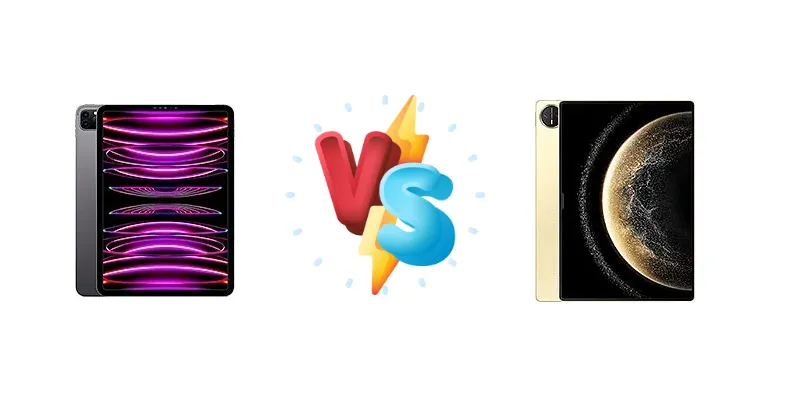
|
🏆 Quick Verdict
For users deeply embedded in the Apple ecosystem and prioritizing sustained performance, the iPad Pro 11 (2022) with its M2 chip is the superior choice. However, the Huawei MatePad Pro 13.2 (2025) offers a compelling alternative for those who value incredibly fast 100W charging and aren't locked into Apple's walled garden.
| PHONES | ||
|---|---|---|
| Phone Names | Apple iPad Pro 11 (2022) | Huawei MatePad Pro 13.2 (2025) |
| Network | ||
|---|---|---|
| 2G bands | GSM 850 / 900 / 1800 / 1900 | GSM 850 / 900 / 1800 / 1900 |
| 3G bands | HSDPA 850 / 900 / 1700(AWS) / 1900 / 2100 | HSDPA 850 / 900 / 1900 / 2100 |
| 4G bands | 1, 2, 3, 4, 5, 7, 8, 11, 12, 13, 14, 17, 18, 19, 20, 21, 25, 26, 28, 29, 30, 32, 34, 38, 39, 40, 41, 42, 46, 48, 66, 71 - A2435, A2761 | LTE |
| 5G bands | 1, 2, 3, 5, 7, 8, 12, 14, 20, 25, 26, 28, 29, 30, 38, 40, 41, 48, 66, 70, 71, 77, 78, 79, 258, 260, 261 SA/NSA/Sub6/mmWave - A2435 | - |
| Speed | HSPA, LTE, 5G - cellular model only | HSPA, LTE - cellular model only |
| Technology | GSM / HSPA / LTE / 5G | GSM / HSPA / LTE |
| 1, 2, 3, 5, 7, 8, 12, 14, 20, 25, 26, 28, 29, 30, 38, 40, 41, 48, 66, 70, 71, 77, 78, 79 SA/NSA/Sub6 - A2761, A2762 | - | |
| Launch | ||
|---|---|---|
| Announced | 2022, October 18 | 2024, November 26 |
| Status | Available. Released 2022, October 26 | Available. Released 2024, December 12 |
| Body | ||
|---|---|---|
| Build | Glass front, aluminum back, aluminum frame | Glass front, nylon fiber back, magnesium alloy frame |
| Dimensions | 247.6 x 178.5 x 5.9 mm (9.75 x 7.03 x 0.23 in) | 289.1 x 196.1 x 5.5 mm (11.38 x 7.72 x 0.22 in) |
| SIM | Nano-SIM + eSIM (cellular model only) | Nano-SIM (cellular model only) |
| Weight | 466 g (Wi-Fi), 470 g (5G) (1.03 lb) | 580 g (Wi-FI) or 590 g (LTE) (1.28 lb) |
| Stylus support (Bluetooth integration; magnetic) | - | |
| Display | ||
|---|---|---|
| Protection | Scratch-resistant glass, oleophobic coating | - |
| Resolution | 1668 x 2388 pixels (~265 ppi density) | 2880 x 1920 pixels, 3:2 ratio (~262 ppi density) |
| Size | 11.0 inches, 366.5 cm2 (~82.9% screen-to-body ratio) | 13.2 inches, 518.8 cm2 (~91.5% screen-to-body ratio) |
| Type | Liquid Retina IPS LCD, 120Hz, HDR10, Dolby Vision, 600 nits (typ) | OLED, 1B colors, 144Hz, HDR Vivid, 1000 nits (peak) |
| Platform | ||
|---|---|---|
| CPU | Octa-core (4x3.49 GHz performance cores, 4 efficiency cores) | Octa-core |
| Chipset | Apple M2 | Kirin T92 |
| GPU | Apple GPU (10-core graphics) | - |
| OS | iPadOS 16.1, upgradable to iPadOS 26.1 | Harmony OS 4.3 |
| Memory | ||
|---|---|---|
| Card slot | No | No |
| Internal | 128GB 8GB RAM, 256GB 8GB RAM, 512GB 8GB RAM, 1TB 16GB RAM, 2TB 16GB RAM | 256GB 12GB RAM, 512GB 12GB RAM, 1TB 16GB RAM |
| Main Camera | ||
|---|---|---|
| Dual | 12 MP, f/1.8, (wide), 1/3.0", 1.22µm, dual pixel PDAF 10 MP, f/2.4, 125˚ (ultrawide) TOF 3D LiDAR scanner (depth) | 50 MP, f/1.8, (wide), PDAF 8 MP, f/2.2, (ultrawide) |
| Features | Quad-LED dual-tone flash, HDR | LED flash |
| Single | 12 MP, f/2.4, 122˚ (ultrawide) | - |
| Video | 4K@24/25/30/60fps, 1080p@25/30/60/120/240fps; gyro-EIS, ProRes | 4K@30fps, 1080p@30fps |
| Selfie camera | ||
|---|---|---|
| Features | Face detection, HDR, panorama | - |
| Single | 12 MP, f/2.4, 122˚ (ultrawide) | 16 MP, f/2.2 |
| Video | 1080p@25/30/60fps, gyro-EIS, HDR | 1080p@30fps |
| Sound | ||
|---|---|---|
| 3.5mm jack | No | - |
| 35mm jack | No | No |
| Loudspeaker | Yes, with stereo speakers (4 speakers) | Yes, with stereo speakers (6 speakers) |
| Comms | ||
|---|---|---|
| Bluetooth | 5.3, A2DP, LE, EDR | 5.2, A2DP, LE, L2HC |
| NFC | No | No |
| Positioning | GPS, GLONASS, GALILEO, QZSS (cellular model only) | GPS, GALILEO, GLONASS, BDS |
| Radio | No | No |
| USB | USB Type-C 4 (Thunderbolt 3), DisplayPort, magnetic connector | USB Type-C 3.1, OTG, DisplayPort 1.2, accessory connector pins |
| WLAN | Wi-Fi 802.11 a/b/g/n/ac/6e, dual-band, hotspot | Wi-Fi 802.11 a/b/g/n/ac/6, dual-band |
| Features | ||
|---|---|---|
| Sensors | Face ID, accelerometer, gyro, compass, barometer | Fingerprint (side-mounted), accelerometer, gyro, compass, proximity (accessories only) |
| Battery | ||
|---|---|---|
| Charging | - | 100W wired 7.5W reverse wired |
| Type | Li-Po 7538 mAh (28.65 Wh) | Li-Po 10100 mAh |
| Misc | ||
|---|---|---|
| Colors | Silver, Space Gray | Black, White, Gold |
| Models | A2435, A2761, A2762, A2759, iPad8,9, iPad8,10, iPad14,3, iPad14,4 | WEB-W00, PCE-W29 |
| Price | About 1050 EUR | About 680 EUR |
Apple iPad Pro 11 (2022)
- Superior CPU performance with Apple M2
- Mature and optimized tabletOS (iPadOS)
- Excellent display quality and color accuracy
- Slower charging speeds compared to MatePad Pro
- Higher price point
- Limited customization options
Huawei MatePad Pro 13.2 (2025)
- Ultra-fast 100W wired charging
- Larger 13.2-inch display for immersive viewing
- Potentially more affordable price
- Kirin T92 performance is unproven against M2
- HarmonyOS ecosystem may be limiting for some
- Camera performance is unknown
Display Comparison
While both tablets likely feature high-quality displays, the context data lacks specifics. Given Apple’s history, the iPad Pro 11 (2022) almost certainly utilizes a Liquid Retina display with ProMotion (adaptive refresh rates up to 120Hz), offering exceptional color accuracy and smoothness. The MatePad Pro 13.2’s 13.2-inch size suggests a focus on immersive media viewing. Without knowing the panel technology (OLED vs LCD) or peak brightness, it’s difficult to definitively declare a winner, but Apple’s display calibration is typically industry-leading. Bezels are likely minimal on both, reflecting current design trends.
Camera Comparison
The provided data doesn’t offer camera details for either tablet. Historically, iPad Pro cameras are competent but not flagship-level. Huawei often prioritizes camera technology, so the MatePad Pro 13.2 *could* feature a more advanced camera system. However, tablets aren’t typically purchased for their photography capabilities, so this is a lower priority comparison point. The absence of sensor size or aperture information prevents a meaningful analysis.
Performance
The core of the comparison lies in the chipsets. Apple’s M2, built on a second-generation 5nm process, delivers exceptional CPU and GPU performance. Its octa-core configuration, with four performance cores clocked at 3.49 GHz, provides a significant advantage in tasks requiring sustained processing power. The Huawei MatePad Pro 13.2’s Kirin T92, while also octa-core, lacks detailed specifications. Without knowing the manufacturing process (e.g., 3nm, 4nm) or clock speeds, it’s challenging to directly compare. However, Apple’s silicon has a proven track record of efficiency and optimization within its ecosystem. The iPad Pro’s LPDDR5 RAM (likely 8GB or 16GB) further enhances performance. Thermal management will be crucial for the Kirin T92 to maintain peak performance under load.
Battery Life
The Huawei MatePad Pro 13.2’s 100W wired charging is a standout feature, drastically reducing charging times compared to the iPad Pro’s likely 20-25W charging. This means significantly less downtime for power users. While the iPad Pro’s battery capacity is likely optimized for the M2’s efficiency, the MatePad Pro’s faster charging could offset a potentially smaller battery capacity. The 7.5W reverse wired charging on the MatePad Pro is a useful addition for topping up accessories.
Buying Guide
Buy the Apple iPad Pro 11 (2022) if you need seamless integration with other Apple devices, access to a mature tabletOS with a vast app library, and consistently high performance for demanding tasks like video editing and graphic design. Buy the Huawei MatePad Pro 13.2 (2025) if you prioritize minimizing downtime with its 100W charging, appreciate a larger display for media consumption, and are comfortable with Huawei’s HarmonyOS ecosystem.