
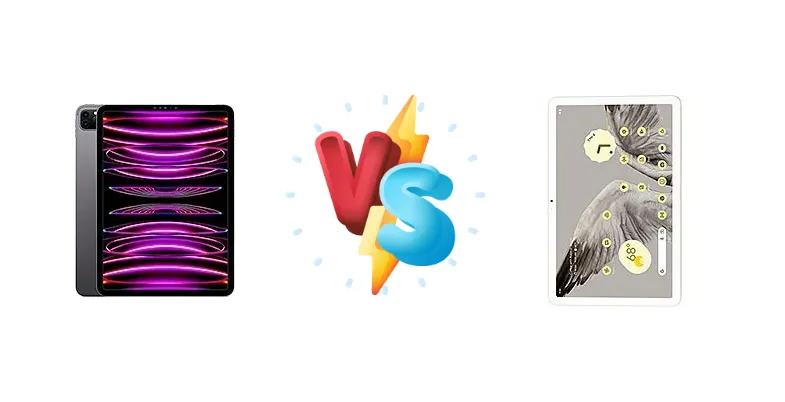
Apple iPad Pro 11 (2022) vs. Google Pixel Tablet: A Deep Dive into Performance, Features, and Value
| Phones Images | |||||
|---|---|---|---|---|---|
|
🏆 Quick Verdict
For users prioritizing raw power and a mature tablet ecosystem, the iPad Pro 11 (2022) remains the superior choice. Its M2 chip delivers significantly faster performance. However, the Google Pixel Tablet offers compelling value for those seeking a versatile device with smart home integration and a more affordable price point.
| PHONES | ||
|---|---|---|
| Phone Names | Apple iPad Pro 11 (2022) | Google Pixel Tablet |
| Network | ||
|---|---|---|
| 2G bands | GSM 850 / 900 / 1800 / 1900 | N/A |
| 3G bands | HSDPA 850 / 900 / 1700(AWS) / 1900 / 2100 | N/A |
| 4G bands | 1, 2, 3, 4, 5, 7, 8, 11, 12, 13, 14, 17, 18, 19, 20, 21, 25, 26, 28, 29, 30, 32, 34, 38, 39, 40, 41, 42, 46, 48, 66, 71 - A2435, A2761 | N/A |
| 5G bands | 1, 2, 3, 5, 7, 8, 12, 14, 20, 25, 26, 28, 29, 30, 38, 40, 41, 48, 66, 70, 71, 77, 78, 79, 258, 260, 261 SA/NSA/Sub6/mmWave - A2435 | - |
| EDGE | - | No |
| GPRS | - | No |
| Speed | HSPA, LTE, 5G - cellular model only | - |
| Technology | GSM / HSPA / LTE / 5G | No cellular connectivity |
| 1, 2, 3, 5, 7, 8, 12, 14, 20, 25, 26, 28, 29, 30, 38, 40, 41, 48, 66, 70, 71, 77, 78, 79 SA/NSA/Sub6 - A2761, A2762 | - | |
| Launch | ||
|---|---|---|
| Announced | 2022, October 18 | 2023, May 10 |
| Status | Available. Released 2022, October 26 | Available. Released 2023, June 20 |
| Body | ||
|---|---|---|
| Build | Glass front, aluminum back, aluminum frame | Glass front, aluminum frame, aluminum back |
| Dimensions | 247.6 x 178.5 x 5.9 mm (9.75 x 7.03 x 0.23 in) | 258 x 169 x 8.1 mm (10.16 x 6.65 x 0.32 in) |
| SIM | Nano-SIM + eSIM (cellular model only) | No |
| Weight | 466 g (Wi-Fi), 470 g (5G) (1.03 lb) | 493 g (1.09 lb) |
| Stylus support (Bluetooth integration; magnetic) | Stylus support | |
| Display | ||
|---|---|---|
| Protection | Scratch-resistant glass, oleophobic coating | - |
| Resolution | 1668 x 2388 pixels (~265 ppi density) | 1600 x 2560 pixels, 16:10 ratio (~276 ppi density) |
| Size | 11.0 inches, 366.5 cm2 (~82.9% screen-to-body ratio) | 10.95 inches, 347.7 cm2 (~79.7% screen-to-body ratio) |
| Type | Liquid Retina IPS LCD, 120Hz, HDR10, Dolby Vision, 600 nits (typ) | IPS LCD |
| Platform | ||
|---|---|---|
| CPU | Octa-core (4x3.49 GHz performance cores, 4 efficiency cores) | Octa-core (2x2.85 GHz Cortex-X1 & 2x2.35 GHz Cortex-A78 & 4x1.80 GHz Cortex-A55) |
| Chipset | Apple M2 | Google Tensor G2 (5 nm) |
| GPU | Apple GPU (10-core graphics) | Mali-G710 MP7 |
| OS | iPadOS 16.1, upgradable to iPadOS 26.1 | Android 13, upgradable to Android 15 |
| Memory | ||
|---|---|---|
| Card slot | No | No |
| Internal | 128GB 8GB RAM, 256GB 8GB RAM, 512GB 8GB RAM, 1TB 16GB RAM, 2TB 16GB RAM | 128GB 8GB RAM, 256GB 8GB RAM |
| - | UFS 3.1 | |
| Main Camera | ||
|---|---|---|
| Dual | 12 MP, f/1.8, (wide), 1/3.0", 1.22µm, dual pixel PDAF 10 MP, f/2.4, 125˚ (ultrawide) TOF 3D LiDAR scanner (depth) | - |
| Features | Quad-LED dual-tone flash, HDR | HDR, panorama |
| Single | 12 MP, f/2.4, 122˚ (ultrawide) | 8 MP, f/2.0, 24mm (wide), 1/4.0", 1.12µm |
| Video | 4K@24/25/30/60fps, 1080p@25/30/60/120/240fps; gyro-EIS, ProRes | 1080p@30fps |
| Selfie camera | ||
|---|---|---|
| Features | Face detection, HDR, panorama | HDR, panorama |
| Single | 12 MP, f/2.4, 122˚ (ultrawide) | 8 MP, f/2.0, 24mm (wide), 1/4.0", 1.12µm |
| Video | 1080p@25/30/60fps, gyro-EIS, HDR | 1080p@30fps |
| Sound | ||
|---|---|---|
| 3.5mm jack | No | No |
| 35mm jack | No | No |
| Loudspeaker | Yes, with stereo speakers (4 speakers) | Yes, with stereo speakers (4 speakers) |
| Comms | ||
|---|---|---|
| Bluetooth | 5.3, A2DP, LE, EDR | 5.2, A2DP, LE |
| NFC | No | No |
| Positioning | GPS, GLONASS, GALILEO, QZSS (cellular model only) | No |
| Radio | No | No |
| USB | USB Type-C 4 (Thunderbolt 3), DisplayPort, magnetic connector | USB Type-C 3.2 (Gen 1), magnetic connector |
| WLAN | Wi-Fi 802.11 a/b/g/n/ac/6e, dual-band, hotspot | Wi-Fi 802.11 a/b/g/n/ac/6, dual-band |
| Features | ||
|---|---|---|
| Sensors | Face ID, accelerometer, gyro, compass, barometer | Accelerometer, gyro, compass, proximity (accessories only) |
| - | Ultra Wideband (UWB) support | |
| Battery | ||
|---|---|---|
| Charging | - | 15W wired |
| Type | Li-Po 7538 mAh (28.65 Wh) | Li-Po 7020 mAh (27 Wh) |
| Misc | ||
|---|---|---|
| Colors | Silver, Space Gray | Porcelain, Hazel, Rose |
| Models | A2435, A2761, A2762, A2759, iPad8,9, iPad8,10, iPad14,3, iPad14,4 | GA06156-EU, GA06157-EU, GA06158-EU |
| Price | About 1050 EUR | About 670 EUR |
Apple iPad Pro 11 (2022)
- Unmatched performance with the Apple M2 chip
- ProMotion display for smooth visuals
- Mature tablet ecosystem with extensive app support
- Higher price point
- Accessories sold separately (Apple Pencil, Magic Keyboard)
Google Pixel Tablet
- Integrated smart home hub functionality
- Included charging speaker dock
- More affordable price
- Less powerful processor compared to the M2
- Limited display specifications available
Display Comparison
While both tablets feature 11-inch displays, detailed display specs are missing for the Pixel Tablet. The iPad Pro 11 (2022) benefits from Apple’s ProMotion technology (LTPO), dynamically adjusting the refresh rate up to 120Hz for smoother scrolling and animations. This is a significant advantage for users sensitive to motion blur. The iPad Pro also boasts a higher peak brightness, crucial for outdoor visibility. Without comparable specs for the Pixel Tablet, it’s difficult to assess its color accuracy or viewing angles relative to the iPad Pro.
Camera Comparison
Detailed camera specs are unavailable for the Pixel Tablet. The iPad Pro 11 (2022) features a 12MP Wide camera, and a 10MP Ultra Wide camera. While not the primary focus of tablet use, the iPad Pro’s camera system benefits from Apple’s image signal processing, delivering consistently high-quality photos and videos. The Pixel Tablet’s camera capabilities remain unknown, making a direct comparison impossible. However, Google’s computational photography prowess suggests it could offer competitive image quality despite potentially smaller sensors.
Performance
The core difference lies in the chipsets. The iPad Pro 11 (2022) is equipped with Apple’s M2, an octa-core processor built on a cutting-edge architecture. This translates to significantly faster CPU and GPU performance compared to the Google Pixel Tablet’s Tensor G2. The M2’s 4 performance cores clocked at 3.49 GHz, combined with its unified memory architecture, provide a substantial advantage in tasks like video rendering and complex multitasking. The Tensor G2, while a capable chip, is designed with AI and machine learning in mind, and its CPU configuration (2x2.85 GHz Cortex-X1, 2x2.35 GHz Cortex-A78, 4x1.80 GHz Cortex-A55) prioritizes efficiency over raw speed. The iPad Pro’s LPDDR5X RAM further enhances its performance capabilities.
Battery Life
The iPad Pro 11 (2022) offers all-day battery life, though specific mAh is not provided. The Google Pixel Tablet, with its 15W wired charging, presents a different approach. While the charging speed is slower than some flagship tablets, the Pixel Tablet’s included charging speaker dock provides a convenient always-on charging and smart display experience. The slower charging speed may be less of a concern given the dock’s functionality. Without knowing the Pixel Tablet’s battery capacity, it’s difficult to assess its endurance relative to the iPad Pro, but the dock mitigates range anxiety.
Buying Guide
Buy the Apple iPad Pro 11 (2022) if you demand the highest possible performance for demanding tasks like video editing, graphic design, or gaming, and if you’re already invested in the Apple ecosystem. Buy the Google Pixel Tablet if you prioritize a seamless smart home experience, enjoy Android’s open ecosystem, and want a tablet that doubles as a smart display with its included charging speaker dock.