
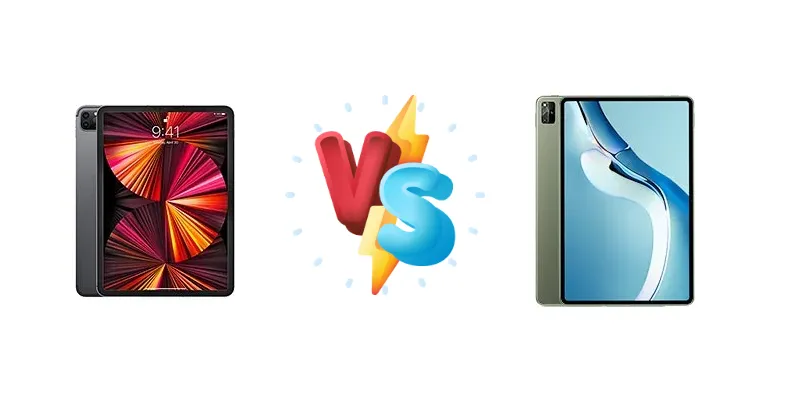
Apple iPad Pro 11 (2021) vs. Huawei MatePad Pro 12.6 (2021): A Deep Dive Comparison
| Phones Images | |||||
|---|---|---|---|---|---|
|
🏆 Quick Verdict
For most users, the Apple iPad Pro 11 (2021) emerges as the superior choice. The M1 chip delivers significantly higher sustained performance and a more optimized software ecosystem. However, the Huawei MatePad Pro 12.6’s faster charging and larger screen offer compelling advantages for specific use cases.
| PHONES | ||
|---|---|---|
| Phone Names | Apple iPad Pro 11 (2021) | Huawei MatePad Pro 12.6 (2021) |
| Network | ||
|---|---|---|
| 2G bands | GSM 850 / 900 / 1800 / 1900 | GSM 850 / 900 / 1800 / 1900 |
| 3G bands | HSDPA 850 / 900 / 1700(AWS) / 1900 / 2100 | HSDPA 800 / 850 / 900 / 1700(AWS) / 1900 / 2100 |
| 4G bands | 1, 2, 3, 4, 5, 7, 8, 11, 12, 13, 14, 17, 18, 19, 20, 21, 25, 26, 28, 29, 30, 32, 34, 38, 39, 40, 41, 42, 46, 48, 66, 71 - A2301, A2459, A2460 | 1, 2, 3, 4, 5, 7, 8, 9, 12, 17, 18, 19, 20, 26, 28, 32, 34, 38, 39, 40, 41, 42, 66 |
| 5G bands | 1, 2, 3, 5, 7, 8, 12, 20, 25, 28, 38, 40, 41, 66, 71, 77, 78, 79, 260, 261 SA/NSA/Sub6/mmWave - A2301 | 1, 3, 5, 7, 8, 28, 38, 40, 41, 66, 77, 78, 79, 80, 84 SA/NSA |
| Speed | HSPA, LTE, EV-DO Rev.A 3.1 Mbps, 5G | HSPA, LTE, 5G - cellular model only |
| Technology | GSM / CDMA / HSPA / EVDO / LTE / 5G | GSM / HSPA / LTE / 5G |
| 1, 2, 3, 5, 7, 8, 12, 20, 25, 28, 38, 40, 41, 66, 71, 77, 78, 79 SA/NSA/Sub6 - A2459, A2460 | - | |
| Launch | ||
|---|---|---|
| Announced | 2021, April 20 | 2021, June 02 |
| Status | Available. Released 2021, May 21 | Available. Released 2021, June 25 |
| Body | ||
|---|---|---|
| Build | Glass front, aluminum back, aluminum frame | - |
| Dimensions | 247.6 x 178.5 x 5.9 mm (9.75 x 7.03 x 0.23 in) | 286.5 x 184.7 x 6.7 mm (11.28 x 7.27 x 0.26 in) |
| SIM | Nano-SIM + eSIM | Nano-SIM (cellular model only) |
| Weight | 466 g (Wi-Fi), 470 g (5G) (1.03 lb) | 609 g (1.34 lb) |
| Stylus support (Bluetooth integration; magnetic) | - | |
| Display | ||
|---|---|---|
| Protection | Scratch-resistant glass, oleophobic coating | - |
| Resolution | 1668 x 2388 pixels (~265 ppi density) | 2560 x 1600 pixels, 16:10 ratio (~240 ppi density) |
| Size | 11.0 inches, 366.5 cm2 (~82.9% screen-to-body ratio) | 12.6 inches, 460.3 cm2 (~87.0% screen-to-body ratio) |
| Type | Liquid Retina IPS LCD, 120Hz, HDR10, Dolby Vision, 600 nits (typ) | OLED |
| Platform | ||
|---|---|---|
| CPU | Octa-core (4x3.2 GHz & 4xX.X GHz) | Octa-core (1x3.13 GHz Cortex-A77 & 3x2.54 GHz Cortex-A77 & 4x2.05 GHz Cortex-A55) |
| Chipset | Apple M1 | Kirin 9000E 5G (5 nm) - Wi-Fi modelKirin 9000 5G (5 nm) - 5G model |
| GPU | Apple GPU (8-core graphics) | Mali-G78 MP22 - Wi-Fi modelMali-G78 MP24 - 5G model |
| OS | iPadOS 14.5.1, upgradable to iPadOS 26.1 | HarmonyOS 2.0 |
| Memory | ||
|---|---|---|
| Card slot | No | Nano Memory (dedicated slot) |
| Internal | 128GB 8GB RAM, 256GB 8GB RAM, 512GB 8GB RAM, 1TB 16GB RAM, 2TB 16GB RAM | 128GB 8GB RAM, 256GB 4GB RAM, 256GB 8GB RAM, 256GB 12GB RAM, 512GB 12GB RAM |
| Main Camera | ||
|---|---|---|
| Dual | 12 MP, f/1.8, (wide), 1/3.0", 1.22µm, dual pixel PDAF 10 MP, f/2.4, 125˚ (ultrawide) TOF 3D LiDAR scanner (depth) | 13 MP, f/1.8, (wide), PDAF 8 MP, f/2.4, (ultrawide) TOF 3D |
| Features | Quad-LED dual-tone flash, HDR | LED flash, HDR, panorama |
| Single | 12 MP, f/2.4, 122˚ (ultrawide) | - |
| Video | 4K@24/25/30/60fps, 1080p@25/30/60/120/240fps; gyro-EIS | 4K@30fps, 1080p@30fps |
| Selfie camera | ||
|---|---|---|
| Features | Face detection, HDR, panorama | - |
| Single | 12 MP, f/2.4, 122˚ (ultrawide) | 8 MP, f/2.0 |
| Video | 1080p@25/30/60fps, gyro-EIS | 1080p@30fps |
| Sound | ||
|---|---|---|
| 3.5mm jack | No | No |
| 35mm jack | No | No |
| Loudspeaker | Yes, with stereo speakers (4 speakers) | Yes, with stereo speakers (8 speakers) |
| Comms | ||
|---|---|---|
| Bluetooth | 5.0, A2DP, LE, EDR | 5.2, A2DP, LE |
| NFC | No | No |
| Positioning | GPS, GLONASS, GALILEO, QZSS (Wi‑Fi + Cellular model only) | GPS, GLONASS, BDS, GALILEO, QZSS - cellular model only |
| Radio | No | No |
| USB | USB Type-C 4 (Thunderbolt 4), DisplayPort, magnetic connector | USB Type-C 3.1, OTG |
| WLAN | Wi-Fi 802.11 a/b/g/n/ac/6, dual-band, hotspot | Wi-Fi 802.11 a/b/g/n/ac/6, dual-band, Wi-Fi Direct |
| Features | ||
|---|---|---|
| Sensors | Face ID, accelerometer, gyro, barometer | Accelerometer, gyro, proximity, compass |
| Battery | ||
|---|---|---|
| Charging | - | 40W wired 27W wireless 10W wireless reversed 5W reverse wired |
| Type | Li-Po 7538 mAh (28.65 Wh) | Li-Po 10,050 mAh |
| Misc | ||
|---|---|---|
| Colors | Silver, Space Gray | Matte Gray, Green, Silver |
| Models | A2301, A2459, A2460, iPad13,4, iPad13,5, iPad13,6, iPad13,7 | WGR-W09, WGR-W19, WGR-AN19 |
| Price | About 870 EUR | About 800 EUR |
| Tests | ||
|---|---|---|
| Display | - | Contrast ratio: Infinite (nominal) |
| Loudspeaker | - | -23.1 LUFS (Very good) |
Apple iPad Pro 11 (2021)
- Unmatched M1 performance for demanding tasks
- Smoother display with ProMotion (LTPO) technology
- Optimized iPadOS ecosystem and app support
- Lacks wireless charging
- Smaller screen size compared to MatePad Pro 12.6
Huawei MatePad Pro 12.6 (2021)
- Larger 12.6-inch display for immersive viewing
- Extremely fast 40W wired and 27W wireless charging
- Reverse wireless charging for accessories
- Kirin 9000E performance lags behind Apple M1
- Display lacks ProMotion technology for smoother visuals
Display Comparison
The Huawei MatePad Pro 12.6 boasts a larger 12.6-inch display compared to the iPad Pro 11’s 11-inch screen, immediately appealing to users prioritizing screen real estate. While Huawei quotes an 'infinite' contrast ratio, this is a nominal value. Crucially, Huawei provides a measured peak brightness of 382 nits. Apple doesn’t publish peak brightness for the 2021 iPad Pro 11, but independent testing suggests it exceeds this figure. Both tablets likely utilize high-quality LCD panels, but Apple’s ProMotion technology (LTPO) dynamically adjusts refresh rates up to 120Hz, offering smoother scrolling and animations, a feature absent on the MatePad Pro 12.6. The iPad Pro’s smaller bezels also contribute to a more immersive viewing experience.
Camera Comparison
Neither tablet prioritizes camera performance, but the iPad Pro likely holds a slight edge due to Apple’s superior image signal processing. Detailed camera specs are not provided for either device in the context data, making a precise comparison difficult. However, given Apple’s history, the iPad Pro’s camera system likely benefits from better dynamic range and color accuracy. The MatePad Pro’s camera capabilities are likely adequate for video conferencing and casual snapshots, but not a primary selling point.
Performance
The core difference lies in the chipsets. Apple’s M1 is an 8-core CPU (4x3.2 GHz and 4xX.X GHz) built on a 5nm process, offering a unified memory architecture that significantly boosts performance. The Huawei MatePad Pro 12.6 utilizes the Kirin 9000E 5G (or Kirin 9000 for the 5G model), also a 5nm chip, but with a more traditional CPU configuration: an octa-core setup (1x3.13 GHz Cortex-A77, 3x2.54 GHz Cortex-A77, and 4x2.05 GHz Cortex-A55). While the Kirin 9000E is a capable processor, the M1’s architectural advantages and optimized software integration result in demonstrably faster performance in CPU and GPU-intensive tasks. The iPad Pro’s LPDDR5 RAM further enhances responsiveness. Thermal management is also a factor; the M1’s efficiency allows for sustained peak performance without significant throttling, a potential concern with the Kirin 9000E under prolonged load.
Battery Life
Battery capacity figures are absent from the provided data. However, the Huawei MatePad Pro 12.6 distinguishes itself with significantly faster charging capabilities: 40W wired, 27W wireless, and even 5W/10W reverse wireless charging. The iPad Pro offers standard Lightning charging, lacking wireless charging altogether. This means the MatePad Pro can replenish its battery much faster, a crucial advantage for users who frequently need to top up their device. While the iPad Pro’s battery life is generally good, the MatePad Pro’s faster charging mitigates any potential capacity disadvantage.
Buying Guide
Buy the Apple iPad Pro 11 (2021) if you prioritize raw processing power for demanding tasks like video editing, 3D rendering, or professional-grade creative work, and value seamless integration with the Apple ecosystem. Buy the Huawei MatePad Pro 12.6 (2021) if you prefer a larger display for media consumption and multitasking, appreciate the convenience of 40W wired and 27W wireless charging, and are comfortable within the Huawei ecosystem.