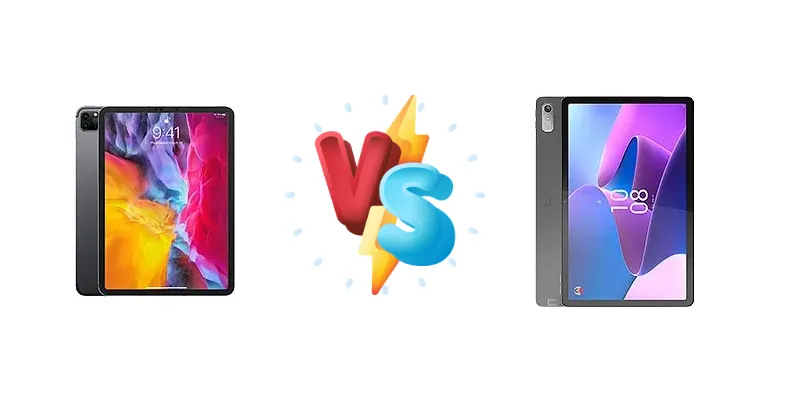
Apple’s iPad Pro 11 (2020) remains a strong contender in the premium tablet space, even with newer models available, thanks to its powerful A12Z Bionic chip. However, Lenovo’s Tab P11 Pro Gen 2 aims to disrupt the market with a compelling combination of features and a more accessible price point. This comparison dissects the key differences between these two tablets, helping you determine which best suits your needs.
🏆 Quick Verdict
For users deeply embedded in the Apple ecosystem and prioritizing raw performance for demanding tasks like video editing, the iPad Pro 11 (2020) is the superior choice. However, the Lenovo Tab P11 Pro Gen 2 offers excellent value, delivering a strong all-around experience with a vibrant display and fast charging at a significantly lower cost.
| Network |
|---|
| 2G bands | GSM 850 / 900 / 1800 / 1900 | GSM 850 / 900 / 1800 / 1900 |
| 3G bands | HSDPA 850 / 900 / 1700(AWS) / 1900 / 2100 | HSDPA 850 / 900 / 1900 / 2100 |
| 4G bands | 1, 2, 3, 4, 5, 7, 8, 11, 12, 13, 14, 17, 18, 19, 20, 21, 25, 26, 29, 30, 34, 38, 39, 40, 41, 46, 48, 66, 71 | LTE |
| Speed | HSPA, LTE, EV-DO Rev.A 3.1 Mbps | HSPA, LTE - cellular model only |
| Technology | GSM / CDMA / HSPA / EVDO / LTE | GSM / HSPA / LTE |
| | CDMA2000 1xEV-DO | - |
| Launch |
|---|
| Announced | 2020, March 18 | 2022, September 01 |
| Status | Available. Released 2020, March 19 | Available. Released 2022, September 01 |
| Body |
|---|
| Build | Glass front, aluminum back, aluminum frame | Glass front, plastic back, plastic frame |
| Dimensions | 247.6 x 178.5 x 5.9 mm (9.75 x 7.03 x 0.23 in) | 263.7 x 166.7 x 6.8 mm (10.38 x 6.56 x 0.27 in) |
| SIM | Nano-SIM + eSIM | Nano-SIM (cellular model only) |
| Weight | 471 g (Wi-Fi), 473 g (LTE) (1.04 lb) | 480 g (1.06 lb) |
| | Stylus support (Bluetooth integration; magnetic) | Stylus support (magnetic) |
| Display |
|---|
| Protection | Scratch-resistant glass, oleophobic coating | - |
| Resolution | 1668 x 2388 pixels (~265 ppi density) | 1536 x 2560 pixels, 5:3 ratio (~267 ppi density) |
| Size | 11.0 inches, 366.5 cm2 (~82.9% screen-to-body ratio) | 11.2 inches, 357.0 cm2 (~81.2% screen-to-body ratio) |
| Type | IPS LCD, 120Hz, 600 nits (typ) | OLED, HDR10+, Dolby Vision, 120Hz, 420 nits (typ), 600 nits (peak) |
| Platform |
|---|
| CPU | Octa-core (4x2.5 GHz Vortex + 4x1.6 GHz Tempest) | Octa-core (4x2.6 GHz Cortex-A78 & 4x2.0 GHz Cortex-A55) |
| Chipset | Apple A12Z Bionic | Mediatek MT8797 Kompanio 1300T (6 nm) |
| GPU | Apple GPU (8-core graphics) | Mali-G77 MC9 |
| OS | iPadOS 13.4, upgradable to iPadOS 26.1 | Android 12, upgradable to Android 13 |
| Memory |
|---|
| Card slot | No | microSDXC (dedicated slot) |
| Internal | 128GB 6GB RAM, 256GB 6GB RAM, 512GB 6GB RAM, 1TB 6GB RAM | 128GB 4GB RAM, 128GB 6GB RAM, 256GB 8GB RAM |
| | - | UFS 3.1 |
| Main Camera |
|---|
| Dual | 12 MP, f/1.8, (wide), 1/3.0", 1.22µm, dual pixel PDAF
10 MP, f/2.4, 11mm (ultrawide)
TOF 3D LiDAR scanner (depth) | - |
| Features | Quad-LED dual-tone flash, HDR | LED flash |
| Single | - | 13 MP, f/2.4, (wide), AF |
| Video | 4K@24/30/60fps, 1080p@30/60/120/240fps; gyro-EIS | 1080p@30fps |
| Selfie camera |
|---|
| Features | Face detection, HDR, panorama | - |
| Single | 7 MP, f/2.2 | 8 MP |
| Video | 1080p@30/60fps | 1080p@30fps |
| Sound |
|---|
| 3.5mm jack | No | No |
| 35mm jack | No | No |
| Loudspeaker | Yes, with stereo speakers (4 speakers) | Yes, with stereo speakers (4 speakers) |
| | - | Tuned by JBL |
| Comms |
|---|
| Bluetooth | 5.0, A2DP, LE, EDR | 5.1, A2DP, LE |
| NFC | No | No |
| Positioning | GPS, GLONASS, GALILEO, QZSS (Wi‑Fi + Cellular model only) | GPS, GLONASS - cellular model only |
| Radio | No | No |
| USB | USB Type-C 3.1, magnetic connector | USB Type-C 3.0, OTG, magnetic connector, video output |
| WLAN | Wi-Fi 802.11 a/b/g/n/ac/6, dual-band, hotspot | Wi-Fi 802.11 a/b/g/n/ac/6, dual-band, Wi-Fi Direct |
| Features |
|---|
| Sensors | Face ID, accelerometer, gyro, proximity, barometer | Accelerometer, gyro, proximity, compass |
| Battery |
|---|
| Charging | - | 20W wired, QC3 |
| Type | Li-Po 7538 mAh (28.65 Wh) | Li-Po 8200 mAh |
| Misc |
|---|
| Colors | Silver, Space Gray | Storm Grey, Oat |
| Models | A2068, A2230, A2228, A2231, iPad8,9, iPad8,10 | ZAB50194GB, ZAB50043SE |
| Price | About 800 EUR | About 500 EUR |
| Tests |
|---|
| Performance | - |
AnTuTu: 616573 (v9)
GeekBench: 2827 (v5.1) |
Apple iPad Pro 11 (2020)
- Superior processing power with the A12Z Bionic chip.
- Optimized software ecosystem and long-term software support.
- Likely higher resale value.
- Higher price point.
- Slower charging speeds.
Lenovo Tab P11 Pro Gen 2
- Vibrant OLED display with excellent contrast.
- Faster 20W charging with QC3 support.
- More affordable price.
- Less powerful processor compared to the A12Z Bionic.
- Potentially less consistent software updates.
Display Comparison
While both tablets offer excellent displays, key differences exist. The iPad Pro 11 (2020) likely features a Liquid Retina display with ProMotion technology (120Hz adaptive refresh rate), though specific nits aren't provided. The Lenovo Tab P11 Pro Gen 2 boasts a 11.2-inch OLED display, promising superior contrast and vibrant colors. The OLED panel inherently offers perfect blacks, a benefit the iPad’s LCD can’t match. Bezels are likely comparable, but the OLED’s color accuracy will be a significant advantage for content creators. The absence of LTPO on the Lenovo model means the refresh rate is likely fixed, potentially impacting battery life during dynamic content.
Camera Comparison
Camera performance isn’t a primary focus for tablets, but differences exist. The iPad Pro 11 (2020) likely features a 12MP main camera with Smart HDR, while the Lenovo Tab P11 Pro Gen 2’s camera specs are not provided. Given Lenovo’s typical approach, it’s unlikely to match the iPad Pro’s image quality. Apple’s image signal processor (ISP) within the A12Z Bionic provides superior image processing capabilities, resulting in better dynamic range and detail. The absence of detailed camera specs for the Lenovo tablet suggests it’s geared towards basic video conferencing and casual snapshots.
Performance
The Apple A12Z Bionic in the iPad Pro 11 (2020) is a 7nm chip, offering a significant performance lead over the Lenovo’s Mediatek Kompanio 1300T (6nm). The A12Z’s octa-core CPU (4x2.5 GHz Vortex + 4x1.6 GHz Tempest) is architecturally more advanced than the Tab P11 Pro Gen 2’s (4x2.6 GHz Cortex-A78 & 4x2.0 GHz Cortex-A55). While the Kompanio 1300T benefits from a newer 6nm process, Apple’s chip design and software optimization provide a substantial advantage in both single-core and multi-core performance. This translates to faster app loading times, smoother multitasking, and superior performance in demanding applications like video editing and 3D rendering. The iPad Pro’s LPDDR4X RAM further contributes to its performance edge.
Battery Life
Battery life is a complex equation. The iPad Pro 11 (2020) has a roughly 7,538 mAh battery, while the Lenovo Tab P11 Pro Gen 2’s capacity is not specified. However, the Lenovo tablet compensates with 20W wired charging with QC3 support, significantly faster than the iPad Pro’s charging speed. This means the Lenovo can achieve a full charge much quicker, mitigating the potential disadvantage of a smaller battery. Real-world battery life will depend heavily on usage patterns, but the Lenovo’s faster charging is a clear advantage for users who need to quickly top up their device.
Buying Guide
Buy the Apple iPad Pro 11 (2020) if you require the highest possible processing power for professional workflows, seamless integration with other Apple devices, and access to Apple’s optimized software ecosystem. Buy the Lenovo Tab P11 Pro Gen 2 if you prioritize a large, high-quality display for media consumption, fast charging capabilities, and a more affordable price without sacrificing essential tablet functionality.
Frequently Asked Questions
❓ Is the Mediatek Kompanio 1300T in the Lenovo Tab P11 Pro Gen 2 powerful enough for demanding tasks like video editing?
While the Kompanio 1300T is a capable processor, it doesn't match the A12Z Bionic's performance. For light to moderate video editing, it will suffice, but professionals working with large files or complex projects will experience slower rendering times and potential lag compared to the iPad Pro 11 (2020).
❓ How does the display on the Lenovo Tab P11 Pro Gen 2 compare to the iPad Pro 11 (2020) for media consumption?
The Lenovo Tab P11 Pro Gen 2’s OLED display offers a superior viewing experience for movies and videos due to its perfect blacks and vibrant colors. While the iPad Pro 11 (2020) has a high-quality LCD, it can’t replicate the contrast ratio of an OLED panel, making the Lenovo a better choice for dedicated media consumers.
❓ Does the iPad Pro 11 (2020) still receive software updates?
Yes, the iPad Pro 11 (2020) continues to receive software updates from Apple, including security patches and new features. Apple provides long-term software support for its devices, ensuring the tablet remains secure and functional for years to come.