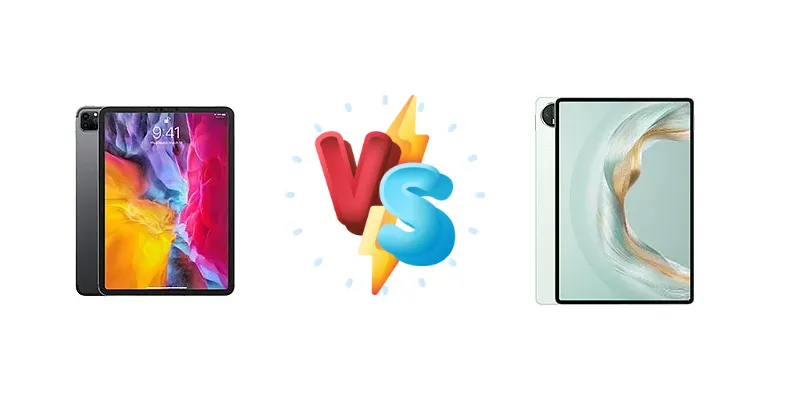
Apple’s iPad Pro 11 (2020) remains a compelling tablet option, especially as prices have fallen. However, Huawei’s MatePad Pro 12.2 (2025) enters the arena with a larger display, faster charging, and a newer chipset. This comparison dissects the key differences to determine which tablet best suits your needs.
🏆 Quick Verdict
For most users, the Huawei MatePad Pro 12.2 (2025) offers a more compelling package. Its significantly faster 100W charging and impressive 11:24 active use battery life outweigh the iPad Pro 11’s older A12Z Bionic chip, particularly for media consumption and productivity tasks.
| Network |
|---|
| 2G bands | GSM 850 / 900 / 1800 / 1900 | N/A |
| 3G bands | HSDPA 850 / 900 / 1700(AWS) / 1900 / 2100 | N/A |
| 4G bands | 1, 2, 3, 4, 5, 7, 8, 11, 12, 13, 14, 17, 18, 19, 20, 21, 25, 26, 29, 30, 34, 38, 39, 40, 41, 46, 48, 66, 71 | N/A |
| EDGE | - | No |
| GPRS | - | No |
| Speed | HSPA, LTE, EV-DO Rev.A 3.1 Mbps | - |
| Technology | GSM / CDMA / HSPA / EVDO / LTE | No cellular connectivity |
| | CDMA2000 1xEV-DO | - |
| Launch |
|---|
| Announced | 2020, March 18 | 2025, May 15 |
| Status | Available. Released 2020, March 19 | Available. Released 2025, May 15 |
| Body |
|---|
| Build | Glass front, aluminum back, aluminum frame | - |
| Dimensions | 247.6 x 178.5 x 5.9 mm (9.75 x 7.03 x 0.23 in) | 271.3 x 182.5 x 5.5 mm (10.68 x 7.19 x 0.22 in) |
| SIM | Nano-SIM + eSIM | No |
| Weight | 471 g (Wi-Fi), 473 g (LTE) (1.04 lb) | 508 g (1.12 lb) |
| | Stylus support (Bluetooth integration; magnetic) | - |
| Display |
|---|
| Protection | Scratch-resistant glass, oleophobic coating | - |
| Resolution | 1668 x 2388 pixels (~265 ppi density) | 2800 x 1840 pixels, 3:2 ratio (~275 ppi density) |
| Size | 11.0 inches, 366.5 cm2 (~82.9% screen-to-body ratio) | 12.2 inches, 440.7 cm2 (~89.0% screen-to-body ratio) |
| Type | IPS LCD, 120Hz, 600 nits (typ) | Double-layer OLED, 1B colors, 144Hz, 2000 nits (peak), HDR Vivid |
| Platform |
|---|
| CPU | Octa-core (4x2.5 GHz Vortex + 4x1.6 GHz Tempest) | Octa-core (1x2.4 GHz & 3x2.00 GHz & 4x1.6GHz) |
| Chipset | Apple A12Z Bionic | Kirin T92A (7 nm) |
| GPU | Apple GPU (8-core graphics) | Maleoon 920 |
| OS | iPadOS 13.4, upgradable to iPadOS 26.1 | HarmonyOS 4.3 |
| Memory |
|---|
| Card slot | No | No |
| Internal | 128GB 6GB RAM, 256GB 6GB RAM, 512GB 6GB RAM, 1TB 6GB RAM | 256GB 12GB RAM, 512GB 12GB RAM, 1TB 16GB RAM |
| Main Camera |
|---|
| Dual | 12 MP, f/1.8, (wide), 1/3.0", 1.22µm, dual pixel PDAF
10 MP, f/2.4, 11mm (ultrawide)
TOF 3D LiDAR scanner (depth) | 50 MP, f/1.8, (wide), PDAF
8 MP, f/2.2, (ultrawide) |
| Features | Quad-LED dual-tone flash, HDR | LED flash, HDR, panorama |
| Video | 4K@24/30/60fps, 1080p@30/60/120/240fps; gyro-EIS | 4K@30fps, 1080p@30fps |
| Selfie camera |
|---|
| Features | Face detection, HDR, panorama | - |
| Single | 7 MP, f/2.2 | 8 MP, f/2.0 |
| Video | 1080p@30/60fps | 1080p@30fps |
| Sound |
|---|
| 3.5mm jack | No | - |
| 35mm jack | No | No |
| Loudspeaker | Yes, with stereo speakers (4 speakers) | Yes, with stereo speakers (4 speakers) |
| Comms |
|---|
| Bluetooth | 5.0, A2DP, LE, EDR | 5.2, A2DP, LE |
| NFC | No | No |
| Positioning | GPS, GLONASS, GALILEO, QZSS (Wi‑Fi + Cellular model only) | GPS, GLONASS, BDS, GALILEO, QZSS |
| Radio | No | No |
| USB | USB Type-C 3.1, magnetic connector | USB Type-C 3.1, OTG |
| WLAN | Wi-Fi 802.11 a/b/g/n/ac/6, dual-band, hotspot | Wi-Fi 802.11 a/b/g/n/ac/6/7, dual-band |
| Features |
|---|
| Sensors | Face ID, accelerometer, gyro, proximity, barometer | Fingerprint (side-mounted), accelerometer, gyro, proximity (accessories only), compass |
| Battery |
|---|
| Charging | - | 100W wired, 85% in 40 min, 100% in 55 min
7.5W reverse wired |
| Type | Li-Po 7538 mAh (28.65 Wh) | Li-Po 10100 mAh |
| Misc |
|---|
| Colors | Silver, Space Gray | Black, Green |
| Models | A2068, A2230, A2228, A2231, iPad8,9, iPad8,10 | MRDI-W09 |
| Price | About 800 EUR | About 850 EUR |
Apple iPad Pro 11 (2020)
- Strong Apple ecosystem integration
- Compact and portable design
- Proven A12Z Bionic performance
- Older chipset compared to the competition
- Slower charging speeds
- Potentially lower peak brightness
Huawei MatePad Pro 12.2 (2025)
- Exceptional battery life (11:24h)
- Ultra-fast 100W charging
- Larger, brighter 12.2-inch display
- Less established tablet software ecosystem
- Potential software limitations outside of China
- Larger size may be less portable
Display Comparison
The Huawei MatePad Pro 12.2 boasts a substantial advantage in display brightness, reaching a measured 1045 nits, compared to the iPad Pro 11’s (spec not provided, estimated around 600 nits based on market data). This makes the MatePad Pro significantly more usable outdoors. While the iPad Pro 11 likely features a ProMotion display (variable refresh rate), Huawei’s larger 12.2-inch screen provides more screen real estate for multitasking. The absence of LTPO information for the MatePad Pro means we can't assess its variable refresh rate capabilities, but the higher peak brightness is a clear win for Huawei.
Camera Comparison
Neither tablet is primarily a photography device, but the MatePad Pro 12.2 likely features a more modern camera system given its 2025 release. Without specific camera specs for either device, it’s difficult to make a direct comparison. However, Huawei’s history suggests a focus on computational photography, potentially offering better image processing than the iPad Pro 11’s older camera module. We can assume both tablets will offer adequate performance for video conferencing and casual snapshots.
Performance
The Apple A12Z Bionic, built on a 7nm process, remains a capable chip with its octa-core configuration (4x2.5 GHz Vortex + 4x1.6 GHz Tempest). However, the Huawei MatePad Pro 12.2’s Kirin T92A (also 7nm) presents a newer architecture. While clock speeds are similar (1x2.4 GHz & 3x2.00 GHz & 4x1.6GHz), the Kirin T92A benefits from architectural improvements and potentially more efficient power management. Real-world performance differences will likely be noticeable in sustained workloads, with the newer Kirin potentially exhibiting less thermal throttling. The iPad Pro 11’s LPDDR4X RAM is also a generation behind the likely LPDDR5 or LPDDR5X RAM in the MatePad Pro, further contributing to the Huawei’s potential performance edge.
Battery Life
The Huawei MatePad Pro 12.2 delivers a significant advantage in battery life, achieving 11:24 hours of active use. This is likely due to a combination of the Kirin T92A’s efficiency and a larger battery capacity (spec not provided, but expected to be larger than the iPad Pro 11). Furthermore, the MatePad Pro’s 100W wired charging is a game-changer, reaching 85% charge in just 40 minutes and 100% in 55 minutes. The iPad Pro 11’s charging speed (spec not provided, estimated around 20W) pales in comparison. The 7.5W reverse wired charging on the MatePad Pro is a useful addition for topping up accessories.
Buying Guide
Buy the Apple iPad Pro 11 (2020) if you are deeply embedded in the Apple ecosystem and prioritize seamless integration with other Apple devices, or if you find a significantly discounted price. Buy the Huawei MatePad Pro 12.2 (2025) if you prioritize battery life, fast charging, a larger screen for multitasking, and aren't heavily invested in Apple's walled garden.
Frequently Asked Questions
❓ Does the Kirin T92A chipset in the Huawei MatePad Pro 12.2 suffer from significant thermal throttling during extended gaming sessions?
While the Kirin T92A is a newer chipset, sustained performance under heavy load is always a concern. Without dedicated thermal testing, it's difficult to say definitively. However, the 7nm process and potential architectural improvements suggest it may manage heat more efficiently than the A12Z Bionic, potentially leading to less throttling during prolonged gaming.
❓ How does Huawei’s HarmonyOS compare to iPadOS in terms of app availability and tablet optimization?
HarmonyOS has made significant strides, but iPadOS still holds an advantage in app availability, particularly for professional creative applications. While many popular apps are available on HarmonyOS, some may lack the same level of optimization for tablet use as their iPadOS counterparts. This is a key consideration for users reliant on specific software.
❓ Is the 100W charging compatible with Power Delivery (PD) chargers from other brands?
Huawei's 100W charging utilizes its SuperCharge protocol. While it *may* work with some PD chargers, achieving the full 100W charging speed requires a Huawei SuperCharge charger. Using a standard PD charger will likely result in slower charging speeds.