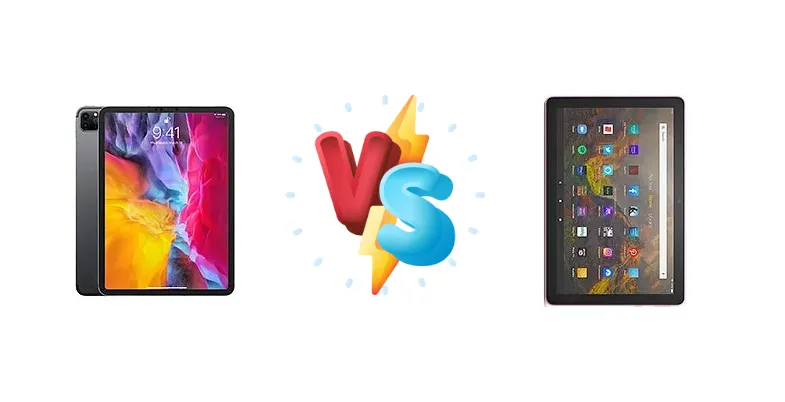
The tablet market caters to vastly different needs. Apple’s iPad Pro 11 (2020) represents a premium, performance-focused experience, while Amazon’s Fire HD 10 (2021) prioritizes affordability and content consumption. This comparison dissects the core differences between these devices, helping you determine which aligns best with your workflow and budget.
🏆 Quick Verdict
For users demanding professional-level performance, particularly in creative tasks or gaming, the iPad Pro 11 (2020) is the clear winner. However, the Amazon Fire HD 10 (2021) provides excellent value for casual users focused on media consumption and basic productivity, offering a functional tablet experience at a significantly lower price point.
| Network |
|---|
| 2G bands | GSM 850 / 900 / 1800 / 1900 | N/A |
| 3G bands | HSDPA 850 / 900 / 1700(AWS) / 1900 / 2100 | - |
| 4G bands | 1, 2, 3, 4, 5, 7, 8, 11, 12, 13, 14, 17, 18, 19, 20, 21, 25, 26, 29, 30, 34, 38, 39, 40, 41, 46, 48, 66, 71 | - |
| EDGE | - | No |
| GPRS | - | No |
| Speed | HSPA, LTE, EV-DO Rev.A 3.1 Mbps | - |
| Technology | GSM / CDMA / HSPA / EVDO / LTE | No cellular connectivity |
| | CDMA2000 1xEV-DO | - |
| Launch |
|---|
| Announced | 2020, March 18 | 2021, April 27. Released 2021, May 26 |
| Status | Available. Released 2020, March 19 | Discontinued |
| Body |
|---|
| Build | Glass front, aluminum back, aluminum frame | - |
| Dimensions | 247.6 x 178.5 x 5.9 mm (9.75 x 7.03 x 0.23 in) | 247 x 166 x 9.2 mm (9.72 x 6.54 x 0.36 in) |
| SIM | Nano-SIM + eSIM | No |
| Weight | 471 g (Wi-Fi), 473 g (LTE) (1.04 lb) | 465 g (1.03 lb) |
| | Stylus support (Bluetooth integration; magnetic) | - |
| Display |
|---|
| Protection | Scratch-resistant glass, oleophobic coating | Aluminosilicate glass |
| Resolution | 1668 x 2388 pixels (~265 ppi density) | 1920 x 1200 pixels, 16:10 ratio (~224 ppi density) |
| Size | 11.0 inches, 366.5 cm2 (~82.9% screen-to-body ratio) | 10.1 inches, 295.8 cm2 (~72.1% screen-to-body ratio) |
| Type | IPS LCD, 120Hz, 600 nits (typ) | IPS LCD |
| Platform |
|---|
| CPU | Octa-core (4x2.5 GHz Vortex + 4x1.6 GHz Tempest) | Octa-core (4x2.0 GHz Cortex-A73 & 4x2.0 GHz Cortex-A53) |
| Chipset | Apple A12Z Bionic | Mediatek MT8183 Helio P60T (12 nm) |
| GPU | Apple GPU (8-core graphics) | Mali-G72 MP3 |
| OS | iPadOS 13.4, upgradable to iPadOS 26.1 | Android 9.0 (Pie), Fire OS 7 |
| Memory |
|---|
| Card slot | No | microSDXC (dedicated slot) |
| Internal | 128GB 6GB RAM, 256GB 6GB RAM, 512GB 6GB RAM, 1TB 6GB RAM | 32GB 3GB RAM, 64GB 3GB RAM |
| | - | eMMC 5.1 |
| Main Camera |
|---|
| Dual | 12 MP, f/1.8, (wide), 1/3.0", 1.22µm, dual pixel PDAF
10 MP, f/2.4, 11mm (ultrawide)
TOF 3D LiDAR scanner (depth) | - |
| Features | Quad-LED dual-tone flash, HDR | - |
| Single | - | 5 MP |
| Video | 4K@24/30/60fps, 1080p@30/60/120/240fps; gyro-EIS | 720p |
| Selfie camera |
|---|
| Features | Face detection, HDR, panorama | - |
| Single | 7 MP, f/2.2 | 2 MP |
| Video | 1080p@30/60fps | 720p |
| Sound |
|---|
| 3.5mm jack | No | Yes |
| 35mm jack | No | Yes |
| Loudspeaker | Yes, with stereo speakers (4 speakers) | Yes, with stereo speakers |
| Comms |
|---|
| Bluetooth | 5.0, A2DP, LE, EDR | 5.0, A2DP, LE |
| NFC | No | No |
| Positioning | GPS, GLONASS, GALILEO, QZSS (Wi‑Fi + Cellular model only) | No |
| Radio | No | No |
| USB | USB Type-C 3.1, magnetic connector | USB Type-C 2.0, OTG |
| WLAN | Wi-Fi 802.11 a/b/g/n/ac/6, dual-band, hotspot | Wi-Fi 802.11 a/b/g/n/ac, dual-band |
| Features |
|---|
| Sensors | Face ID, accelerometer, gyro, proximity, barometer | Accelerometer |
| | - | Text-to-Speech English-language content reader |
| Battery |
|---|
| Type | Li-Po 7538 mAh (28.65 Wh) | Li-Ion |
| Misc |
|---|
| Colors | Silver, Space Gray | Black, Denim, Olive, Lavender |
| Models | A2068, A2230, A2228, A2231, iPad8,9, iPad8,10 | T76N2B, KFTRWI, KFTRPWI |
| Price | About 800 EUR | About 130 EUR |
Apple iPad Pro 11 (2020)
- Exceptional performance with the A12Z Bionic chip.
- Stunning Liquid Retina display with ProMotion.
- Premium build quality and design.
- Significantly higher price point.
- Accessories (Apple Pencil, Magic Keyboard) are expensive.
Amazon Fire HD 10 (2021)
- Extremely affordable price.
- Good battery life for basic tasks.
- Seamless integration with Amazon services.
- Limited performance with the Helio P60T.
- Lower-quality display compared to the iPad Pro.
- Amazon’s Fire OS is heavily customized and ad-supported.
Display Comparison
While both tablets feature 11-inch displays, the experience diverges significantly. The iPad Pro 11 (2020) boasts a Liquid Retina display with ProMotion technology, likely offering a variable refresh rate up to 120Hz (based on Apple’s typical implementation), resulting in smoother scrolling and responsiveness. The Fire HD 10 (2021) utilizes a standard IPS LCD panel. The iPad Pro’s superior panel technology, combined with its likely higher peak brightness and wider color gamut, delivers a more vibrant and accurate visual experience, crucial for content creators. The Fire HD 10’s display, while adequate for basic tasks, will appear less refined in comparison.
Camera Comparison
Camera quality isn’t a primary focus for either tablet, but the iPad Pro 11 (2020) offers a more capable system. While specific sensor details aren’t provided, Apple’s image signal processing (ISP) and computational photography algorithms consistently deliver superior image quality. The Fire HD 10 (2021) likely features a basic camera setup, adequate for video calls but lacking in detail and dynamic range. The iPad Pro’s camera is more versatile, offering better performance in low-light conditions and more detailed images.
Performance
The performance gap is substantial. The iPad Pro 11 (2020) is powered by the Apple A12Z Bionic, an octa-core chip built on a 7nm process. Its Vortex and Tempest cores, clocked at 2.5 GHz and 1.6 GHz respectively, deliver exceptional single-core and multi-core performance. In contrast, the Fire HD 10 (2021) utilizes the MediaTek MT8183 Helio P60T, a 12nm chip with a more balanced core configuration (4x2.0 GHz Cortex-A73 & 4x2.0 GHz Cortex-A53). The A12Z Bionic’s architectural advantages and faster clock speeds translate to significantly quicker app loading times, smoother multitasking, and the ability to handle graphically intensive tasks with ease. The Helio P60T is sufficient for basic tasks, but will struggle with demanding applications.
Battery Life
Battery life is difficult to compare without standardized testing. The iPad Pro 11 (2020) likely has a battery capacity around 30-35Wh (based on previous models), while the Fire HD 10 (2021) is around 6100mAh (approximately 23Wh). While the Fire HD 10 has a lower Wh rating, its less powerful chipset and less demanding display contribute to potentially comparable real-world battery life for typical usage scenarios. However, the iPad Pro’s more efficient A12Z Bionic will likely excel in power management during intensive tasks. Charging speeds are also likely faster on the iPad Pro, supporting USB-C Power Delivery.
Buying Guide
Buy the Apple iPad Pro 11 (2020) if you require a powerful tablet for demanding applications like video editing, graphic design, or high-end gaming, and if you value a premium display and seamless integration with the Apple ecosystem. Buy the Amazon Fire HD 10 (2021) if you prioritize affordability, primarily use a tablet for reading, streaming video, and light web browsing, and are comfortable within the Amazon ecosystem.
Frequently Asked Questions
❓ Is the MediaTek Helio P60T in the Fire HD 10 sufficient for playing modern mobile games?
The Helio P60T can handle some mobile games, but it will struggle with graphically demanding titles at higher settings. Expect lower frame rates and potentially noticeable lag in games like Genshin Impact or Call of Duty: Mobile. It's best suited for less intensive games and casual gaming sessions.
❓ How does the Fire HD 10’s Fire OS compare to Apple’s iPadOS in terms of app availability and updates?
Fire OS is based on Android but lacks access to the full Google Play Store. Instead, it relies on the Amazon Appstore, which has a significantly smaller app selection. While many popular apps are available, you may find some are missing or outdated. iPadOS, on the other hand, offers access to the vast and regularly updated Apple App Store, ensuring a wider range of apps and consistent updates.
❓ Can I use a stylus with the Amazon Fire HD 10 (2021)?
While you can connect a capacitive stylus to the Fire HD 10 (2021), the experience is limited. The tablet doesn't offer the same level of pressure sensitivity or palm rejection as the iPad Pro with the Apple Pencil, making it unsuitable for serious note-taking or artistic endeavors.