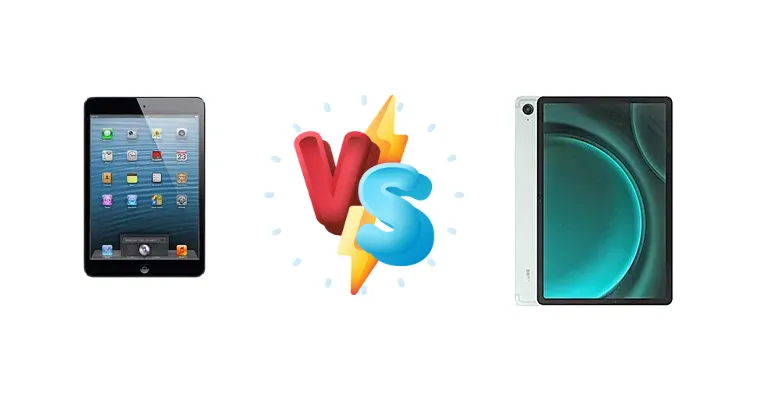
The tablet market offers a spectrum of choices, but finding the right balance between portability and performance can be tricky. We pit Apple’s long-standing iPad mini, with its focus on premium compactness, against Samsung’s Galaxy Tab S9 FE, a more recent contender aiming for a blend of features and affordability. This comparison dissects their core capabilities to determine which tablet best suits your needs.
🏆 Quick Verdict
For users prioritizing raw performance and a refined ecosystem, the iPad mini, despite its age, remains a compelling choice. However, the Samsung Galaxy Tab S9 FE delivers significantly better value with its modern chipset, faster charging, and larger display, making it the winner for the average user.
| Network |
|---|
| 2G bands | GSM 850 / 900 / 1800 / 1900 - A1454; A1455 | GSM 850 / 900 / 1800 / 1900 |
| 3G bands | HSDPA 850 / 900 / 1900 / 2100 - A1454; A1455 | HSDPA 850 / 900 / 1700(AWS) / 1900 / 2100 |
| 4G bands | 4, 17 - A1454 | 1, 2, 3, 4, 5, 7, 8, 12, 13, 17, 20, 26, 28, 32, 38, 40, 41, 66 |
| 5G bands | - | 1, 3, 5, 7, 8, 20, 28, 38, 40, 41, 66, 77, 78 SA/NSA/Sub6 |
| Speed | HSPA 42.2/5.76 Mbps, LTE Cat3 100/50 Mbps, EV-DO Rev.A 3.1 Mbps | HSPA, LTE, 5G - cellular model only |
| Technology | GSM / CDMA / HSPA / LTE | GSM / HSPA / LTE / 5G |
| Launch |
|---|
| Announced | 2012, October. Released 2012, November | 2023, October 04 |
| Status | Discontinued | Available. Released 2023, October 16 |
| Body |
|---|
| Build | - | Glass front, aluminum back, aluminum frame |
| Dimensions | 200 x 134.7 x 7.2 mm (7.87 x 5.30 x 0.28 in) | 254.3 x 165.8 x 6.5 mm (10.01 x 6.53 x 0.26 in) |
| SIM | Nano-SIM | Nano-SIM + eSIM (cellular model only) |
| Weight | 312 g (11.01 oz) | 523 g or 524 g (1.15 lb) |
| Display |
|---|
| Protection | Oleophobic coating | - |
| Resolution | 768 x 1024 pixels, 4:3 ratio (~162 ppi density) | 1440 x 2304 pixels, 16:10 ratio (~249 ppi density) |
| Size | 7.9 inches, 193.3 cm2 (~71.7% screen-to-body ratio) | 10.9 inches, 344.5 cm2 (~81.7% screen-to-body ratio) |
| Type | IPS LCD | IPS LCD, 90Hz |
| Platform |
|---|
| CPU | Dual-core 1.0 GHz Cortex-A9 | Octa-core (4x2.4 GHz Cortex-A78 & 4x2.0 GHz Cortex-A55) |
| Chipset | Apple A5 (45 nm) | Exynos 1380 (5 nm) |
| GPU | PowerVR SGX543MP2 | Mali-G68 MP5 |
| OS | iOS 6, upgradable to iOS 9.3.6 | Android 13, up to 4 major Android upgrades, One UI 6 |
| Memory |
|---|
| Card slot | No | microSDXC (dedicated slot) |
| Internal | 16GB 512MB RAM, 32GB 512MB RAM, 64GB 512MB RAM | 128GB 6GB RAM, 128GB 8GB RAM, 256GB 8GB RAM |
| Main Camera |
|---|
| Single | 5 MP, AF | 8 MP, (wide) |
| Video | 1080p@30fps | 4K@30fps, 1080p@30fps |
| Selfie camera |
|---|
| Features | face detection, FaceTime over Wi-Fi or Cellular | - |
| Single | 1.2 MP | 12 MP, (ultrawide) |
| Video | 720p@30fps | Yes |
| Sound |
|---|
| 35mm jack | Yes | No |
| Loudspeaker | Yes, with stereo speakers | Yes, with stereo speakers |
| Comms |
|---|
| Bluetooth | 4.0, A2DP, EDR | 5.3, A2DP, LE |
| NFC | No | No |
| Positioning | GPS, GLONASS | GPS, GALILEO, GLONASS, BDS, QZSS - cellular model only |
| Radio | No | No |
| USB | Lightning, USB 2.0 | USB Type-C 2.0, magnetic connector |
| WLAN | Wi-Fi 802.11 a/b/g/n, dual-band | Wi-Fi 802.11 a/b/g/n/ac/6, dual-band, Wi-Fi Direct |
| Features |
|---|
| Sensors | Accelerometer, gyro, compass | Fingerprint (side-mounted), accelerometer, gyro, compass, proximity (accessories only) |
| Battery |
|---|
| Charging | - | 45W wired, QC2.0 |
| Talk time | Up to 10 h (multimedia) | - |
| Type | Li-Po 4490 mAh, non-removable (16.7 Wh) | Li-Po 8000 mAh |
| Misc |
|---|
| Colors | Black/Slate, White/Silver | Mint, Silver, Gray, Lavender |
| Models | A1454, A1455, iPad2,6, iPad2,7 | SM-X510, SM-X516B |
| Price | About 300 EUR | About 300 EUR |
| SAR | - | 1.55 W/kg (body) |
| SAR EU | - | 0.59 W/kg (body) |
Apple iPad mini Wi-Fi + Cellular
- Extremely compact and portable design
- Seamless integration with the Apple ecosystem
- Good build quality and premium feel
- Outdated processor and limited performance
- Small screen size may hinder productivity
- Slow charging speeds
Samsung Galaxy Tab S9 FE
- Modern and powerful Exynos 1380 chipset
- Larger display for improved multitasking
- Fast 45W charging with QC2.0
- Larger form factor than the iPad mini
- May not offer the same level of software optimization as iPadOS
- Build quality may not match the iPad mini's premium feel
Display Comparison
The iPad mini boasts a contrast ratio of 812:1, a respectable figure, but lacks specifics on peak brightness or panel technology. This suggests an older LCD panel. Conversely, while the Tab S9 FE’s display specs are absent, Samsung typically employs vibrant LCDs in its FE line. The larger screen size of the Tab S9 FE inherently offers more screen real estate for productivity and media consumption. The iPad mini’s strength lies in its compact form factor, making it ideal for one-handed use, but this comes at the cost of screen size and potentially, color accuracy compared to newer Samsung panels.
Camera Comparison
Given the context data, a detailed camera comparison is limited. Both tablets likely feature basic camera setups geared towards video calls rather than photography. The iPad mini’s camera specs are unknown, but Apple generally prioritizes image processing. The Tab S9 FE’s camera details are also missing, but Samsung often includes features like scene optimization. Without specific sensor information, it’s safe to assume neither tablet will excel in photographic quality.
Performance
The performance gap between these tablets is substantial. The iPad mini’s Apple A5 chipset, fabricated on a 45nm process, is significantly outdated. Its dual-core 1.0 GHz Cortex-A9 CPU pales in comparison to the Samsung Galaxy Tab S9 FE’s Exynos 1380 (5nm). The Exynos 1380’s octa-core configuration (4x2.4 GHz Cortex-A78 & 4x2.0 GHz Cortex-A55) provides a massive leap in multi-core performance and efficiency. The 5nm fabrication process of the Exynos 1380 also translates to significantly better thermal management, reducing the likelihood of performance throttling during sustained workloads. This means the Tab S9 FE will handle demanding tasks like video editing and gaming far more effectively.
Battery Life
Battery capacity figures are absent for both devices. However, the Samsung Galaxy Tab S9 FE benefits from 45W wired charging with QC2.0 support, enabling significantly faster charging speeds than the iPad mini, which likely relies on slower charging technology. While the iPad mini may offer optimized power efficiency due to its smaller display and older chipset, the Tab S9 FE’s faster charging capability provides a more convenient user experience, minimizing downtime.
Buying Guide
Buy the Apple iPad mini Wi-Fi + Cellular if you absolutely require the smallest possible premium tablet and are deeply invested in the Apple ecosystem, valuing seamless integration with other Apple devices. Buy the Samsung Galaxy Tab S9 FE if you prioritize a larger screen for multitasking, faster processing speeds for demanding apps, and a more versatile feature set at a more accessible price point.
Frequently Asked Questions
❓ Does the Exynos 1380 chip in the Galaxy Tab S9 FE overheat during extended gaming sessions?
The Exynos 1380, built on a 5nm process, is designed for efficiency and thermal management. While it will generate heat during demanding tasks, its architecture and the Tab S9 FE’s cooling system should prevent significant overheating and performance throttling, offering a smoother gaming experience than the iPad mini’s aging A5 chip.
❓ Is the iPad mini still a good choice for reading ebooks and browsing the web?
Despite its age, the iPad mini remains a very capable device for basic tasks like reading ebooks and browsing the web. Its compact size and lightweight design make it comfortable to hold for extended periods. However, the smaller screen size may not be ideal for visually intensive websites or PDFs.
❓ What kind of stylus support does each tablet offer?
The Samsung Galaxy Tab S9 FE supports the S Pen, offering a precise and responsive writing and drawing experience. The iPad mini supports the Apple Pencil (1st generation), but requires a separate adapter for charging. Both styluses are sold separately and enhance the tablets' creative capabilities.