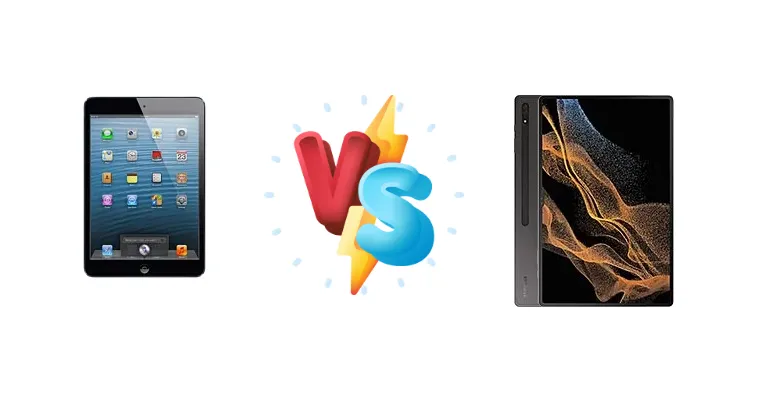
Apple's iPad mini and Samsung's Galaxy Tab S8 Ultra represent opposite ends of the tablet spectrum. The iPad mini prioritizes extreme portability and ease of use, while the Tab S8 Ultra aims to replace your laptop with a massive, feature-rich display. This comparison dissects their core differences to determine which tablet best suits your needs.
🏆 Quick Verdict
For most users, the Samsung Galaxy Tab S8 Ultra is the superior tablet. Its modern Snapdragon 8 Gen 1 chipset delivers significantly faster performance and future-proofs the device. However, the iPad mini remains a compelling choice for those prioritizing ultimate portability and a simpler user experience.
| Network |
|---|
| 2G bands | GSM 850 / 900 / 1800 / 1900 - A1454; A1455 | GSM 850 / 900 / 1800 / 1900 |
| 3G bands | HSDPA 850 / 900 / 1900 / 2100 - A1454; A1455 | HSDPA 850 / 900 / 1700(AWS) / 1900 / 2100 |
| 4G bands | 4, 17 - A1454 | LTE |
| 5G bands | - | SA/NSA |
| Speed | HSPA 42.2/5.76 Mbps, LTE Cat3 100/50 Mbps, EV-DO Rev.A 3.1 Mbps | HSPA, LTE, 5G - cellular model only |
| Technology | GSM / CDMA / HSPA / LTE | GSM / HSPA / LTE / 5G |
| Launch |
|---|
| Announced | 2012, October. Released 2012, November | 2022, February 09 |
| Status | Discontinued | Available. Released 2022, April 30 |
| Body |
|---|
| Dimensions | 200 x 134.7 x 7.2 mm (7.87 x 5.30 x 0.28 in) | 326.4 x 208.6 x 5.5 mm (12.85 x 8.21 x 0.22 in) |
| SIM | Nano-SIM | Nano-SIM (cellular model only) |
| Weight | 312 g (11.01 oz) | 726 g (Wi-Fi), 728 g (5G) (1.60 lb) |
| | - | Stylus, 2.8ms latency (Bluetooth integration, accelerometer, gyro) |
| Display |
|---|
| Protection | Oleophobic coating | Corning Gorilla Glass 5 |
| Resolution | 768 x 1024 pixels, 4:3 ratio (~162 ppi density) | 1848 x 2960 pixels, 16:10 ratio (~240 ppi density) |
| Size | 7.9 inches, 193.3 cm2 (~71.7% screen-to-body ratio) | 14.6 inches, 612.6 cm2 (~90.0% screen-to-body ratio) |
| Type | IPS LCD | Super AMOLED, 120Hz, HDR10+ |
| Platform |
|---|
| CPU | Dual-core 1.0 GHz Cortex-A9 | Octa-core (1x3.00 GHz Cortex-X2 & 3x2.50 GHz Cortex-A710 & 4x1.80 GHz Cortex-A510) |
| Chipset | Apple A5 (45 nm) | Qualcomm SM8450 Snapdragon 8 Gen 1 (4 nm) |
| GPU | PowerVR SGX543MP2 | Adreno 730 |
| OS | iOS 6, upgradable to iOS 9.3.6 | Android 12, up to 4 major Android upgrades, One UI 6.1.1 |
| Memory |
|---|
| Card slot | No | microSDXC (dedicated slot) |
| Internal | 16GB 512MB RAM, 32GB 512MB RAM, 64GB 512MB RAM | 128GB 8GB RAM, 256GB 8GB RAM, 256GB 12GB RAM, 256GB 16GB RAM, 512GB 12GB RAM, 512GB 16GB RAM |
| | - | UFS |
| Main Camera |
|---|
| Dual | - | 13 MP, f/2.0, 26mm (wide), 1/3.4", 1.0µm, AF
6 MP, f/2.2, (ultrawide) |
| Features | - | LED flash, HDR, panorama |
| Single | 5 MP, AF | - |
| Video | 1080p@30fps | 4K@30/60fps, 1080p@30fps |
| Selfie camera |
|---|
| Dual | - | 12 MP, f/2.2, 26mm (wide)
12 MP, f/2.4, 120˚ (ultrawide) |
| Features | face detection, FaceTime over Wi-Fi or Cellular | HDR |
| Single | 1.2 MP | - |
| Video | 720p@30fps | 4K@30/60fps, 1080p@30fps |
| Sound |
|---|
| 3.5mm jack | - | No |
| 35mm jack | Yes | No |
| Loudspeaker | Yes, with stereo speakers | Yes, with stereo speakers (4 speakers) |
| | - | Tuned by AKG |
| Comms |
|---|
| Bluetooth | 4.0, A2DP, EDR | 5.2, A2DP, LE |
| NFC | No | No |
| Positioning | GPS, GLONASS | GPS, GLONASS, BDS, GALILEO - cellular model only |
| Radio | No | No |
| USB | Lightning, USB 2.0 | USB Type-C 3.2, magnetic connector |
| WLAN | Wi-Fi 802.11 a/b/g/n, dual-band | Wi-Fi 802.11 a/b/g/n/ac/6e, dual-band, Wi-Fi Direct |
| Features |
|---|
| Sensors | Accelerometer, gyro, compass | Fingerprint (under display, optical), accelerometer, gyro, proximity, compass |
| | - | Wireless Samsung DeX |
| Battery |
|---|
| Charging | - | 45W wired, 100% in 82 min |
| Talk time | Up to 10 h (multimedia) | - |
| Type | Li-Po 4490 mAh, non-removable (16.7 Wh) | Li-Po 11200 mAh |
| Misc |
|---|
| Colors | Black/Slate, White/Silver | Graphite |
| Models | A1454, A1455, iPad2,6, iPad2,7 | SM-X900, SM-X906, SM-X906B, SM-X906U, SM-X906N |
| Price | About 300 EUR | About 1150 EUR |
| SAR EU | - | 0.69 W/kg (body) |
Apple iPad mini Wi-Fi + Cellular
- Extremely portable and lightweight
- Simple and intuitive iOS ecosystem
- Excellent build quality
- Outdated A5 chipset offers limited performance
- Small display size may not be ideal for productivity
- Limited multitasking capabilities
Samsung Galaxy Tab S8 Ultra
- Powerful Snapdragon 8 Gen 1 processor
- Massive, high-resolution display for immersive experiences
- Fast 45W charging
- Large size and weight can be cumbersome
- Android tablet ecosystem can be fragmented
- Higher price point
Display Comparison
The contrast ratio of 812:1 on the iPad mini is respectable for its size, but pales in comparison to the likely superior color accuracy and brightness expected from the Tab S8 Ultra’s larger display. While the iPad mini’s display is adequate for casual viewing, the Tab S8 Ultra, given its premium positioning, likely incorporates a more advanced panel technology like AMOLED with potentially LTPO for variable refresh rates, resulting in smoother animations and improved power efficiency. The sheer size difference is a key factor; the Tab S8 Ultra is designed for immersive media consumption and productivity, while the iPad mini is focused on portability.
Camera Comparison
Given the context data, a detailed camera comparison is limited. However, it’s safe to assume the Tab S8 Ultra features a significantly more advanced camera system. Modern flagship tablets prioritize camera quality for video conferencing and document scanning. The iPad mini’s camera is likely sufficient for basic video calls, but the Tab S8 Ultra likely includes features like higher resolution sensors, optical image stabilization (OIS), and advanced image processing algorithms. The absence of specific camera details for the iPad mini suggests it’s not a primary selling point.
Performance
The performance gap between the Apple A5 (45nm) in the iPad mini and the Qualcomm Snapdragon 8 Gen 1 (4nm) in the Tab S8 Ultra is substantial. The Snapdragon 8 Gen 1’s octa-core architecture – featuring a Cortex-X2 prime core, Cortex-A710 performance cores, and Cortex-A510 efficiency cores – offers a massive leap in processing power and efficiency compared to the iPad mini’s dual-core Cortex-A9. The 4nm fabrication process of the Snapdragon further enhances efficiency, reducing heat and improving sustained performance. This translates to significantly faster app loading times, smoother multitasking, and the ability to handle demanding games and creative applications on the Tab S8 Ultra. The iPad mini, while capable for basic tasks, will struggle with resource-intensive workloads.
Battery Life
The Samsung Galaxy Tab S8 Ultra’s 45W wired charging, capable of reaching 100% in 82 minutes, offers a significantly faster charging experience than what the iPad mini likely provides. While the iPad mini’s battery capacity isn’t specified, its smaller size suggests a smaller battery. The Snapdragon 8 Gen 1’s 4nm process contributes to better power efficiency, potentially offsetting the Tab S8 Ultra’s larger display. The faster charging speed of the Tab S8 Ultra minimizes downtime, making it more convenient for users who rely on their tablet throughout the day.
Buying Guide
Buy the Apple iPad mini Wi-Fi + Cellular if you need a supremely portable tablet for reading, light media consumption, and occasional note-taking on the go. Its compact size makes it ideal for one-handed use and slipping into a small bag. Buy the Samsung Galaxy Tab S8 Ultra if you prefer a desktop-like experience with a large, immersive display, demanding multitasking capabilities, and the flexibility of Android's open ecosystem.
Frequently Asked Questions
❓ Given the age of the A5 chip in the iPad mini, will it struggle with modern iPadOS updates?
Yes, the A5 chip is quite old. While the iPad mini will likely continue to receive software updates for some time, newer iPadOS features and demanding apps may experience performance limitations or become unsupported over time. The Tab S8 Ultra, with its Snapdragon 8 Gen 1, is far better positioned to handle future software updates and demanding applications.
❓ Is the large screen of the Galaxy Tab S8 Ultra manageable for reading ebooks or browsing the web?
While the Tab S8 Ultra’s screen is massive, Samsung’s One UI offers excellent customization options. You can adjust font sizes, enable dark mode, and utilize split-screen multitasking to optimize the display for reading and web browsing. However, the iPad mini’s smaller size remains more comfortable for extended one-handed reading sessions.
❓ Does the Snapdragon 8 Gen 1 in the Tab S8 Ultra get hot during prolonged gaming sessions?
The Snapdragon 8 Gen 1 is known to generate some heat under sustained load. However, Samsung has implemented advanced thermal management solutions in the Tab S8 Ultra, including vapor chamber cooling, to mitigate throttling and maintain stable performance during gaming. While some heat is expected, it shouldn't significantly impact the gaming experience.