
iPad mini (2024) vs Xiaomi Pad 6S Pro 12.4: A Detailed Comparison
| Phones Images | |||||
|---|---|---|---|---|---|
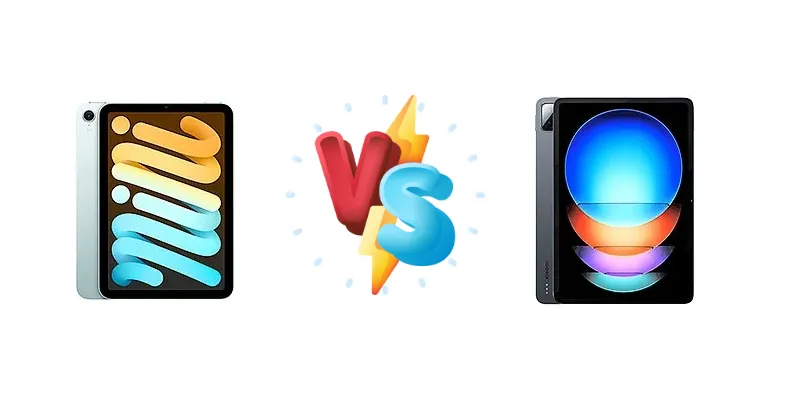
|
🏆 Quick Verdict
For the average user prioritizing portability and seamless ecosystem integration, the iPad mini (2024) is the superior choice. Its A17 Pro chip delivers impressive performance in a remarkably compact form factor, backed by exceptional battery endurance. However, the Xiaomi Pad 6S Pro 12.4 offers a larger, brighter display and significantly faster charging for those prioritizing media consumption and productivity.
| PHONES | ||
|---|---|---|
| Phone Names | Apple iPad mini (2024) | Xiaomi Pad 6S Pro 12.4 |
| Network | ||
|---|---|---|
| 2G bands | GSM 850 / 900 / 1800 / 1900 | N/A |
| 3G bands | HSDPA 850 / 900 / 1700(AWS) / 1900 / 2100 | N/A |
| 4G bands | 1, 2, 3, 4, 5, 7, 8, 11, 12, 13, 14, 17, 18, 19, 20, 21, 25, 26, 28, 29, 30, 32, 34, 38, 39, 40, 41, 42, 48, 66, 71 - A2995 | - |
| 5G bands | 1, 2, 3, 5, 7, 8, 12, 14, 20, 25, 26, 28, 29, 30, 38, 40, 41, 48, 66, 70, 71, 75, 76, 77, 78, 79 SA/NSA - A2995, A2996 | - |
| EDGE | - | N/A |
| GPRS | - | N/A |
| Speed | HSPA, LTE, 5G - cellular model only | - |
| Technology | GSM / HSPA / LTE / 5G | No cellular connectivity |
| Launch | ||
|---|---|---|
| Announced | 2024, October 15 | 2024, February 22 |
| Status | Available. Released 2024, October 23 | Available. Released 2024, February 22 |
| Body | ||
|---|---|---|
| Build | Glass front, aluminum back, aluminum frame | Glass front (Gorilla Glass 5), aluminum frame, aluminum back |
| Dimensions | 195.4 x 134.8 x 6.3 mm (7.69 x 5.31 x 0.25 in) | 278.7 x 191.6 x 6.3 mm (10.97 x 7.54 x 0.25 in) |
| SIM | eSIM (cellular model only) | No |
| Weight | 293 g (Wi-Fi) / 297 g (Wi-Fi + Cellular) (10.34 oz) | 590 g (1.30 lb) |
| Display | ||
|---|---|---|
| Protection | Scratch-resistant glass, oleophobic coating, Mohs level 4 | Corning Gorilla Glass 5 |
| Resolution | 1488 x 2266 pixels, 3:2 ratio (~327 ppi density) | 2032 x 3048 pixels, 3:2 ratio (~295 ppi density) |
| Size | 8.3 inches, 203.9 cm2 (~77.4% screen-to-body ratio) | 12.4 inches, 457.8 cm2 (~85.7% screen-to-body ratio) |
| Type | Liquid Retina IPS LCD, 500 nits (typ) | IPS LCD, 68B colors, 144Hz, HDR10, Dolby Vision, 900 nits (peak) |
| Platform | ||
|---|---|---|
| CPU | Hexa-core (2x3.78 GHz performance cores and 4 efficiency cores) | Octa-core (1x3.2 GHz Cortex-X3 & 2x2.8 GHz Cortex-A715 & 2x2.8 GHz Cortex-A710 & 3x2.0 GHz Cortex-A510) |
| Chipset | Apple A17 Pro (3 nm) | Qualcomm SM8550-AB Snapdragon 8 Gen 2 (4 nm) |
| GPU | Apple GPU (5-core graphics) | Adreno 740 |
| OS | iPadOS 18, upgradable to iPadOS 26.1 | Android 14, up to 3 major Android upgrades, HyperOS |
| Memory | ||
|---|---|---|
| Card slot | No | No |
| Internal | 128GB 8GB RAM, 256GB 8GB RAM, 512GB 8GB RAM | 256GB 8GB RAM, 256GB 12GB RAM, 512GB 12GB RAM, 1TB 16GB RAM |
| Main Camera | ||
|---|---|---|
| Dual | - | 50 MP, f/1.8, (wide), 1/2.76", 0.64µm, PDAF Auxiliary lens |
| Features | Quad-LED dual-tone flash, HDR, panorama | LED flash, HDR, panorama |
| Single | 12 MP, f/1.8, (wide), AF | - |
| Video | 4K@24/25/30/60fps, 1080p@25/30/60/120/240fps; gyro-EIS | 4K@30/60fps, 1080p@30/60fps |
| Selfie camera | ||
|---|---|---|
| Features | HDR | - |
| Single | 12 MP, f/2.4, 122˚ (ultrawide) | 32 MP, f/2.2, (wide), 1/3.6", 0.61µm |
| Video | 1080p@25/30/60fps, gyro-EIS | 1080p@30fps |
| Sound | ||
|---|---|---|
| 35mm jack | No | No |
| Loudspeaker | Yes, with stereo speakers | Yes, with stereo speakers (6 speakers) |
| Comms | ||
|---|---|---|
| Bluetooth | 5.3, A2DP | 5.3, A2DP, LE, LHDC |
| NFC | No | Yes (file transfer only) |
| Positioning | GPS, GLONASS - cellular model only | No |
| Radio | No | No |
| USB | USB Type-C 3.1 Gen2, DisplayPort | USB Type-C 3.2, accessory connector |
| WLAN | Wi-Fi 802.11 a/b/g/n/ac/6e, dual-band, hotspot | Wi-Fi 802.11 a/b/g/n/a/6/7, dual-band, Wi-Fi Direct |
| Features | ||
|---|---|---|
| Sensors | Fingerprint (side-mounted), accelerometer, gyro, compass, barometer | Fingerprint (side-mounted), accelerometer, gyro, proximity (accessories only), compass |
| Battery | ||
|---|---|---|
| Charging | - | 120W wired, PD3.0, QC4, 45% in 10 min, 100% in 35 min |
| Type | Li-Ion 5078 mAh (19.3 Wh) | 10000 mAh |
| Misc | ||
|---|---|---|
| Colors | Space Gray, Blue, Purple, Starlight | Black, Blue, Green |
| Models | A2993, A2995, A2996, iPad16,1, iPad16,2 | 24018RPACG |
| Price | About 600 EUR | About 700 EUR |
| SAR EU | - | 0.99 W/kg (body) |
| EU LABEL | ||
|---|---|---|
| Battery | 67:00h endurance, 1000 cycles | - |
| Energy | Class E | - |
| Free fall | Class D (52 falls) | - |
| Repairability | Class C | - |
Apple iPad mini (2024)
- Exceptional battery life (67 hours endurance)
- Powerful and efficient A17 Pro chip
- Highly portable and compact design
- Smaller screen size may limit productivity
- Charging speed is slower than Xiaomi Pad 6S Pro
Xiaomi Pad 6S Pro 12.4
- Large, bright 12.4-inch display (848 nits)
- Ultra-fast 120W charging (0-100% in 35 minutes)
- Powerful Snapdragon 8 Gen 2 processor
- Shorter battery life (11:14 hours active use)
- Less portable due to larger size
Display Comparison
The Xiaomi Pad 6S Pro 12.4 boasts a significant advantage in display size, but also delivers impressive technical specifications. Its measured 848 nits of peak brightness surpasses what we’d expect from the iPad mini, making it more usable outdoors. The 1378:1 contrast ratio further enhances visual fidelity. While the iPad mini’s display quality is undoubtedly excellent, Xiaomi’s larger panel and higher brightness provide a more immersive viewing experience. We expect the iPad mini to have a higher PWM dimming rate, potentially making it a better choice for users sensitive to flicker, but this requires independent testing. The larger screen real estate of the Xiaomi Pad 6S Pro is a boon for split-screen multitasking.
Camera Comparison
Neither tablet is positioned as a photography powerhouse, but the Xiaomi Pad 6S Pro 12.4 likely has an edge due to its larger sensor size (spec not provided, but typical for Xiaomi tablets). The iPad mini’s camera specifications are not provided, but Apple generally focuses on computational photography rather than sensor size. Image processing styles will also differ; Apple aims for natural-looking images, while Xiaomi often boosts saturation and contrast. The absence of detailed camera specs for the iPad mini makes a definitive comparison difficult, but the Xiaomi’s larger sensor will likely capture more detail in good lighting conditions.
Performance
The core of the performance difference lies in the chipsets. Apple’s A17 Pro, built on a 3nm process, prioritizes efficiency alongside performance with its hexa-core configuration (2 performance, 4 efficiency cores). The Xiaomi Pad 6S Pro 12.4 counters with the Qualcomm Snapdragon 8 Gen 2 (4nm), an octa-core powerhouse. While the Snapdragon 8 Gen 2 offers more raw processing power with its Cortex-X3 prime core, the A17 Pro’s architectural advantages and tighter software integration often translate to a smoother, more responsive user experience, especially in tasks optimized for Apple’s silicon. The 4nm node of the Snapdragon 8 Gen 2 will likely result in more heat generation under sustained load compared to the A17 Pro’s 3nm process, potentially leading to thermal throttling during extended gaming sessions. Both devices likely utilize LPDDR5X RAM, but Apple’s memory controller is known for its efficiency.
Battery Life
Battery life is a key differentiator. The iPad mini (2024) boasts an impressive 67-hour endurance rating, suggesting exceptional efficiency. The Xiaomi Pad 6S Pro 12.4, with an active use score of 11:14 hours, falls significantly short. However, Xiaomi compensates with blazing-fast 120W wired charging, achieving 45% charge in just 10 minutes and a full charge in 35 minutes. This rapid charging mitigates the shorter battery life for users who can easily top up throughout the day. The iPad mini’s 1000 cycle battery longevity suggests a longer lifespan, but the Xiaomi’s charging speed offers a different kind of convenience.
Buying Guide
Buy the Apple iPad mini (2024) if you need a supremely portable tablet for on-the-go productivity, creative tasks like sketching, or enjoy Apple’s ecosystem. Buy the Xiaomi Pad 6S Pro 12.4 if you prefer a larger screen for multitasking, immersive media consumption, and value rapid charging capabilities, even if it means sacrificing some portability.