
iPad mini (2024) vs Samsung Galaxy Tab A9+: A Deep Dive into Performance and Value
| Phones Images | |||||
|---|---|---|---|---|---|
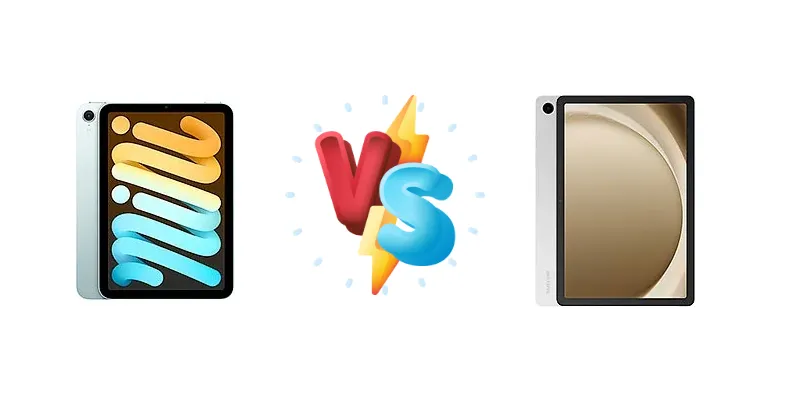
|
🏆 Quick Verdict
For users prioritizing raw performance and long-term software support, the iPad mini (2024) is the clear winner, thanks to its A17 Pro chipset and 1000 charge cycle battery. However, the Samsung Galaxy Tab A9+ offers a strong value proposition for casual users seeking a larger screen and expandable storage without breaking the bank.
| PHONES | ||
|---|---|---|
| Phone Names | Apple iPad mini (2024) | Samsung Galaxy Tab A9+ |
| Network | ||
|---|---|---|
| 2G bands | GSM 850 / 900 / 1800 / 1900 | GSM 850 / 900 / 1800 / 1900 |
| 3G bands | HSDPA 850 / 900 / 1700(AWS) / 1900 / 2100 | HSDPA 850 / 900 / 1700(AWS) / 1900 / 2100 |
| 4G bands | 1, 2, 3, 4, 5, 7, 8, 11, 12, 13, 14, 17, 18, 19, 20, 21, 25, 26, 28, 29, 30, 32, 34, 38, 39, 40, 41, 42, 48, 66, 71 - A2995 | 1, 2, 3, 4, 5, 7, 8, 12, 13, 17, 20, 26, 28, 38, 40, 41, 66 |
| 5G bands | 1, 2, 3, 5, 7, 8, 12, 14, 20, 25, 26, 28, 29, 30, 38, 40, 41, 48, 66, 70, 71, 75, 76, 77, 78, 79 SA/NSA - A2995, A2996 | 1, 3, 5, 7, 8, 20, 28, 38, 40, 41, 66, 77, 78 SA/NSA/Sub6 |
| Speed | HSPA, LTE, 5G - cellular model only | HSPA, LTE, 5G - cellular model only |
| Technology | GSM / HSPA / LTE / 5G | GSM / HSPA / LTE / 5G |
| Launch | ||
|---|---|---|
| Announced | 2024, October 15 | 2023, October 05 |
| Status | Available. Released 2024, October 23 | Available. Released 2023, October 17 |
| Body | ||
|---|---|---|
| Build | Glass front, aluminum back, aluminum frame | - |
| Dimensions | 195.4 x 134.8 x 6.3 mm (7.69 x 5.31 x 0.25 in) | 257.1 x 168.7 x 6.9 mm (10.12 x 6.64 x 0.27 in) |
| SIM | eSIM (cellular model only) | Nano-SIM + eSIM (cellular model only) |
| Weight | 293 g (Wi-Fi) / 297 g (Wi-Fi + Cellular) (10.34 oz) | 480 g or 492 g (1.06 lb) |
| Display | ||
|---|---|---|
| Protection | Scratch-resistant glass, oleophobic coating, Mohs level 4 | - |
| Resolution | 1488 x 2266 pixels, 3:2 ratio (~327 ppi density) | 1200 x 1920 pixels, 16:10 ratio (~206 ppi density) |
| Size | 8.3 inches, 203.9 cm2 (~77.4% screen-to-body ratio) | 11.0 inches, 350.9 cm2 (~80.9% screen-to-body ratio) |
| Type | Liquid Retina IPS LCD, 500 nits (typ) | TFT LCD, 90Hz |
| Platform | ||
|---|---|---|
| CPU | Hexa-core (2x3.78 GHz performance cores and 4 efficiency cores) | Octa-core (2x2.2 GHz Kryo 660 Gold & 6x1.8 GHz Kryo 660 Silver) |
| Chipset | Apple A17 Pro (3 nm) | Qualcomm SM6375 Snapdragon 695 5G (6 nm) |
| GPU | Apple GPU (5-core graphics) | Adreno 619 |
| OS | iPadOS 18, upgradable to iPadOS 26.1 | Android 13, upgradable to Android 15, One UI 7 |
| Memory | ||
|---|---|---|
| Card slot | No | microSDXC (dedicated slot) |
| Internal | 128GB 8GB RAM, 256GB 8GB RAM, 512GB 8GB RAM | 64GB 4GB RAM, 128GB 4GB RAM, 128GB 8GB RAM, 256GB 8GB RAM |
| Main Camera | ||
|---|---|---|
| Features | Quad-LED dual-tone flash, HDR, panorama | - |
| Single | 12 MP, f/1.8, (wide), AF | 8 MP, AF |
| Video | 4K@24/25/30/60fps, 1080p@25/30/60/120/240fps; gyro-EIS | 1080p@30fps |
| Selfie camera | ||
|---|---|---|
| Features | HDR | - |
| Single | 12 MP, f/2.4, 122˚ (ultrawide) | 5 MP |
| Video | 1080p@25/30/60fps, gyro-EIS | 1080p@30fps |
| Sound | ||
|---|---|---|
| 35mm jack | No | Yes |
| Loudspeaker | Yes, with stereo speakers | Yes, with stereo speakers (4 speakers) |
| Comms | ||
|---|---|---|
| Bluetooth | 5.3, A2DP | 5.1, A2DP, LE |
| NFC | No | No |
| Positioning | GPS, GLONASS - cellular model only | GPS, GLONASS, GALILEO, BDS, QZSS - cellular model only |
| Radio | No | No |
| USB | USB Type-C 3.1 Gen2, DisplayPort | USB Type-C 2.0 |
| WLAN | Wi-Fi 802.11 a/b/g/n/ac/6e, dual-band, hotspot | Wi-Fi 802.11 a/b/g/n/ac, dual-band, Wi-Fi Direct |
| Features | ||
|---|---|---|
| Sensors | Fingerprint (side-mounted), accelerometer, gyro, compass, barometer | Accelerometer, gyro, proximity (accessories only), compass |
| Battery | ||
|---|---|---|
| Charging | - | 15W wired |
| Type | Li-Ion 5078 mAh (19.3 Wh) | Li-Po 7040 mAh |
| Misc | ||
|---|---|---|
| Colors | Space Gray, Blue, Purple, Starlight | Graphite, Silver, Navy |
| Models | A2993, A2995, A2996, iPad16,1, iPad16,2 | SM-X210, SM-X215, SM-X216B |
| Price | About 600 EUR | $ 199.99 |
| SAR | - | 0.42 W/kg (body) |
| SAR EU | - | 1.19 W/kg (body) |
| EU LABEL | ||
|---|---|---|
| Battery | 67:00h endurance, 1000 cycles | - |
| Energy | Class E | - |
| Free fall | Class D (52 falls) | - |
| Repairability | Class C | - |
Apple iPad mini (2024)
- Unmatched processing power with the A17 Pro chip
- Exceptional battery life and longevity (1000 charge cycles)
- Optimized software and long-term support from Apple
- Higher price point compared to the Galaxy Tab A9+
- Likely limited storage options without cloud reliance
Samsung Galaxy Tab A9+
- More affordable price point
- Expandable storage via microSD card
- Larger display size (assumed) for enhanced media consumption
- Significantly less powerful processor (Snapdragon 695)
- Slower charging speed (15W)
- Potentially shorter software support lifespan
Display Comparison
While display specs are missing for the iPad mini (2024), Apple typically employs high-quality LCD panels with excellent color accuracy. The Galaxy Tab A9+ likely features a standard LCD panel. The key differentiator will be brightness; Apple's displays generally achieve higher peak brightness for better outdoor visibility. The A9+'s larger screen size (assumed, based on the 'A' series positioning) will be preferable for media viewing, but the iPad mini's compact form factor enhances portability. The absence of LTPO technology in either device suggests neither will offer adaptive refresh rates for power saving.
Camera Comparison
Camera performance is not a primary focus for either tablet, but differences exist. Given the context data, we can assume the Galaxy Tab A9+ will have a more conventional multi-camera setup, while the iPad mini (2024) likely prioritizes image signal processing (ISP) within the A17 Pro. Without specific sensor details, it's difficult to make a definitive judgment, but Apple's computational photography capabilities often compensate for smaller sensor sizes. The focus should be on video recording quality, where the A17 Pro's advanced video encoders will likely provide a noticeable advantage.
Performance
The performance gap between these tablets is substantial. The iPad mini (2024)'s Apple A17 Pro, built on a 3nm process, boasts a hexa-core CPU with two high-performance cores clocked at 3.78 GHz. This architecture is designed for sustained peak performance. In contrast, the Galaxy Tab A9+'s Qualcomm Snapdragon 695 5G (6nm) is an octa-core processor geared towards efficiency and connectivity. The A17 Pro will deliver significantly faster app launch times, smoother multitasking, and superior performance in demanding applications and games. The 3nm node of the A17 Pro also implies superior thermal efficiency, reducing throttling during prolonged use. The Snapdragon 695 is adequate for everyday tasks but will struggle with resource-intensive workloads.
Battery Life
The iPad mini (2024) claims a 67-hour endurance rating and a remarkable 1000 charge cycles, indicating exceptional battery longevity. The Galaxy Tab A9+ features 15W wired charging, suggesting a slower charging speed. While the A9+'s battery capacity is unknown, the iPad mini's endurance suggests a highly optimized power management system. The 1000 charge cycle rating on the iPad mini is a significant advantage, promising years of reliable use before noticeable battery degradation.
Buying Guide
Buy the Apple iPad mini (2024) if you need a supremely portable tablet for demanding tasks like video editing, graphic design, or mobile gaming, and value Apple's ecosystem. Buy the Samsung Galaxy Tab A9+ if you prefer a larger display for media consumption, require expandable storage via microSD, and prioritize affordability over peak performance.