
iPad mini (2024) vs Google Pixel Tablet: A Deep Dive into Performance and Purpose
| Phones Images | |||||
|---|---|---|---|---|---|
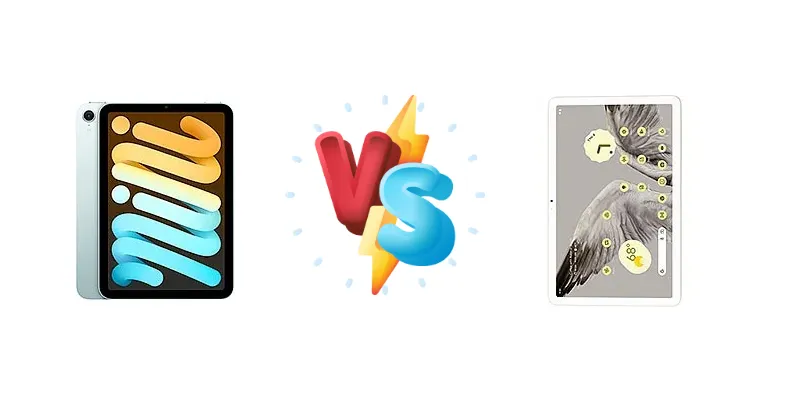
|
🏆 Quick Verdict
For users demanding peak performance and a truly portable experience, the iPad mini (2024) is the clear winner. Its A17 Pro chip delivers significantly faster processing, making it ideal for gaming and demanding creative tasks. However, the Pixel Tablet offers a compelling value proposition for those seeking a smart home integration and casual use.
| PHONES | ||
|---|---|---|
| Phone Names | Apple iPad mini (2024) | Google Pixel Tablet |
| Network | ||
|---|---|---|
| 2G bands | GSM 850 / 900 / 1800 / 1900 | N/A |
| 3G bands | HSDPA 850 / 900 / 1700(AWS) / 1900 / 2100 | N/A |
| 4G bands | 1, 2, 3, 4, 5, 7, 8, 11, 12, 13, 14, 17, 18, 19, 20, 21, 25, 26, 28, 29, 30, 32, 34, 38, 39, 40, 41, 42, 48, 66, 71 - A2995 | N/A |
| 5G bands | 1, 2, 3, 5, 7, 8, 12, 14, 20, 25, 26, 28, 29, 30, 38, 40, 41, 48, 66, 70, 71, 75, 76, 77, 78, 79 SA/NSA - A2995, A2996 | - |
| EDGE | - | No |
| GPRS | - | No |
| Speed | HSPA, LTE, 5G - cellular model only | - |
| Technology | GSM / HSPA / LTE / 5G | No cellular connectivity |
| Launch | ||
|---|---|---|
| Announced | 2024, October 15 | 2023, May 10 |
| Status | Available. Released 2024, October 23 | Available. Released 2023, June 20 |
| Body | ||
|---|---|---|
| Build | Glass front, aluminum back, aluminum frame | Glass front, aluminum frame, aluminum back |
| Dimensions | 195.4 x 134.8 x 6.3 mm (7.69 x 5.31 x 0.25 in) | 258 x 169 x 8.1 mm (10.16 x 6.65 x 0.32 in) |
| SIM | eSIM (cellular model only) | No |
| Weight | 293 g (Wi-Fi) / 297 g (Wi-Fi + Cellular) (10.34 oz) | 493 g (1.09 lb) |
| - | Stylus support | |
| Display | ||
|---|---|---|
| Protection | Scratch-resistant glass, oleophobic coating, Mohs level 4 | - |
| Resolution | 1488 x 2266 pixels, 3:2 ratio (~327 ppi density) | 1600 x 2560 pixels, 16:10 ratio (~276 ppi density) |
| Size | 8.3 inches, 203.9 cm2 (~77.4% screen-to-body ratio) | 10.95 inches, 347.7 cm2 (~79.7% screen-to-body ratio) |
| Type | Liquid Retina IPS LCD, 500 nits (typ) | IPS LCD |
| Platform | ||
|---|---|---|
| CPU | Hexa-core (2x3.78 GHz performance cores and 4 efficiency cores) | Octa-core (2x2.85 GHz Cortex-X1 & 2x2.35 GHz Cortex-A78 & 4x1.80 GHz Cortex-A55) |
| Chipset | Apple A17 Pro (3 nm) | Google Tensor G2 (5 nm) |
| GPU | Apple GPU (5-core graphics) | Mali-G710 MP7 |
| OS | iPadOS 18, upgradable to iPadOS 26.1 | Android 13, upgradable to Android 15 |
| Memory | ||
|---|---|---|
| Card slot | No | No |
| Internal | 128GB 8GB RAM, 256GB 8GB RAM, 512GB 8GB RAM | 128GB 8GB RAM, 256GB 8GB RAM |
| - | UFS 3.1 | |
| Main Camera | ||
|---|---|---|
| Features | Quad-LED dual-tone flash, HDR, panorama | HDR, panorama |
| Single | 12 MP, f/1.8, (wide), AF | 8 MP, f/2.0, 24mm (wide), 1/4.0", 1.12µm |
| Video | 4K@24/25/30/60fps, 1080p@25/30/60/120/240fps; gyro-EIS | 1080p@30fps |
| Selfie camera | ||
|---|---|---|
| Features | HDR | HDR, panorama |
| Single | 12 MP, f/2.4, 122˚ (ultrawide) | 8 MP, f/2.0, 24mm (wide), 1/4.0", 1.12µm |
| Video | 1080p@25/30/60fps, gyro-EIS | 1080p@30fps |
| Sound | ||
|---|---|---|
| 3.5mm jack | - | No |
| 35mm jack | No | No |
| Loudspeaker | Yes, with stereo speakers | Yes, with stereo speakers (4 speakers) |
| Comms | ||
|---|---|---|
| Bluetooth | 5.3, A2DP | 5.2, A2DP, LE |
| NFC | No | No |
| Positioning | GPS, GLONASS - cellular model only | No |
| Radio | No | No |
| USB | USB Type-C 3.1 Gen2, DisplayPort | USB Type-C 3.2 (Gen 1), magnetic connector |
| WLAN | Wi-Fi 802.11 a/b/g/n/ac/6e, dual-band, hotspot | Wi-Fi 802.11 a/b/g/n/ac/6, dual-band |
| Features | ||
|---|---|---|
| Sensors | Fingerprint (side-mounted), accelerometer, gyro, compass, barometer | Accelerometer, gyro, compass, proximity (accessories only) |
| - | Ultra Wideband (UWB) support | |
| Battery | ||
|---|---|---|
| Charging | - | 15W wired |
| Type | Li-Ion 5078 mAh (19.3 Wh) | Li-Po 7020 mAh (27 Wh) |
| Misc | ||
|---|---|---|
| Colors | Space Gray, Blue, Purple, Starlight | Porcelain, Hazel, Rose |
| Models | A2993, A2995, A2996, iPad16,1, iPad16,2 | GA06156-EU, GA06157-EU, GA06158-EU |
| Price | About 600 EUR | About 670 EUR |
| EU LABEL | ||
|---|---|---|
| Battery | 67:00h endurance, 1000 cycles | - |
| Energy | Class E | - |
| Free fall | Class D (52 falls) | - |
| Repairability | Class C | - |
Apple iPad mini (2024)
- Unmatched performance with the A17 Pro chip
- Exceptional battery life and longevity (67h endurance, 1000 cycles)
- Highly portable and compact design
- Likely higher price point
- Limited smart home integration compared to Pixel Tablet
Google Pixel Tablet
- Seamless integration with Google’s smart home ecosystem
- More affordable price point
- Versatile design for both entertainment and productivity
- Slower performance compared to the A17 Pro
- Slower charging speed (15W)
Display Comparison
While display specs are missing for the Pixel Tablet, the iPad mini’s performance is anchored by the A17 Pro. The Pixel Tablet’s focus on smart home integration suggests a display optimized for viewing angles rather than peak brightness. The A17 Pro’s processing power allows for advanced display features like ProMotion (adaptive refresh rate) which is likely present on the iPad mini, contributing to smoother scrolling and animations. Color accuracy is expected to be excellent on both, given both brands’ reputations, but the iPad mini likely has a wider color gamut.
Camera Comparison
Camera details are absent for both devices, but given the iPad mini’s focus on portability and the Pixel Tablet’s smart home integration, neither is likely to be a photography powerhouse. The Pixel Tablet may leverage Google’s computational photography expertise for improved image processing, but the iPad mini’s A17 Pro could offer faster image processing speeds. We anticipate both will feature adequate cameras for video calls and casual snapshots, but not for serious photography.
Performance
The core difference lies in the chipsets. Apple’s A17 Pro, built on a 3nm process, represents a significant leap in efficiency and performance compared to Google’s Tensor G2 (5nm). The A17 Pro’s hexa-core configuration (2x3.78 GHz performance cores + 4 efficiency cores) is designed for sustained high performance, while the Tensor G2’s octa-core setup (2x2.85 GHz Cortex-X1, 2x2.35 GHz Cortex-A78, 4x1.80 GHz Cortex-A55) prioritizes AI and machine learning tasks. This translates to faster app loading, smoother multitasking, and superior gaming performance on the iPad mini. The 3nm node of the A17 Pro also implies better thermal management, reducing throttling during extended use.
Battery Life
The iPad mini (2024) boasts an impressive 67-hour endurance and a 1000-cycle battery lifespan, indicating a focus on long-term reliability. The Pixel Tablet, with only 15W wired charging, suggests a slower charging speed. While the Pixel Tablet’s battery capacity is unknown, the iPad mini’s endurance suggests a larger battery or significantly more efficient power management thanks to the A17 Pro’s 3nm architecture. The 1000 cycle lifespan of the iPad mini also points to superior battery health retention over time.
Buying Guide
Buy the Apple iPad mini (2024) if you need a supremely portable tablet for demanding tasks like video editing, graphic design, or mobile gaming, and value the seamless integration within the Apple ecosystem. Buy the Google Pixel Tablet if you prioritize a tablet that seamlessly integrates with your smart home, serves as a hub for casual entertainment, and offers a more affordable entry point into the tablet market.