
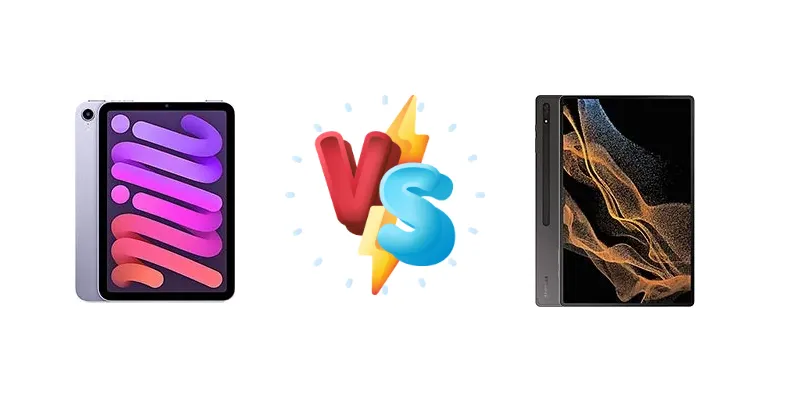
iPad mini (2021) vs. Samsung Galaxy Tab S8 Ultra: Which Tablet Reigns Supreme?
| Phones Images | |||||
|---|---|---|---|---|---|
|
🏆 Quick Verdict
For most users, the Samsung Galaxy Tab S8 Ultra offers a more versatile experience. Its larger display, faster charging, and powerful Snapdragon 8 Gen 1 chipset outweigh the iPad mini’s portability advantage. However, the iPad mini remains the king of compact tablets for on-the-go consumption.
| PHONES | ||
|---|---|---|
| Phone Names | Apple iPad mini (2021) | Samsung Galaxy Tab S8 Ultra |
| Network | ||
|---|---|---|
| 2G bands | GSM 850 / 900 / 1800 / 1900 | GSM 850 / 900 / 1800 / 1900 |
| 3G bands | HSDPA 850 / 900 / 1700(AWS) / 1900 / 2100 | HSDPA 850 / 900 / 1700(AWS) / 1900 / 2100 |
| 4G bands | 1, 2, 3, 4, 5, 7, 8, 11, 12, 13, 14, 17, 18, 19, 20, 21, 25, 26, 28, 29, 30, 32, 34, 38, 39, 40, 41, 46, 48, 66, 71 | LTE |
| 5G bands | 1, 2, 3, 5, 7, 8, 12, 20, 25, 28, 29, 30, 38, 40, 41, 48, 66, 71, 77, 78, 79 SA/NSA | SA/NSA |
| Speed | HSPA, LTE, 5G - cellular model only | HSPA, LTE, 5G - cellular model only |
| Technology | GSM / HSPA / LTE / 5G | GSM / HSPA / LTE / 5G |
| Launch | ||
|---|---|---|
| Announced | 2021, September 14 | 2022, February 09 |
| Status | Available. Released 2021, September 24 | Available. Released 2022, April 30 |
| Body | ||
|---|---|---|
| Build | Glass front, aluminum back, aluminum frame | - |
| Dimensions | 195.4 x 134.8 x 6.3 mm (7.69 x 5.31 x 0.25 in) | 326.4 x 208.6 x 5.5 mm (12.85 x 8.21 x 0.22 in) |
| SIM | Nano-SIM + eSIM (cellular model only) | Nano-SIM (cellular model only) |
| Weight | 293 g (Wi-Fi) / 297 g (Wi-Fi + Cellular) (10.34 oz) | 726 g (Wi-Fi), 728 g (5G) (1.60 lb) |
| Stylus support (2nd gen only) | Stylus, 2.8ms latency (Bluetooth integration, accelerometer, gyro) | |
| Display | ||
|---|---|---|
| Protection | Scratch-resistant glass, oleophobic coating | Corning Gorilla Glass 5 |
| Resolution | 1488 x 2266 pixels, 3:2 ratio (~327 ppi density) | 1848 x 2960 pixels, 16:10 ratio (~240 ppi density) |
| Size | 8.3 inches, 203.9 cm2 (~77.4% screen-to-body ratio) | 14.6 inches, 612.6 cm2 (~90.0% screen-to-body ratio) |
| Type | Liquid Retina IPS LCD, 500 nits (typ) | Super AMOLED, 120Hz, HDR10+ |
| Platform | ||
|---|---|---|
| CPU | Hexa-core (2x2.93 GHz + 4xX.X GHz) | Octa-core (1x3.00 GHz Cortex-X2 & 3x2.50 GHz Cortex-A710 & 4x1.80 GHz Cortex-A510) |
| Chipset | Apple A15 Bionic (5 nm) | Qualcomm SM8450 Snapdragon 8 Gen 1 (4 nm) |
| GPU | Apple GPU (5-core) | Adreno 730 |
| OS | iPadOS 15, upgradable to iPadOS 26.1 | Android 12, up to 4 major Android upgrades, One UI 6.1.1 |
| Memory | ||
|---|---|---|
| Card slot | No | microSDXC (dedicated slot) |
| Internal | 64GB 4GB RAM, 256GB 4GB RAM | 128GB 8GB RAM, 256GB 8GB RAM, 256GB 12GB RAM, 256GB 16GB RAM, 512GB 12GB RAM, 512GB 16GB RAM |
| - | UFS | |
| Main Camera | ||
|---|---|---|
| Dual | - | 13 MP, f/2.0, 26mm (wide), 1/3.4", 1.0µm, AF 6 MP, f/2.2, (ultrawide) |
| Features | Quad-LED dual-tone flash, HDR, panorama | LED flash, HDR, panorama |
| Single | 12 MP, f/1.8, (wide), AF | - |
| Video | 4K@24/25/30/60fps, 1080p@25/30/60/120/240fps; gyro-EIS | 4K@30/60fps, 1080p@30fps |
| Selfie camera | ||
|---|---|---|
| Dual | - | 12 MP, f/2.2, 26mm (wide) 12 MP, f/2.4, 120˚ (ultrawide) |
| Features | HDR | HDR |
| Single | 12 MP, f/2.4, 122˚ (ultrawide) | - |
| Video | 1080p@25/30/60fps, gyro-EIS | 4K@30/60fps, 1080p@30fps |
| Sound | ||
|---|---|---|
| 3.5mm jack | No | No |
| 35mm jack | No | No |
| Loudspeaker | Yes, with stereo speakers | Yes, with stereo speakers (4 speakers) |
| - | Tuned by AKG | |
| Comms | ||
|---|---|---|
| Bluetooth | 5.0, A2DP | 5.2, A2DP, LE |
| NFC | No | No |
| Positioning | GPS, GLONASS - cellular model only | GPS, GLONASS, BDS, GALILEO - cellular model only |
| Radio | No | No |
| USB | USB Type-C 3.1, DisplayPort | USB Type-C 3.2, magnetic connector |
| WLAN | Wi-Fi 802.11 a/b/g/n/ac/6, dual-band, hotspot | Wi-Fi 802.11 a/b/g/n/ac/6e, dual-band, Wi-Fi Direct |
| Features | ||
|---|---|---|
| Sensors | Fingerprint (side-mounted), accelerometer, gyro, compass, barometer | Fingerprint (under display, optical), accelerometer, gyro, proximity, compass |
| - | Wireless Samsung DeX | |
| Battery | ||
|---|---|---|
| Charging | - | 45W wired, 100% in 82 min |
| Type | Li-Ion 5078 mAh (19.3 Wh) | Li-Po 11200 mAh |
| Misc | ||
|---|---|---|
| Colors | Space Gray, Pink, Purple, Starlight | Graphite |
| Models | A2568, iPad14,1, iPad14,2 | SM-X900, SM-X906, SM-X906B, SM-X906U, SM-X906N |
| Price | About 550 EUR | About 1150 EUR |
| SAR EU | - | 0.69 W/kg (body) |
| Tests | ||
|---|---|---|
| Loudspeaker | -29.7 LUFS (Average) | - |
Apple iPad mini (2021)
- Extremely portable and lightweight
- Powerful A15 Bionic chip for smooth performance
- Excellent display quality with high contrast
- Limited multitasking capabilities due to smaller screen
- Slower charging speeds compared to the Tab S8 Ultra
Samsung Galaxy Tab S8 Ultra
- Massive, immersive display for productivity and entertainment
- Fast 45W charging with a full charge in 82 minutes
- Powerful Snapdragon 8 Gen 1 processor
- Less portable and harder to use one-handed
- Higher price point
Display Comparison
The display philosophies diverge sharply. The iPad mini boasts a 518-nit panel with a 1325:1 contrast ratio, delivering vibrant colors and good visibility. However, it’s significantly smaller than the Tab S8 Ultra’s expansive screen. While the Tab S8 Ultra’s specs aren’t provided, Samsung typically employs AMOLED technology with excellent color accuracy and potentially higher peak brightness. The Ultra’s larger size is geared towards productivity, allowing for side-by-side app viewing, while the iPad mini’s smaller footprint is better for single-handed use and portability. The lack of LTPO information for either device makes it difficult to assess adaptive refresh rate capabilities, but the larger screen of the Tab S8 Ultra would benefit more from such a feature.
Camera Comparison
Camera performance isn’t a primary focus for tablets, but the Tab S8 Ultra likely benefits from Samsung’s image processing expertise. Without specific sensor details for either device, it’s difficult to make a direct comparison. However, Samsung typically equips its tablets with higher-resolution sensors than Apple. The iPad mini’s camera is adequate for quick scans and video calls, but the Tab S8 Ultra is more likely to deliver usable photos and videos in various lighting conditions. We can assume the Tab S8 Ultra will have a more versatile camera system overall.
Performance
Under the hood, the Samsung Galaxy Tab S8 Ultra leverages the Qualcomm Snapdragon 8 Gen 1 (4nm), an octa-core processor designed for sustained performance. This contrasts with the Apple iPad mini’s A15 Bionic (5nm) hexa-core chip. The 4nm process node of the Snapdragon 8 Gen 1 generally offers better thermal efficiency than the 5nm A15, potentially leading to less throttling during extended demanding tasks. The Snapdragon’s more complex core configuration (1x Cortex-X2, 3x Cortex-A710, 4x Cortex-A510) suggests a focus on both peak performance and power efficiency, while the A15’s architecture is optimized for Apple’s software ecosystem. The Tab S8 Ultra’s likely inclusion of LPDDR5x RAM further enhances memory bandwidth, benefiting multitasking and demanding applications.
Battery Life
The Samsung Galaxy Tab S8 Ultra’s 45W wired charging, capable of reaching 100% in 82 minutes, is a significant advantage over the iPad mini, which lacks such rapid charging capabilities. While the iPad mini’s battery capacity isn’t specified, its smaller size inherently limits its potential. The Tab S8 Ultra’s larger battery, combined with the Snapdragon 8 Gen 1’s efficiency, should provide longer runtimes, especially during demanding tasks like video streaming and gaming. The faster charging speed of the Tab S8 Ultra minimizes downtime, making it a more practical choice for users who rely on their tablet throughout the day.
Buying Guide
Buy the Apple iPad mini (2021) if you need a supremely portable tablet for reading, light gaming, and quick tasks while traveling. Its compact size and capable A15 Bionic chip make it ideal for single-handed use. Buy the Samsung Galaxy Tab S8 Ultra if you prioritize a large, immersive display for multitasking, creative work, and media consumption, and if you want a tablet that can genuinely replace a laptop with the right accessories.