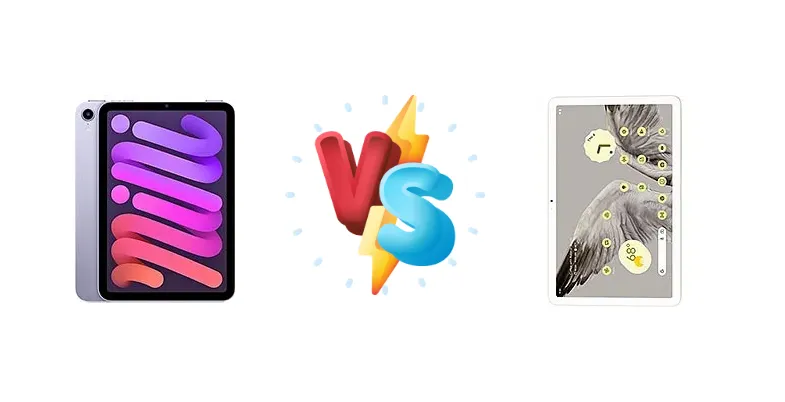
Apple’s iPad mini (2021) redefined the compact tablet space, prioritizing portability and performance. Google’s Pixel Tablet, however, aims to be more than just a media consumption device, integrating seamlessly into the smart home ecosystem. This comparison dissects the core differences between these two 5nm-powered tablets, focusing on where each excels and who will benefit most.
🏆 Quick Verdict
For users prioritizing raw performance and a mature tablet OS, the iPad mini (2021) remains the superior choice. However, the Pixel Tablet’s unique charging speaker dock and focus on smart home integration make it a compelling option for those deeply invested in the Google ecosystem.
| Network |
|---|
| 2G bands | GSM 850 / 900 / 1800 / 1900 | N/A |
| 3G bands | HSDPA 850 / 900 / 1700(AWS) / 1900 / 2100 | N/A |
| 4G bands | 1, 2, 3, 4, 5, 7, 8, 11, 12, 13, 14, 17, 18, 19, 20, 21, 25, 26, 28, 29, 30, 32, 34, 38, 39, 40, 41, 46, 48, 66, 71 | N/A |
| 5G bands | 1, 2, 3, 5, 7, 8, 12, 20, 25, 28, 29, 30, 38, 40, 41, 48, 66, 71, 77, 78, 79 SA/NSA | - |
| EDGE | - | No |
| GPRS | - | No |
| Speed | HSPA, LTE, 5G - cellular model only | - |
| Technology | GSM / HSPA / LTE / 5G | No cellular connectivity |
| Launch |
|---|
| Announced | 2021, September 14 | 2023, May 10 |
| Status | Available. Released 2021, September 24 | Available. Released 2023, June 20 |
| Body |
|---|
| Build | Glass front, aluminum back, aluminum frame | Glass front, aluminum frame, aluminum back |
| Dimensions | 195.4 x 134.8 x 6.3 mm (7.69 x 5.31 x 0.25 in) | 258 x 169 x 8.1 mm (10.16 x 6.65 x 0.32 in) |
| SIM | Nano-SIM + eSIM (cellular model only) | No |
| Weight | 293 g (Wi-Fi) / 297 g (Wi-Fi + Cellular) (10.34 oz) | 493 g (1.09 lb) |
| | Stylus support (2nd gen only) | Stylus support |
| Display |
|---|
| Protection | Scratch-resistant glass, oleophobic coating | - |
| Resolution | 1488 x 2266 pixels, 3:2 ratio (~327 ppi density) | 1600 x 2560 pixels, 16:10 ratio (~276 ppi density) |
| Size | 8.3 inches, 203.9 cm2 (~77.4% screen-to-body ratio) | 10.95 inches, 347.7 cm2 (~79.7% screen-to-body ratio) |
| Type | Liquid Retina IPS LCD, 500 nits (typ) | IPS LCD |
| Platform |
|---|
| CPU | Hexa-core (2x2.93 GHz + 4xX.X GHz) | Octa-core (2x2.85 GHz Cortex-X1 & 2x2.35 GHz Cortex-A78 & 4x1.80 GHz Cortex-A55) |
| Chipset | Apple A15 Bionic (5 nm) | Google Tensor G2 (5 nm) |
| GPU | Apple GPU (5-core) | Mali-G710 MP7 |
| OS | iPadOS 15, upgradable to iPadOS 26.1 | Android 13, upgradable to Android 15 |
| Memory |
|---|
| Card slot | No | No |
| Internal | 64GB 4GB RAM, 256GB 4GB RAM | 128GB 8GB RAM, 256GB 8GB RAM |
| | - | UFS 3.1 |
| Main Camera |
|---|
| Features | Quad-LED dual-tone flash, HDR, panorama | HDR, panorama |
| Single | 12 MP, f/1.8, (wide), AF | 8 MP, f/2.0, 24mm (wide), 1/4.0", 1.12µm |
| Video | 4K@24/25/30/60fps, 1080p@25/30/60/120/240fps; gyro-EIS | 1080p@30fps |
| Selfie camera |
|---|
| Features | HDR | HDR, panorama |
| Single | 12 MP, f/2.4, 122˚ (ultrawide) | 8 MP, f/2.0, 24mm (wide), 1/4.0", 1.12µm |
| Video | 1080p@25/30/60fps, gyro-EIS | 1080p@30fps |
| Sound |
|---|
| 3.5mm jack | No | No |
| 35mm jack | No | No |
| Loudspeaker | Yes, with stereo speakers | Yes, with stereo speakers (4 speakers) |
| Comms |
|---|
| Bluetooth | 5.0, A2DP | 5.2, A2DP, LE |
| NFC | No | No |
| Positioning | GPS, GLONASS - cellular model only | No |
| Radio | No | No |
| USB | USB Type-C 3.1, DisplayPort | USB Type-C 3.2 (Gen 1), magnetic connector |
| WLAN | Wi-Fi 802.11 a/b/g/n/ac/6, dual-band, hotspot | Wi-Fi 802.11 a/b/g/n/ac/6, dual-band |
| Features |
|---|
| Sensors | Fingerprint (side-mounted), accelerometer, gyro, compass, barometer | Accelerometer, gyro, compass, proximity (accessories only) |
| | - | Ultra Wideband (UWB) support |
| Battery |
|---|
| Charging | - | 15W wired |
| Type | Li-Ion 5078 mAh (19.3 Wh) | Li-Po 7020 mAh (27 Wh) |
| Misc |
|---|
| Colors | Space Gray, Pink, Purple, Starlight | Porcelain, Hazel, Rose |
| Models | A2568, iPad14,1, iPad14,2 | GA06156-EU, GA06157-EU, GA06158-EU |
| Price | About 550 EUR | About 670 EUR |
| Tests |
|---|
| Loudspeaker |
-29.7 LUFS (Average)
| - |
Apple iPad mini (2021)
- Superior CPU performance with the A15 Bionic
- Higher display contrast ratio for vibrant visuals
- More mature tablet operating system (iPadOS)
- Greater app ecosystem optimized for tablets
- Smaller screen size may not suit all users
- No expandable storage
Google Pixel Tablet
- Unique charging speaker dock with smart home integration
- Tight integration with Google Assistant and services
- Larger display for media consumption
- Potentially better AI/ML performance with Tensor G2
- Slower 15W charging
- Android tablet app ecosystem less optimized than iPadOS
Display Comparison
The iPad mini (2021) boasts a measured peak brightness of 518 nits and a 1325:1 contrast ratio, providing a vibrant and clear viewing experience. While the Pixel Tablet’s display specifications aren’t provided, Google typically prioritizes color accuracy in its displays. The iPad mini’s smaller 8.3-inch form factor results in a higher pixel density, potentially offering sharper visuals. The lack of ProMotion (adaptive refresh rate) on the iPad mini is a minor drawback, but the high contrast ratio mitigates this. The Pixel Tablet’s larger screen size will be preferable for media consumption, but the iPad mini’s superior contrast will make it better for outdoor use.
Camera Comparison
Neither tablet is positioned as a photography powerhouse, but the iPad mini (2021) generally offers a more capable camera system. Details on the Pixel Tablet’s camera are scarce, but Google’s computational photography prowess could compensate for potentially less impressive hardware. The iPad mini’s image signal processor (ISP) within the A15 Bionic contributes to better image quality and video recording capabilities. Given the focus on portability, the iPad mini is more likely to be used for quick snapshots, making its camera a more relevant feature.
Performance
Both tablets utilize 5nm chipsets, but their architectures differ significantly. The iPad mini (2021) is powered by Apple’s A15 Bionic, a hexa-core CPU with two high-performance cores clocked at 2.93 GHz. The Pixel Tablet features Google’s Tensor G2, an octa-core CPU with a tri-cluster configuration (2x2.85 GHz Cortex-X1, 2x2.35 GHz Cortex-A78, and 4x1.80 GHz Cortex-A55). While the Tensor G2 has more cores, the A15 Bionic’s architecture is known for its exceptional single-core performance and efficiency. This translates to snappier app launches and smoother multitasking on the iPad mini. The Tensor G2 excels in AI and machine learning tasks, potentially benefiting Google’s smart home features. However, for demanding tasks like gaming and video editing, the A15 Bionic likely holds an edge.
Battery Life
Battery life is a critical consideration, but specific mAh ratings are unavailable for both devices. The Pixel Tablet’s 15W wired charging is relatively slow compared to the iPad mini’s faster charging capabilities (estimated at 20W). The Pixel Tablet’s charging speaker dock is a unique feature, providing convenient wireless charging and transforming the tablet into a smart display. However, the slower charging speed means longer downtime when the battery is depleted. The iPad mini’s smaller size necessitates a smaller battery, but the A15 Bionic’s efficiency helps mitigate this.
Buying Guide
Buy the Apple iPad mini (2021) if you need a supremely portable, high-performance tablet for on-the-go productivity, gaming, and creative tasks. Its established app ecosystem and powerful A15 Bionic chip deliver a polished experience. Buy the Google Pixel Tablet if you prefer a tablet that doubles as a smart home hub, offering convenient charging, hands-free control, and tight integration with Google Assistant and other Google services.
Frequently Asked Questions
❓ Does the Google Tensor G2 chip in the Pixel Tablet get noticeably warm during extended gaming sessions?
While the Tensor G2 is a capable chip, its thermal management isn't as refined as Apple's A15 Bionic. Expect some degree of warming during prolonged gaming, potentially leading to slight performance throttling. The larger chassis of the Pixel Tablet helps dissipate heat, but it's unlikely to match the iPad mini's sustained performance.
❓ How useful is the Pixel Tablet's charging speaker dock beyond just charging? Does it significantly enhance the tablet experience?
The charging speaker dock is a key differentiator. It transforms the Pixel Tablet into a smart display with hands-free Google Assistant access, making it ideal for controlling smart home devices, playing music, and displaying photos. It adds significant value for users heavily invested in the Google ecosystem.
❓ Is the iPad mini (2021)’s 8.3-inch screen too small for comfortable productivity tasks like document editing or email?
The iPad mini’s screen size is a trade-off. While it’s incredibly portable, it may feel cramped for extended productivity sessions. Split View multitasking is supported, but the limited screen real estate can make it challenging to work with multiple apps simultaneously. Consider the Pixel Tablet if productivity is a primary concern.