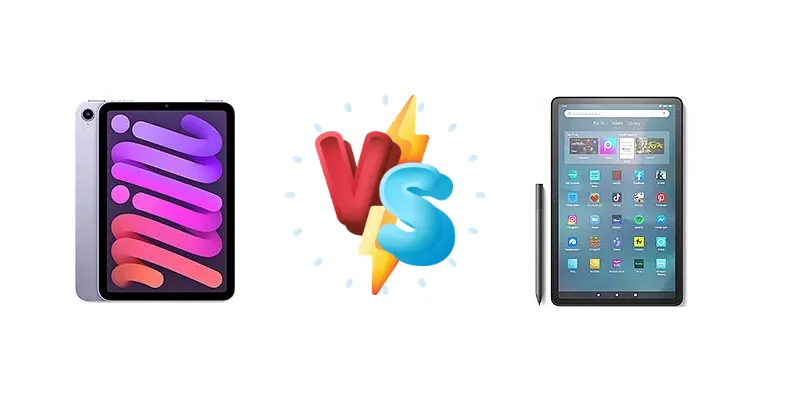
The tablet market offers a spectrum of choices, from premium, high-performance devices to affordable, content-focused options. This comparison pits Apple’s iPad mini (2021), a compact powerhouse, against Amazon’s Fire Max 11, a tablet aiming to deliver a solid experience at a significantly lower price point. We’ll dissect their core components to determine which tablet best suits your needs.
🏆 Quick Verdict
For users prioritizing performance, a vibrant display, and a polished ecosystem, the Apple iPad mini (2021) is the clear winner. However, the Amazon Fire Max 11 provides a compelling value proposition for casual users focused on media consumption and light tasks, especially those already invested in the Amazon ecosystem.
| Network |
|---|
| 2G bands | GSM 850 / 900 / 1800 / 1900 | N/A |
| 3G bands | HSDPA 850 / 900 / 1700(AWS) / 1900 / 2100 | - |
| 4G bands | 1, 2, 3, 4, 5, 7, 8, 11, 12, 13, 14, 17, 18, 19, 20, 21, 25, 26, 28, 29, 30, 32, 34, 38, 39, 40, 41, 46, 48, 66, 71 | - |
| 5G bands | 1, 2, 3, 5, 7, 8, 12, 20, 25, 28, 29, 30, 38, 40, 41, 48, 66, 71, 77, 78, 79 SA/NSA | - |
| EDGE | - | No |
| GPRS | - | No |
| Speed | HSPA, LTE, 5G - cellular model only | - |
| Technology | GSM / HSPA / LTE / 5G | No cellular connectivity |
| Launch |
|---|
| Announced | 2021, September 14 | 2023, May 23 |
| Status | Available. Released 2021, September 24 | Available. Released 2023, May 23 |
| Body |
|---|
| Build | Glass front, aluminum back, aluminum frame | - |
| Dimensions | 195.4 x 134.8 x 6.3 mm (7.69 x 5.31 x 0.25 in) | 259.1 x 163.7 x 7.5 mm (10.20 x 6.44 x 0.30 in) |
| SIM | Nano-SIM + eSIM (cellular model only) | No |
| Weight | 293 g (Wi-Fi) / 297 g (Wi-Fi + Cellular) (10.34 oz) | 490 g (1.08 lb) |
| | Stylus support (2nd gen only) | - |
| Display |
|---|
| Protection | Scratch-resistant glass, oleophobic coating | - |
| Resolution | 1488 x 2266 pixels, 3:2 ratio (~327 ppi density) | 2000 x 1200 pixels, 5:3 ratio (~212 ppi density) |
| Size | 8.3 inches, 203.9 cm2 (~77.4% screen-to-body ratio) | 11.0 inches, 344.4 cm2 (~81.2% screen-to-body ratio) |
| Type | Liquid Retina IPS LCD, 500 nits (typ) | IPS LCD |
| Platform |
|---|
| CPU | Hexa-core (2x2.93 GHz + 4xX.X GHz) | Octa-core (2x2.2 GHz Cortex-A78 & 6x2.0 GHz Cortex-A55) |
| Chipset | Apple A15 Bionic (5 nm) | Mediatek MT8188J |
| GPU | Apple GPU (5-core) | Mali-G57 MC2 |
| OS | iPadOS 15, upgradable to iPadOS 26.1 | Android 11, Fire OS 8 |
| Memory |
|---|
| Card slot | No | microSDXC (dedicated slot) |
| Internal | 64GB 4GB RAM, 256GB 4GB RAM | 64GB 4GB RAM, 128GB 4GB RAM |
| Main Camera |
|---|
| Features | Quad-LED dual-tone flash, HDR, panorama | - |
| Single | 12 MP, f/1.8, (wide), AF | 8 MP, AF |
| Video | 4K@24/25/30/60fps, 1080p@25/30/60/120/240fps; gyro-EIS | 1080p |
| Selfie camera |
|---|
| Features | HDR | - |
| Single | 12 MP, f/2.4, 122˚ (ultrawide) | 8 MP |
| Video | 1080p@25/30/60fps, gyro-EIS | 1080p |
| Sound |
|---|
| 3.5mm jack | No | - |
| 35mm jack | No | No |
| Loudspeaker | Yes, with stereo speakers | Yes, with stereo speakers |
| Comms |
|---|
| Bluetooth | 5.0, A2DP | 5.3, A2DP, LE |
| NFC | No | No |
| Positioning | GPS, GLONASS - cellular model only | No |
| Radio | No | No |
| USB | USB Type-C 3.1, DisplayPort | USB Type-C 2.0, OTG, magnetic accessory connector |
| WLAN | Wi-Fi 802.11 a/b/g/n/ac/6, dual-band, hotspot | Wi-Fi 802.11 a/b/g/n/ac/6, dual-band |
| Features |
|---|
| Sensors | Fingerprint (side-mounted), accelerometer, gyro, compass, barometer | Fingerprint (side-mounted), accelerometer, proximity (accessories only) |
| Battery |
|---|
| Charging | - | 15W wired |
| Type | Li-Ion 5078 mAh (19.3 Wh) | Li-Ion |
| Misc |
|---|
| Colors | Space Gray, Pink, Purple, Starlight | Gray |
| Models | A2568, iPad14,1, iPad14,2 | KFSNWI |
| Price | About 550 EUR | About 270 EUR |
| Tests |
|---|
| Loudspeaker |
-29.7 LUFS (Average)
| - |
Apple iPad mini (2021)
- Significantly faster processor (A15 Bionic)
- Superior display quality (brightness, contrast)
- Access to Apple’s ecosystem and software
- Higher price point
- Smaller screen size may not suit all users
Amazon Fire Max 11
- Much more affordable
- Amazon ecosystem integration (Kindle, Prime Video)
- Decent for basic media consumption
- Slower processor (Mediatek MT8188J)
- Inferior display quality
- Fire OS limitations and potential bloatware
Display Comparison
The iPad mini (2021) boasts a superior display experience. While the Fire Max 11’s specs aren’t available, the iPad mini’s measured 518 nits of max brightness significantly outshines typical Fire tablet displays, ensuring excellent visibility outdoors. Furthermore, the iPad mini’s 1325:1 contrast ratio delivers richer blacks and more vibrant colors. The absence of LTPO technology on either device means refresh rates are likely fixed, but the iPad mini’s overall panel quality is a substantial advantage for content creators and viewers.
Camera Comparison
Camera performance isn’t a primary focus for either device, but the iPad mini likely holds an edge due to Apple’s image signal processing capabilities. The Fire Max 11’s camera specs are unavailable, but Amazon’s tablets historically prioritize affordability over camera quality. The A15 Bionic’s ISP allows for better noise reduction and dynamic range in photos and videos, making the iPad mini a more capable option for capturing memories.
Performance
The core difference lies in the chipsets. Apple’s A15 Bionic (5nm) is a powerhouse, featuring a hexa-core CPU with two high-performance cores clocked at 2.93 GHz. This architecture is designed for sustained performance and efficiency. In contrast, the Amazon Fire Max 11 utilizes the Mediatek MT8188J, an octa-core processor with a mix of Cortex-A78 and A55 cores clocked at 2.2 GHz and 2.0 GHz respectively. While the Mediatek chip has more cores, the A15 Bionic’s superior architecture and 5nm process node provide a significant performance advantage in CPU-intensive tasks and graphics processing. The A15’s LPDDR5 RAM (spec not provided for Fire Max 11) further enhances responsiveness.
Battery Life
Battery life will depend heavily on usage patterns. The Fire Max 11 supports 15W wired charging, a relatively slow charging speed compared to modern standards. The iPad mini’s battery capacity is not provided, but Apple’s efficient chip design and software optimization contribute to excellent battery life. While the Fire Max 11’s 15W charging might be sufficient for overnight charging, the iPad mini will likely offer faster charging times and potentially longer sustained usage.
Buying Guide
Buy the Apple iPad mini (2021) if you need a highly portable tablet for demanding tasks like photo editing, gaming, or professional work, and value Apple’s software and ecosystem. Buy the Amazon Fire Max 11 if you prioritize affordability, primarily consume media (reading, streaming), and are comfortable with Amazon’s Fire OS and its limitations.
Frequently Asked Questions
❓ Is the Mediatek MT8188J in the Fire Max 11 powerful enough for multitasking?
The Mediatek MT8188J is capable of handling basic multitasking, such as switching between apps and browsing the web. However, it will struggle with demanding tasks like video editing or running multiple resource-intensive applications simultaneously. The A15 Bionic in the iPad mini offers a far smoother multitasking experience.
❓ How does Fire OS compare to iPadOS in terms of app availability?
iPadOS has a significantly larger and more robust app ecosystem than Fire OS. While the Amazon Appstore offers a selection of apps, it lacks many popular titles available on the Apple App Store. Fire OS relies heavily on Amazon’s services and may not be ideal for users who prefer a wider range of app choices.
❓ Can I use Google services like Gmail and YouTube on the Amazon Fire Max 11?
Yes, you can install Google services on the Fire Max 11, but it requires sideloading apps, which is a more technical process and may void your warranty. Amazon doesn’t officially support Google services, so the experience may not be as seamless as on a device with native Google support like the iPad mini.