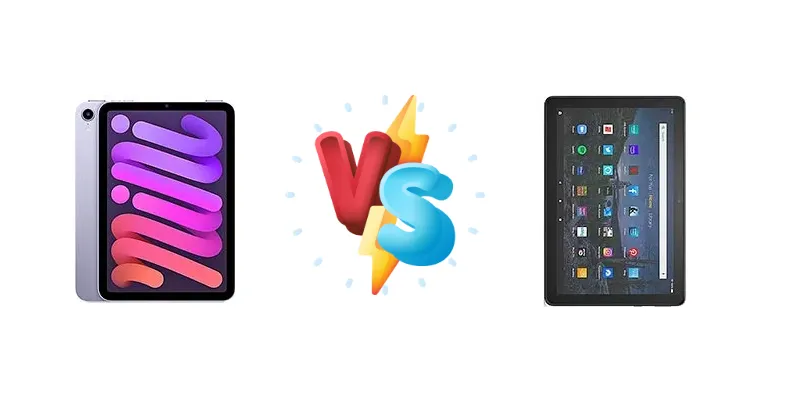
The tablet market caters to diverse needs, from demanding creative professionals to casual media consumers. The Apple iPad mini (2021) represents a premium, compact experience, while the Amazon Fire HD 10 Plus (2021) prioritizes affordability and accessibility. This comparison dissects their core strengths and weaknesses to determine which tablet best suits your workflow and budget.
🏆 Quick Verdict
For users prioritizing performance and a superior display, the Apple iPad mini (2021) is the clear winner. However, the Amazon Fire HD 10 Plus (2021) provides excellent value, especially for those deeply embedded in the Amazon ecosystem and seeking features like wireless charging, making it ideal for casual use.
| Network |
|---|
| 2G bands | GSM 850 / 900 / 1800 / 1900 | N/A |
| 3G bands | HSDPA 850 / 900 / 1700(AWS) / 1900 / 2100 | - |
| 4G bands | 1, 2, 3, 4, 5, 7, 8, 11, 12, 13, 14, 17, 18, 19, 20, 21, 25, 26, 28, 29, 30, 32, 34, 38, 39, 40, 41, 46, 48, 66, 71 | - |
| 5G bands | 1, 2, 3, 5, 7, 8, 12, 20, 25, 28, 29, 30, 38, 40, 41, 48, 66, 71, 77, 78, 79 SA/NSA | - |
| EDGE | - | No |
| GPRS | - | No |
| Speed | HSPA, LTE, 5G - cellular model only | - |
| Technology | GSM / HSPA / LTE / 5G | No cellular connectivity |
| Launch |
|---|
| Announced | 2021, September 14 | 2021, April 27. Released 2021, May 26 |
| Status | Available. Released 2021, September 24 | Discontinued |
| Body |
|---|
| Build | Glass front, aluminum back, aluminum frame | - |
| Dimensions | 195.4 x 134.8 x 6.3 mm (7.69 x 5.31 x 0.25 in) | 247 x 166 x 9.2 mm (9.72 x 6.54 x 0.36 in) |
| SIM | Nano-SIM + eSIM (cellular model only) | No |
| Weight | 293 g (Wi-Fi) / 297 g (Wi-Fi + Cellular) (10.34 oz) | 468 g (1.03 lb) |
| | Stylus support (2nd gen only) | - |
| Display |
|---|
| Protection | Scratch-resistant glass, oleophobic coating | Aluminosilicate glass |
| Resolution | 1488 x 2266 pixels, 3:2 ratio (~327 ppi density) | 1920 x 1200 pixels, 16:10 ratio (~224 ppi density) |
| Size | 8.3 inches, 203.9 cm2 (~77.4% screen-to-body ratio) | 10.1 inches, 295.8 cm2 (~72.1% screen-to-body ratio) |
| Type | Liquid Retina IPS LCD, 500 nits (typ) | IPS LCD |
| Platform |
|---|
| CPU | Hexa-core (2x2.93 GHz + 4xX.X GHz) | Octa-core (4x2.0 GHz Cortex-A73 & 4x2.0 GHz Cortex-A53) |
| Chipset | Apple A15 Bionic (5 nm) | Mediatek MT8183 Helio P60T (12 nm) |
| GPU | Apple GPU (5-core) | Mali-G72 MP3 |
| OS | iPadOS 15, upgradable to iPadOS 26.1 | Android 9.0 (Pie), Fire OS 7 |
| Memory |
|---|
| Card slot | No | microSDXC (dedicated slot) |
| Internal | 64GB 4GB RAM, 256GB 4GB RAM | 32GB 4GB RAM, 64GB 4GB RAM |
| | - | eMMC 5.1 |
| Main Camera |
|---|
| Features | Quad-LED dual-tone flash, HDR, panorama | - |
| Single | 12 MP, f/1.8, (wide), AF | 5 MP |
| Video | 4K@24/25/30/60fps, 1080p@25/30/60/120/240fps; gyro-EIS | 720p |
| Selfie camera |
|---|
| Features | HDR | - |
| Single | 12 MP, f/2.4, 122˚ (ultrawide) | 2 MP |
| Video | 1080p@25/30/60fps, gyro-EIS | 720p |
| Sound |
|---|
| 3.5mm jack | No | Yes |
| 35mm jack | No | Yes |
| Loudspeaker | Yes, with stereo speakers | Yes, with stereo speakers |
| Comms |
|---|
| Bluetooth | 5.0, A2DP | 5.0, A2DP, LE |
| NFC | No | No |
| Positioning | GPS, GLONASS - cellular model only | No |
| Radio | No | No |
| USB | USB Type-C 3.1, DisplayPort | USB Type-C 2.0, OTG |
| WLAN | Wi-Fi 802.11 a/b/g/n/ac/6, dual-band, hotspot | Wi-Fi 802.11 a/b/g/n/ac, dual-band |
| Features |
|---|
| Sensors | Fingerprint (side-mounted), accelerometer, gyro, compass, barometer | Accelerometer |
| | - | Text-to-Speech English-language content reader |
| Battery |
|---|
| Charging | - | Wireless |
| Type | Li-Ion 5078 mAh (19.3 Wh) | Li-Ion |
| Misc |
|---|
| Colors | Space Gray, Pink, Purple, Starlight | Slate |
| Models | A2568, iPad14,1, iPad14,2 | T76N2P |
| Price | About 550 EUR | About 150 EUR |
| Tests |
|---|
| Loudspeaker |
-29.7 LUFS (Average)
| - |
Apple iPad mini (2021)
- Exceptional performance with the A15 Bionic chip
- Superior display quality with high brightness and contrast
- Compact and highly portable design
- Higher price point
- Lacks wireless charging
Amazon Fire HD 10 Plus (2021)
- Affordable price
- Wireless charging support
- Integration with Amazon ecosystem
- Significantly lower performance
- Inferior display quality
- Potentially limited software updates
Display Comparison
The iPad mini (2021) boasts a significantly more refined display experience. While both tablets lack refresh rate information, the iPad mini’s measured 518 nits of max brightness surpasses expectations for a small form factor, ensuring excellent visibility outdoors. The 1325:1 contrast ratio further enhances image quality. The Fire HD 10 Plus, lacking comparable data, likely offers a lower peak brightness and contrast, typical of budget tablets. This impacts HDR content viewing and overall image vibrancy. The iPad mini’s smaller size also means a higher pixel density, resulting in sharper text and images.
Camera Comparison
Camera performance isn't a primary focus for either tablet, but the iPad mini likely holds an advantage due to Apple’s superior image signal processing. The Fire HD 10 Plus’s camera specifications are not provided, but Amazon tablets typically feature modest camera systems. The iPad mini’s camera, while not detailed in the provided data, benefits from the A15 Bionic’s image processing capabilities, resulting in better dynamic range and detail. Given the context, focusing on camera quality for either device is not a strong buying factor.
Performance
The performance gap between these tablets is substantial. The Apple A15 Bionic (5nm) chip in the iPad mini is a powerhouse, featuring a hexa-core CPU with two high-performance cores clocked at 2.93 GHz. This architecture, built on a 5nm process, delivers exceptional speed and efficiency. In contrast, the Amazon Fire HD 10 Plus utilizes the MediaTek MT8183 Helio P60T (12nm). While the Helio P60T’s octa-core configuration (4x2.0 GHz Cortex-A73 & 4x2.0 GHz Cortex-A53) appears competitive on paper, the older 12nm process and less advanced architecture result in significantly lower performance. The A15 Bionic will handle demanding apps, multitasking, and gaming with ease, while the Helio P60T may struggle with resource-intensive tasks. The iPad mini’s likely use of faster LPDDR4X or LPDDR5 RAM further contributes to its performance advantage.
Battery Life
Battery life is difficult to assess without specific mAh ratings or usage tests. However, the A15 Bionic’s 5nm efficiency could offset a potentially smaller battery capacity in the iPad mini. The Fire HD 10 Plus benefits from wireless charging, a convenience feature absent on the iPad mini. While charging wattage isn’t specified for either device, the Fire HD 10 Plus’s wireless charging capability adds flexibility, even if it’s slower than wired charging. The actual 0-100% charge times will depend on the charger used and usage patterns.
Buying Guide
Buy the Apple iPad mini (2021) if you need a highly portable tablet for demanding tasks like photo editing, gaming, or note-taking, and value seamless integration with the Apple ecosystem. Buy the Amazon Fire HD 10 Plus (2021) if you prefer a larger screen for media consumption, prioritize affordability, and frequently utilize Amazon services like Prime Video and Kindle.
Frequently Asked Questions
❓ Is the MediaTek Helio P60T in the Fire HD 10 Plus sufficient for streaming video and browsing?
Yes, the Helio P60T is adequate for basic tasks like streaming video (Amazon Prime Video, Netflix, YouTube) and web browsing. However, it will struggle with demanding games or multitasking with numerous apps open. Expect some lag and slowdowns when pushing the processor.
❓ How does the Apple A15 Bionic chip handle graphically intensive games on the iPad mini?
The A15 Bionic excels at gaming. It can handle virtually any mobile game at maximum settings with smooth frame rates. The chip’s integrated GPU and efficient thermal design prevent significant throttling, ensuring consistent performance during extended gaming sessions.
❓ Does the Amazon Fire HD 10 Plus have access to the full Google Play Store?
No, the Fire HD 10 Plus runs Fire OS, which is based on Android but does not include the Google Play Store. Instead, it utilizes Amazon’s Appstore, which has a smaller selection of apps. Sideloading apps is possible, but requires technical knowledge and may not be supported for all applications.
❓ What are the benefits of the Apple ecosystem integration with the iPad mini?
The iPad mini seamlessly integrates with other Apple devices through features like Handoff, AirDrop, and Universal Clipboard. This allows you to start a task on one device and continue it on another effortlessly. iCloud also provides seamless syncing of photos, documents, and other data.