
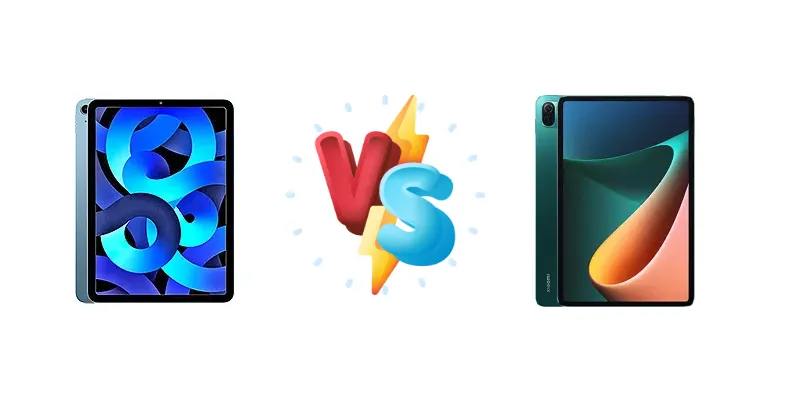
iPad Air 2022 vs Xiaomi Pad 5: The Ultimate Tablet Battle
| Phones Images | |||||
|---|---|---|---|---|---|
|
🏆 Quick Verdict
The iPad Air (2022) wins on raw power thanks to the M1 chip, offering a smoother experience for demanding tasks. However, the Xiaomi Pad 5 provides excellent value with a vibrant display, fast charging, and a competitive price, making it a strong contender for everyday use.
| PHONES | ||
|---|---|---|
| Phone Names | Apple iPad Air (2022) | Xiaomi Pad 5 |
| Network | ||
|---|---|---|
| 2G bands | GSM 850 / 900 / 1800 / 1900 | N/A |
| 3G bands | HSDPA 850 / 900 / 1700(AWS) / 1900 / 2100 | N/A |
| 4G bands | 1, 2, 3, 4, 5, 7, 8, 11, 12, 13, 14, 17, 18, 19, 20, 21, 25, 26, 28, 29, 30, 32, 34, 38, 39, 40, 41, 42, 46, 48, 66, 71 - A2589 | - |
| 5G bands | 1, 2, 3, 5, 7, 8, 12, 20, 25, 28, 29, 30, 38, 40, 41, 48, 66, 71, 77, 78, 79 SA/NSA/Sub6 - A2589, A2591 | - |
| EDGE | - | N/A |
| GPRS | - | N/A |
| Speed | HSPA, LTE, 5G | - |
| Technology | GSM / HSPA / LTE / 5G | No cellular connectivity |
| 1, 2, 3, 4, 5, 7, 8, 12, 13, 14, 17, 18, 19, 20, 25, 26, 28, 29, 30, 32, 34, 38, 39, 40, 41, 42, 46, 48, 66, 71 - A2591 | - | |
| Launch | ||
|---|---|---|
| Announced | 2022, March 08 | 2021, August 10 |
| Status | Available. Released 2022, March 18 | Available. Released 2021, August 10 |
| Body | ||
|---|---|---|
| Build | Glass front, aluminum back, aluminum frame | Glass front, aluminum frame, plastic back |
| Dimensions | 247.6 x 178.5 x 6.1 mm (9.75 x 7.03 x 0.24 in) | 254.7 x 166.3 x 6.9 mm (10.03 x 6.55 x 0.27 in) |
| SIM | Nano-SIM + eSIM | No |
| Weight | 461 g (Wi-Fi) / 462 g (5G) (1.02 lb) | 511 g (1.13 lb) |
| Stylus support (2nd gen) | Stylus support (magnetic) | |
| Display | ||
|---|---|---|
| Protection | Scratch-resistant glass, oleophobic coating | - |
| Resolution | 1640 x 2360 pixels (~264 ppi density) | 1600 x 2560 pixels, 16:10 ratio (~274 ppi density) |
| Size | 10.9 inches, 359.2 cm2 (~81.3% screen-to-body ratio) | 11.0 inches, 350.9 cm2 (~82.8% screen-to-body ratio) |
| Type | Liquid Retina IPS LCD, 500 nits (typ) | IPS LCD, 1B colors, 120Hz, HDR10, Dolby Vision |
| Platform | ||
|---|---|---|
| CPU | Octa-core (4x3.2 GHz & 4xX.X GHz) | Octa-core (1x2.96 GHz Kryo 485 Gold & 3x2.42 GHz Kryo 485 Gold & 4x1.78 GHz Kryo 485 Silver) |
| Chipset | Apple M1 | Qualcomm Snapdragon 860 (7 nm) |
| GPU | Apple GPU (8-core graphics) | Adreno 640 |
| OS | iPadOS 15.4, upgradable to iPadOS 26.1 | Android 11, upgradable to Android 13, MIUI 14 |
| Memory | ||
|---|---|---|
| Card slot | No | No |
| Internal | 64GB, 256GB 8GB RAM | 128GB 6GB RAM, 256GB 6GB RAM |
| - | UFS 3.1 | |
| Main Camera | ||
|---|---|---|
| Features | HDR | Dual-LED flash, HDR, panorama |
| Single | 12 MP, f/1.8, (wide), 1/3.0", 1.22µm, dual pixel PDAF | 13 MP, f/2.0 |
| Video | 4K@24/25/30/60fps, 1080p@25/30/60/120/240fps; gyro-EIS | 4K@30fps, 1080p@30fps |
| Selfie camera | ||
|---|---|---|
| Features | HDR | - |
| Single | 12 MP, f/2.4, 122˚ (ultrawide) | 8 MP, f/2.0 |
| Video | 1080p@30/60fps | 1080p@30fps |
| Sound | ||
|---|---|---|
| 3.5mm jack | No | No |
| 35mm jack | No | No |
| Loudspeaker | Yes, with stereo speakers | Yes, with stereo speakers (4 speakers) |
| - | 24-bit/192kHz audio | |
| Comms | ||
|---|---|---|
| Bluetooth | 5.0, A2DP, EDR | 5.0, A2DP, LE |
| NFC | No | No |
| Positioning | GPS, GLONASS (5G model only) | No |
| Radio | No | No |
| USB | USB Type-C 3.1 Gen2, DisplayPort, magnetic connector | USB Type-C |
| WLAN | Wi-Fi 802.11 a/b/g/n/ac/6, dual-band, hotspot | Wi-Fi 802.11 a/b/g/n/ac, dual-band, Wi-Fi Direct |
| Features | ||
|---|---|---|
| Sensors | Fingerprint (top-mounted), accelerometer, gyro, compass, barometer | Accelerometer, gyro, proximity, compass |
| Battery | ||
|---|---|---|
| Charging | - | 33W wired, PD3.0 |
| Type | Li-Ion 7600 mAh (28.6 Wh) | Li-Po 8720 mAh |
| Misc | ||
|---|---|---|
| Colors | Space Gray, Starlight, Pink, Purple, Blue | Cosmic Gray, Pearl White, Green |
| Models | A2588, A2589, A2591, iPad13,16, iPad13,17 | 21051182G, 21051182C |
| Price | About 550 EUR | About 350 EUR |
| Tests | ||
|---|---|---|
| Display | - | Contrast ratio: 1271:1 (nominal) |
| Loudspeaker | - | -24.4 LUFS (Very good) |
| Performance | - | AnTuTu: 473819 (v8), 555079 (v9) GeekBench: 2583 (v5.1) GFXBench: 24fps (ES 3.1 onscreen) |
Apple iPad Air (2022)
- Blazing-fast M1 chip
- Excellent display quality
- Optimized iPadOS
- Good camera performance
- Sleek design
- Higher price
- Slower charging compared to Xiaomi Pad 5
- Limited ports
Xiaomi Pad 5
- Excellent value for money
- Vibrant display
- Fast charging (33W)
- Good audio quality
- Expandable storage (via microSD)
- Less powerful processor
- Android software experience may not appeal to all
- Camera performance not as good as iPad Air
Display Comparison
The Xiaomi Pad 5 features an 11-inch IPS LCD display with a 1271:1 contrast ratio and 478 nits brightness. While the iPad Air (2022) also has an 11-inch Liquid Retina display, Apple's color accuracy and overall visual quality are generally considered superior. The iPad Air's display also supports P3 wide color gamut and True Tone technology for more natural colors.
Camera Comparison
The iPad Air (2022) has a 12MP rear camera and a 12MP front camera. The Xiaomi Pad 5 features a 13MP rear camera and an 8MP front camera. Image quality is decent on both, but the iPad Air generally produces more detailed and accurate photos, especially in good lighting. The iPad Air's front camera is also better for video calls.
Performance
This is where the iPad Air (2022) truly shines. The M1 chip provides a significant performance advantage over the Snapdragon 860 in the Xiaomi Pad 5. Expect faster app loading, smoother multitasking, and better performance in demanding games and creative applications. The iPadOS ecosystem is also highly optimized for Apple's hardware.
Battery Life
Both tablets offer all-day battery life for typical usage. The Xiaomi Pad 5 supports 33W fast charging, while the iPad Air (2022) supports 20W charging. This means the Xiaomi Pad 5 can be charged faster.
Buying Guide
Who should buy the Apple iPad Air (2022)? Creative professionals, students needing powerful performance, and those deeply embedded in the Apple ecosystem. Who should buy the Xiaomi Pad 5? Budget-conscious users, those seeking a great display for media consumption, and Android enthusiasts.