
iPad Air 13 (2025) vs Lenovo Tab P12 Pro: A Head-to-Head Performance and Battery Showdown
| Phones Images | |||||
|---|---|---|---|---|---|
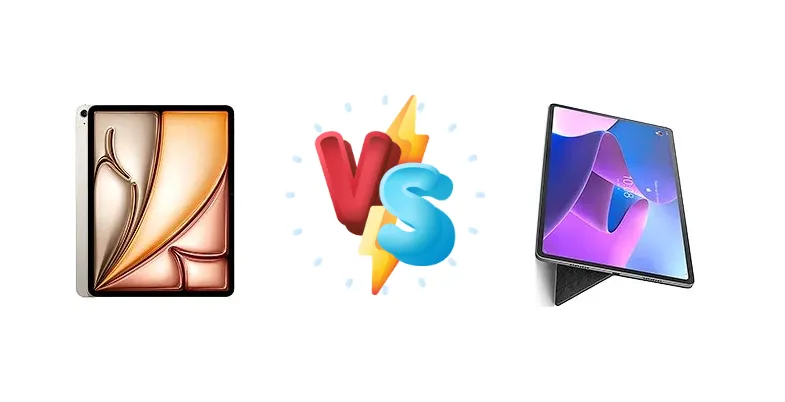
|
🏆 Quick Verdict
For most users prioritizing sustained performance and long-term software support, the Apple iPad Air 13 (2025) is the superior choice. Its M3 chip offers a significant architectural advantage, and the 72-hour battery endurance provides peace of mind. However, the Lenovo Tab P12 Pro remains a compelling option for Android enthusiasts seeking a feature-packed tablet at a potentially lower price point.
| PHONES | ||
|---|---|---|
| Phone Names | Apple iPad Air 13 (2025) | Lenovo Tab P12 Pro |
| Network | ||
|---|---|---|
| 2G bands | GSM 850 / 900 / 1800 / 1900 | GSM 850 / 900 / 1800 / 1900 |
| 3G bands | HSDPA 850 / 900 / 1700(AWS) / 1900 / 2100 | HSDPA 850 / 900 / 1900 / 2100 |
| 4G bands | 1, 2, 3, 4, 5, 7, 8, 11, 12, 13, 14, 17, 18, 19, 20, 21, 25, 26, 28, 29, 30, 32, 34, 38, 39, 40, 41, 42, 48, 66, 71 - A3269 | 1, 2, 3, 4, 5, 7, 8, 19, 20, 26, 28, 34, 38, 39, 40, 41 |
| 5G bands | 1, 2, 3, 5, 7, 8, 12, 14, 20, 25, 26, 28, 29, 30, 38, 40, 41, 48, 66, 70, 71, 75, 76, 77, 78, 79 SA/NSA/Sub6 - A3269, A3271 | 1, 3, 7, 8, 20, 28, 38, 41, 77, 78 SA/NSA/Sub6 |
| Speed | HSPA, LTE, 5G - cellular model only | HSPA, LTE, 5G - cellular model only |
| Technology | GSM / HSPA / LTE / 5G | GSM / HSPA / LTE / 5G |
| Launch | ||
|---|---|---|
| Announced | 2025, March 04 | 2021, September 08 |
| Status | Available. Released 2025, March 12 | Available. Released 2021, November 19 |
| Body | ||
|---|---|---|
| Build | Glass front, aluminum back, aluminum frame | - |
| Dimensions | 280.6 x 214.9 x 6.1 mm (11.05 x 8.46 x 0.24 in) | 285.6 x 184.5 x 5.6 mm (11.24 x 7.26 x 0.22 in) |
| SIM | eSIM (cellular model only) | Nano-SIM (cellular model only) |
| Weight | 616 g (Wi-Fi) / 617 g (5G) (1.36 lb) | 565 g (1.25 lb) |
| - | Stylus support | |
| Display | ||
|---|---|---|
| Protection | Scratch-resistant glass, oleophobic coating, Mohs level 4 | - |
| Resolution | 2048 x 2732 pixels, 4:3 ratio (~264 ppi density) | 1600 x 2560 pixels, 16:10 ratio (~240 ppi density) |
| Size | 13.0 inches, 519.3 cm2 (~86.1% screen-to-body ratio) | 12.6 inches, 460.3 cm2 (~87.4% screen-to-body ratio) |
| Type | Liquid Retina IPS LCD, 600 nits (typ) | AMOLED, 120Hz, HDR10+, Dolby Vision, 600 nits (HBM) |
| Platform | ||
|---|---|---|
| CPU | Octa-core (4 performance cores and 4 efficiency cores) | Octa-core (1x3.2 GHz Kryo 585 & 3x2.42 GHz Kryo 585 & 4x1.80 GHz Kryo 585) |
| Chipset | Apple M3 | Qualcomm SM8250-AC Snapdragon 870 5G (7 nm) |
| GPU | Apple GPU (9-core graphics) | Adreno 650 |
| OS | iPadOS 18.3.2, upgradable to iPadOS 26.1 | Android 11 |
| Memory | ||
|---|---|---|
| Card slot | No | microSDXC (dedicated slot) |
| Internal | 128GB 8GB RAM, 256GB 8GB RAM, 512GB 8GB RAM, 1TB 8GB RAM | 128GB 6GB RAM, 256GB 8GB RAM |
| Main Camera | ||
|---|---|---|
| Dual | - | 13 MP, (wide), AF 5 MP, (ultrawide) |
| Features | HDR | - |
| Single | 12 MP, f/1.8, (wide), 1/3.0", 1.22µm, dual pixel PDAF | - |
| Video | 4K@24/25/30/60fps, 1080p@25/30/60/120/240fps; gyro-EIS | 4K@30fps, 1080p@30fps |
| Selfie camera | ||
|---|---|---|
| Features | HDR | - |
| Single | 12 MP, f/2.0, 122˚ (ultrawide) | 8 MP, (wide) 8 MP, IR TOF 3D, (biometrics sensor only) |
| Video | 1080p@25/30/60fps; gyro-EIS | 1080p@30fps |
| Sound | ||
|---|---|---|
| 3.5mm jack | - | No |
| 35mm jack | No | No |
| Loudspeaker | Yes, with stereo speakers | Yes, with stereo speakers (4 speakers) |
| - | JBL speakers | |
| Comms | ||
|---|---|---|
| Bluetooth | 5.3, A2DP, LE | 5.2, A2DP, LE |
| NFC | No | Yes (wireless charging and data transfer only) |
| Positioning | GPS, GLONASS (5G model only) | GPS, GLONASS, BDS - cellular model only |
| Radio | No | Unspecified |
| USB | USB Type-C 3.1 Gen2, DisplayPort, magnetic connector | USB Type-C 3.1 |
| WLAN | Wi-Fi 802.11 a/b/g/n/ac/6e, dual-band, hotspot | Wi-Fi 802.11 a/b/g/n/ac/6, dual-band, Wi-Fi Direct |
| Features | ||
|---|---|---|
| Sensors | Fingerprint (top-mounted), accelerometer, gyro, compass, barometer | Fingerprint (side-mounted), accelerometer, gyro, proximity |
| Battery | ||
|---|---|---|
| Charging | - | 45W wired, QC4 |
| Type | Li-Po 9705 mAh (36.59 Wh) | Li-Po 10200 mAh |
| Misc | ||
|---|---|---|
| Colors | Space Gray, Starlight, Purple, Blue | Storm Grey |
| Models | A3269, A3271, A3268 | TB-Q706Z, TB-Q706F |
| Price | About 950 EUR | About 520 EUR |
| SAR | 1.09 W/kg (body) | - |
| SAR EU | 1.48 W/kg (body) | - |
| EU LABEL | ||
|---|---|---|
| Battery | 72:00h endurance, 1000 cycles | - |
| Energy | Class G | - |
| Free fall | Class E (0 falls) | - |
| Repairability | Class C | - |
Apple iPad Air 13 (2025)
- Superior performance with the Apple M3 chip
- Exceptional battery life (72 hours)
- Long-term software support from Apple
- Potential for LTPO display technology
- Potentially higher price point
- Limited customization options compared to Android
Lenovo Tab P12 Pro
- Fast 45W charging with QC4 support
- Android operating system with greater customization
- Potentially lower price point
- 5G connectivity
- Less efficient Snapdragon 870 chip
- Shorter battery life compared to iPad Air 13 (2025)
- Potentially shorter software update lifespan
Display Comparison
While display specifications are missing for the iPad Air 13 (2025), Apple typically employs high-quality panels with excellent color accuracy. The Lenovo Tab P12 Pro’s display is likely to feature a high refresh rate, given its flagship status, but the iPad Air’s potential for LTPO technology (based on Apple’s recent iPad Pro releases) could offer superior power efficiency. The Snapdragon 870’s GPU will need to work harder to drive a high refresh rate display compared to the M3’s integrated graphics.
Camera Comparison
Camera details are absent for both devices. However, given Apple’s focus on computational photography, the iPad Air 13 (2025) is likely to deliver superior image quality, even with similar sensor specifications. The Snapdragon 870’s ISP is capable, but Apple’s image signal processing pipeline is generally more refined. Without specific sensor information, it’s difficult to make a definitive judgment, but Apple’s software advantage is a significant factor.
Performance
The core difference lies in the chipsets. Apple’s M3, built on a likely 3nm or 4nm process, features an octa-core CPU with a split of 4 performance and 4 efficiency cores. This architecture prioritizes both speed and power efficiency. Conversely, the Lenovo Tab P12 Pro utilizes the Qualcomm Snapdragon 870 5G (7nm). While the Snapdragon 870 is a capable chip, its older manufacturing process and architecture mean it will generate more heat and consume more power under sustained load compared to the M3. The M3’s unified memory architecture also provides a performance advantage in tasks that require significant memory bandwidth.
Battery Life
The iPad Air 13 (2025) boasts an impressive 72-hour battery endurance, coupled with a lifespan of 1000 charge cycles, indicating a focus on long-term usability. The Lenovo Tab P12 Pro compensates with 45W wired charging and Quick Charge 4 (QC4) support, allowing for faster top-ups. While the Tab P12 Pro’s battery capacity is unknown, the Snapdragon 870’s less efficient architecture will likely require more frequent charging compared to the iPad Air 13 (2025).
Buying Guide
Buy the Apple iPad Air 13 (2025) if you need a tablet for demanding tasks like video editing, graphic design, or professional productivity, and value Apple’s ecosystem and long-term software updates. Buy the Lenovo Tab P12 Pro if you prefer the Android operating system, prioritize fast charging with its 45W QC4 support, and seek a versatile tablet for media consumption and casual gaming.