
Apple iPad Air 13 (2024) vs Xiaomi Pad 6S Pro 12.4: A Deep Dive Comparison
| Phones Images | |||||
|---|---|---|---|---|---|
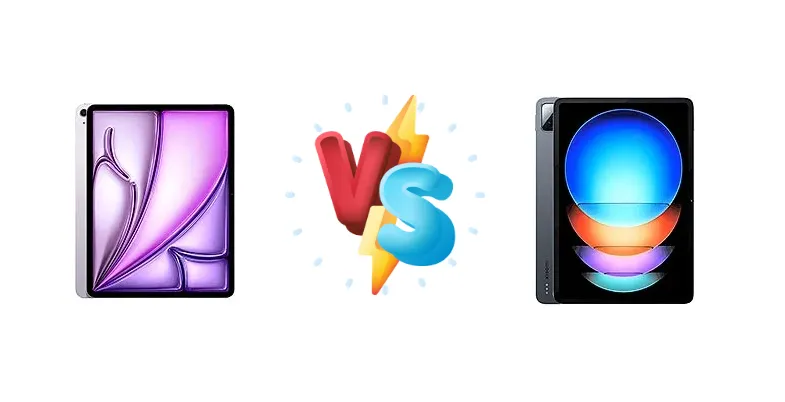
|
🏆 Quick Verdict
For users deeply embedded in the Apple ecosystem and prioritizing seamless software integration, the iPad Air 13 (2024) is the superior choice. However, the Xiaomi Pad 6S Pro 12.4 offers a compelling alternative with its faster 120W charging and impressive display, making it ideal for Android enthusiasts seeking raw performance and quick power-ups.
| PHONES | ||
|---|---|---|
| Phone Names | Apple iPad Air 13 (2024) | Xiaomi Pad 6S Pro 12.4 |
| Network | ||
|---|---|---|
| 2G bands | GSM 850 / 900 / 1800 / 1900 | N/A |
| 3G bands | HSDPA 850 / 900 / 1700(AWS) / 1900 / 2100 | N/A |
| 4G bands | 1, 2, 3, 4, 5, 7, 8, 11, 12, 13, 14, 17, 18, 19, 20, 21, 25, 26, 28, 29, 30, 32, 34, 38, 39, 40, 41, 42, 48, 66, 71 - A2899 | - |
| 5G bands | 1, 2, 3, 5, 7, 8, 12, 14, 20, 25, 26, 28, 29, 30, 38, 40, 41, 48, 66, 70, 71, 75, 76, 77, 78, 79 SA/NSA/Sub6 - A2899, A2900 | - |
| EDGE | - | N/A |
| GPRS | - | N/A |
| Speed | HSPA, LTE, 5G - cellular model only | - |
| Technology | GSM / HSPA / LTE / 5G | No cellular connectivity |
| Launch | ||
|---|---|---|
| Announced | 2024, May 07 | 2024, February 22 |
| Status | Available. Released 2024, May 15 | Available. Released 2024, February 22 |
| Body | ||
|---|---|---|
| Build | Glass front, aluminum back, aluminum frame | Glass front (Gorilla Glass 5), aluminum frame, aluminum back |
| Dimensions | 280.6 x 214.9 x 6.1 mm (11.05 x 8.46 x 0.24 in) | 278.7 x 191.6 x 6.3 mm (10.97 x 7.54 x 0.25 in) |
| SIM | eSIM (cellular model only) | No |
| Weight | 617 g (Wi-Fi) / 618 g (5G) (1.36 lb) | 590 g (1.30 lb) |
| Display | ||
|---|---|---|
| Protection | Scratch-resistant glass, oleophobic coating | Corning Gorilla Glass 5 |
| Resolution | 2048 x 2732 pixels, 4:3 ratio (~264 ppi density) | 2032 x 3048 pixels, 3:2 ratio (~295 ppi density) |
| Size | 13.0 inches, 519.3 cm2 (~86.1% screen-to-body ratio) | 12.4 inches, 457.8 cm2 (~85.7% screen-to-body ratio) |
| Type | Liquid Retina IPS LCD, 600 nits (typ) | IPS LCD, 68B colors, 144Hz, HDR10, Dolby Vision, 900 nits (peak) |
| Platform | ||
|---|---|---|
| CPU | Octa-core (4x3.46 GHz performance cores and 4 efficiency cores) | Octa-core (1x3.2 GHz Cortex-X3 & 2x2.8 GHz Cortex-A715 & 2x2.8 GHz Cortex-A710 & 3x2.0 GHz Cortex-A510) |
| Chipset | Apple M2 | Qualcomm SM8550-AB Snapdragon 8 Gen 2 (4 nm) |
| GPU | Apple GPU (9-core graphics) | Adreno 740 |
| OS | iPadOS 17.5.1, upgradable to iPadOS 26.1 | Android 14, up to 3 major Android upgrades, HyperOS |
| Memory | ||
|---|---|---|
| Card slot | No | No |
| Internal | 128GB 8GB RAM, 256GB 8GB RAM, 512GB 8GB RAM, 1TB 8GB RAM | 256GB 8GB RAM, 256GB 12GB RAM, 512GB 12GB RAM, 1TB 16GB RAM |
| Main Camera | ||
|---|---|---|
| Dual | - | 50 MP, f/1.8, (wide), 1/2.76", 0.64µm, PDAF Auxiliary lens |
| Features | HDR | LED flash, HDR, panorama |
| Single | 12 MP, f/1.8, (wide), 1/3.0", 1.22µm, dual pixel PDAF | - |
| Video | 4K@24/25/30/60fps, 1080p@25/30/60/120/240fps; gyro-EIS | 4K@30/60fps, 1080p@30/60fps |
| Selfie camera | ||
|---|---|---|
| Features | HDR | - |
| Single | 12 MP, f/2.0, 122˚ (ultrawide) | 32 MP, f/2.2, (wide), 1/3.6", 0.61µm |
| Video | 1080p@25/30/60fps; gyro-EIS | 1080p@30fps |
| Sound | ||
|---|---|---|
| 35mm jack | No | No |
| Loudspeaker | Yes, with stereo speakers | Yes, with stereo speakers (6 speakers) |
| Comms | ||
|---|---|---|
| Bluetooth | 5.3, A2DP, LE | 5.3, A2DP, LE, LHDC |
| NFC | No | Yes (file transfer only) |
| Positioning | GPS, GLONASS (5G model only) | No |
| Radio | No | No |
| USB | USB Type-C 3.1 Gen2, DisplayPort, magnetic connector | USB Type-C 3.2, accessory connector |
| WLAN | Wi-Fi 802.11 a/b/g/n/ac/6e, dual-band, hotspot | Wi-Fi 802.11 a/b/g/n/a/6/7, dual-band, Wi-Fi Direct |
| Features | ||
|---|---|---|
| Sensors | Fingerprint (top-mounted), accelerometer, gyro, compass, barometer | Fingerprint (side-mounted), accelerometer, gyro, proximity (accessories only), compass |
| Battery | ||
|---|---|---|
| Charging | 45W wired | 120W wired, PD3.0, QC4, 45% in 10 min, 100% in 35 min |
| Type | Li-Po 9705 mAh (36.59 Wh) | 10000 mAh |
| Misc | ||
|---|---|---|
| Colors | Space Gray, Starlight, Purple, Blue | Black, Blue, Green |
| Models | A2898, A2899, A2900, iPad14,10, iPad14,11 | 24018RPACG |
| Price | About 950 EUR | About 700 EUR |
| SAR EU | - | 0.99 W/kg (body) |
Apple iPad Air 13 (2024)
- Optimized M2 chip for smooth performance
- Seamless integration with Apple ecosystem
- Excellent software support and updates
- Slower 45W charging
- Potentially less powerful camera system
- Higher price compared to Xiaomi
Xiaomi Pad 6S Pro 12.4
- Blazing-fast 120W charging
- Powerful Snapdragon 8 Gen 2 processor
- Large 12.4-inch display with high brightness
- Android ecosystem fragmentation
- Potential for software bloatware
- Less refined user experience compared to iPadOS
Display Comparison
The Xiaomi Pad 6S Pro 12.4 boasts a measured peak brightness of 848 nits and a 1378:1 contrast ratio, suggesting a vibrant and punchy visual experience. While Apple doesn’t publish peak brightness figures for the iPad Air 13 (2024), its displays are typically known for color accuracy. The larger screen size of the Xiaomi Pad 6S Pro (12.4 inches vs 13 inches) may offer a more immersive experience for media consumption. The absence of LTPO technology in either device means refresh rates are likely fixed, impacting battery life during dynamic content.
Camera Comparison
Neither tablet is positioned as a photography powerhouse, but the Xiaomi Pad 6S Pro likely has an advantage due to its potential for a more sophisticated camera system (details not provided in context). Apple typically prioritizes camera quality in its iPad Pro line, suggesting the Air may have a more basic setup. Without specific sensor details, it’s difficult to assess image quality, but the Xiaomi’s potential for larger sensors and advanced image processing could yield better results.
Performance
The core difference lies in the chipsets: Apple’s M2 versus Qualcomm’s Snapdragon 8 Gen 2. The M2, with its 4 performance and 4 efficiency cores clocked up to 3.46 GHz, is renowned for its efficient performance and optimized software integration. The Snapdragon 8 Gen 2, built on a 4nm process, features an octa-core configuration (1x3.2 GHz Cortex-X3, 2x2.8 GHz Cortex-A715, 2x2.8 GHz Cortex-A710, and 3x2.0 GHz Cortex-A510) and delivers impressive raw power. While the Snapdragon 8 Gen 2 excels in benchmark scores, the M2’s architectural advantages and software optimization often translate to a smoother, more responsive experience in real-world tasks. Both devices likely utilize LPDDR5x RAM, ensuring fast memory access.
Battery Life
The Xiaomi Pad 6S Pro 12.4 demonstrates a clear advantage in charging speed with its 120W wired charging, capable of reaching 45% charge in just 10 minutes and 100% in 35 minutes. The iPad Air 13 (2024) is limited to 45W wired charging, resulting in a significantly slower charging time. While the Xiaomi Pad 6S Pro’s active use battery score is 11:14h, the iPad Air’s battery life is unknown. Apple’s chip optimization often leads to excellent power efficiency, potentially offsetting the Xiaomi’s faster charging with longer runtimes.
Buying Guide
Buy the Apple iPad Air 13 (2024) if you need a tablet that integrates flawlessly with other Apple devices, benefits from Apple’s optimized software, and prioritizes a refined user experience. Buy the Xiaomi Pad 6S Pro 12.4 if you prefer the Android ecosystem, demand the fastest possible charging speeds, and want a tablet that maximizes raw processing power for demanding tasks.