
iPad Air 13 (2024) vs Samsung Galaxy Tab S9+: A Deep Dive into Apple's M2 and Snapdragon 8 Gen 2
| Phones Images | |||||
|---|---|---|---|---|---|
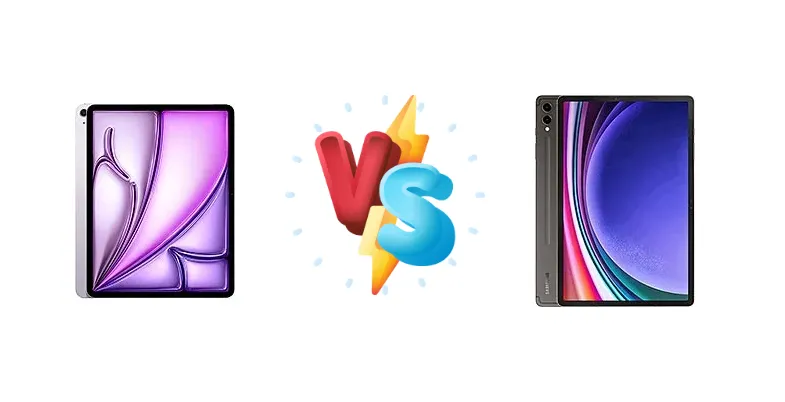
|
🏆 Quick Verdict
For the average user prioritizing a seamless, optimized experience and strong resale value, the Apple iPad Air 13 (2024) is the better choice. The M2 chip delivers excellent performance, and Apple’s software ecosystem provides a polished user experience. However, the Galaxy Tab S9+ offers a more open Android platform and potentially better multitasking for power users.
| PHONES | ||
|---|---|---|
| Phone Names | Apple iPad Air 13 (2024) | Samsung Galaxy Tab S9+ |
| Network | ||
|---|---|---|
| 2G bands | GSM 850 / 900 / 1800 / 1900 | GSM 850 / 900 / 1800 / 1900 |
| 3G bands | HSDPA 850 / 900 / 1700(AWS) / 1900 / 2100 | HSDPA 850 / 900 / 1700(AWS) / 1900 / 2100 |
| 4G bands | 1, 2, 3, 4, 5, 7, 8, 11, 12, 13, 14, 17, 18, 19, 20, 21, 25, 26, 28, 29, 30, 32, 34, 38, 39, 40, 41, 42, 48, 66, 71 - A2899 | 1, 2, 3, 4, 5, 7, 8, 12, 13, 17, 20, 25, 26, 28, 32, 38, 40, 41, 66 |
| 5G bands | 1, 2, 3, 5, 7, 8, 12, 14, 20, 25, 26, 28, 29, 30, 38, 40, 41, 48, 66, 70, 71, 75, 76, 77, 78, 79 SA/NSA/Sub6 - A2899, A2900 | 1, 3, 5, 7, 8, 20, 28, 38, 40, 41, 66, 77, 78 SA/NSA/Sub6 |
| Speed | HSPA, LTE, 5G - cellular model only | HSPA, LTE, 5G - cellular model only |
| Technology | GSM / HSPA / LTE / 5G | GSM / HSPA / LTE / 5G |
| Launch | ||
|---|---|---|
| Announced | 2024, May 07 | 2023, July 26 |
| Status | Available. Released 2024, May 15 | Available. Released 2023, August 11 |
| Body | ||
|---|---|---|
| Build | Glass front, aluminum back, aluminum frame | Glass front, aluminum frame, aluminum back |
| Dimensions | 280.6 x 214.9 x 6.1 mm (11.05 x 8.46 x 0.24 in) | 285.4 x 185.4 x 5.7 mm (11.24 x 7.30 x 0.22 in) |
| SIM | eSIM (cellular model only) | Nano-SIM + eSIM (cellular model only) |
| Weight | 617 g (Wi-Fi) / 618 g (5G) (1.36 lb) | 586 g (581 g Wi-Fi) (1.29 lb) |
| Display | ||
|---|---|---|
| Protection | Scratch-resistant glass, oleophobic coating | Corning Gorilla Glass |
| Resolution | 2048 x 2732 pixels, 4:3 ratio (~264 ppi density) | 1752 x 2800 pixels, 16:10 ratio (~266 ppi density) |
| Size | 13.0 inches, 519.3 cm2 (~86.1% screen-to-body ratio) | 12.4 inches, 446.1 cm2 (~84.3% screen-to-body ratio) |
| Type | Liquid Retina IPS LCD, 600 nits (typ) | Dynamic AMOLED 2X, 120Hz, HDR10+ |
| Platform | ||
|---|---|---|
| CPU | Octa-core (4x3.46 GHz performance cores and 4 efficiency cores) | Octa-core (1x3.36 GHz Cortex-X3 & 2x2.8 GHz Cortex-A715 & 2x2.8 GHz Cortex-A710 & 3x2.0 GHz Cortex-A510) |
| Chipset | Apple M2 | Qualcomm SM8550-AC Snapdragon 8 Gen 2 (4 nm) |
| GPU | Apple GPU (9-core graphics) | Adreno 740 |
| OS | iPadOS 17.5.1, upgradable to iPadOS 26.1 | Android 13, up to 4 major Android upgrades, One UI 6 |
| Memory | ||
|---|---|---|
| Card slot | No | microSDXC (dedicated slot) |
| Internal | 128GB 8GB RAM, 256GB 8GB RAM, 512GB 8GB RAM, 1TB 8GB RAM | 256GB 12GB RAM, 512GB 12GB RAM |
| Main Camera | ||
|---|---|---|
| Dual | - | 13 MP, f/2.0, 26mm (wide), 1/3.4", 1.0µm, AF 8 MP, f/2.2, (ultrawide) |
| Features | HDR | LED flash, HDR, panorama |
| Single | 12 MP, f/1.8, (wide), 1/3.0", 1.22µm, dual pixel PDAF | - |
| Video | 4K@24/25/30/60fps, 1080p@25/30/60/120/240fps; gyro-EIS | 4K@30fps, 1080p@30fps |
| Selfie camera | ||
|---|---|---|
| Features | HDR | HDR |
| Single | 12 MP, f/2.0, 122˚ (ultrawide) | 12 MP, f/2.4, 120˚ (ultrawide) |
| Video | 1080p@25/30/60fps; gyro-EIS | 4K@30fps, 1080p@30fps |
| Sound | ||
|---|---|---|
| 35mm jack | No | No |
| Loudspeaker | Yes, with stereo speakers | Yes, with stereo speakers (4 speakers) |
| Comms | ||
|---|---|---|
| Bluetooth | 5.3, A2DP, LE | 5.3, A2DP, LE |
| NFC | No | No |
| Positioning | GPS, GLONASS (5G model only) | GPS, GLONASS, BDS, GALILEO - cellular model only |
| Radio | No | No |
| USB | USB Type-C 3.1 Gen2, DisplayPort, magnetic connector | USB Type-C 3.2, magnetic connector |
| WLAN | Wi-Fi 802.11 a/b/g/n/ac/6e, dual-band, hotspot | Wi-Fi 802.11 a/b/g/n/ac/6e, tri-band, Wi-Fi Direct |
| Features | ||
|---|---|---|
| Sensors | Fingerprint (top-mounted), accelerometer, gyro, compass, barometer | Fingerprint (under display, optical), accelerometer, gyro, proximity, compass |
| Battery | ||
|---|---|---|
| Charging | 45W wired | 45W wired |
| Type | Li-Po 9705 mAh (36.59 Wh) | Li-Po 10090 mAh |
| Misc | ||
|---|---|---|
| Colors | Space Gray, Starlight, Purple, Blue | Beige, Graphite |
| Models | A2898, A2899, A2900, iPad14,10, iPad14,11 | SM-X810, SM-X816B |
| Price | About 950 EUR | About 1000 EUR |
| SAR EU | - | 1.35 W/kg (body) |
Apple iPad Air 13 (2024)
- Powerful M2 chip for smooth performance
- Optimized iPadOS ecosystem
- Strong resale value
- Limited customization options compared to Android
- Accessories sold separately (Apple Pencil, Magic Keyboard)
Samsung Galaxy Tab S9+
- Flexible Android operating system
- Expandable storage via microSD
- Samsung DeX mode for desktop-like experience
- Software updates may be less frequent than on iPadOS
- One UI can be resource-intensive
Display Comparison
While both tablets likely feature high-quality displays, specific details like panel type and resolution are missing. However, the underlying chipsets influence display responsiveness. The M2’s integrated GPU is optimized for Apple’s display pipeline, potentially offering smoother animations. The Snapdragon 8 Gen 2, built on a 4nm process, offers excellent graphics capabilities, but its performance is dependent on Samsung’s display calibration. Both are expected to support high refresh rates, but the Tab S9+'s potential for LTPO technology could lead to more dynamic refresh rate adjustments and improved battery efficiency.
Camera Comparison
Given the tablet form factor, camera performance isn't a primary focus. However, the quality of the sensors matters for video calls and occasional snapshots. Without specific sensor details, it’s difficult to make a definitive judgment. Samsung typically emphasizes camera features in its tablets, potentially giving the Tab S9+ an edge in image processing and low-light performance. Apple prioritizes natural-looking images, which may appeal to users who prefer less aggressive post-processing.
Performance
The core of this comparison lies in the chipsets. Apple’s M2, with its octa-core CPU (4x3.46 GHz performance cores and 4 efficiency cores), is known for its strong single-core performance, crucial for responsive app launches and everyday tasks. Samsung’s Snapdragon 8 Gen 2, an octa-core CPU (1x3.36 GHz Cortex-X3 & 2x2.8 GHz Cortex-A715 & 2x2.8 GHz Cortex-A710 & 3x2.0 GHz Cortex-A510), excels in multi-core workloads. The 4nm fabrication process of the Snapdragon 8 Gen 2 provides a thermal advantage, potentially reducing throttling during sustained intensive tasks like video editing or gaming. Both utilize LPDDR5x RAM, but Apple’s memory controller is tightly integrated with the M2, potentially offering faster memory access speeds.
Battery Life
Both tablets support 45W wired charging, suggesting similar charging speeds from 0-100%. However, real-world battery life depends on a complex interplay of factors, including battery capacity (not specified), display brightness, and software optimization. The M2 chip’s efficiency could translate to longer battery life during typical usage scenarios. The Snapdragon 8 Gen 2’s 4nm process also contributes to improved power efficiency, but Android’s background processes and Samsung’s One UI can impact overall battery drain.
Buying Guide
Buy the Apple iPad Air 13 (2024) if you need a tablet deeply integrated with the Apple ecosystem, prioritize long-term software support, and value a streamlined, intuitive user interface. Buy the Samsung Galaxy Tab S9+ if you prefer the flexibility of Android, require expandable storage (via microSD), and frequently engage in heavy multitasking or utilize Samsung’s DeX mode for a desktop-like experience.