
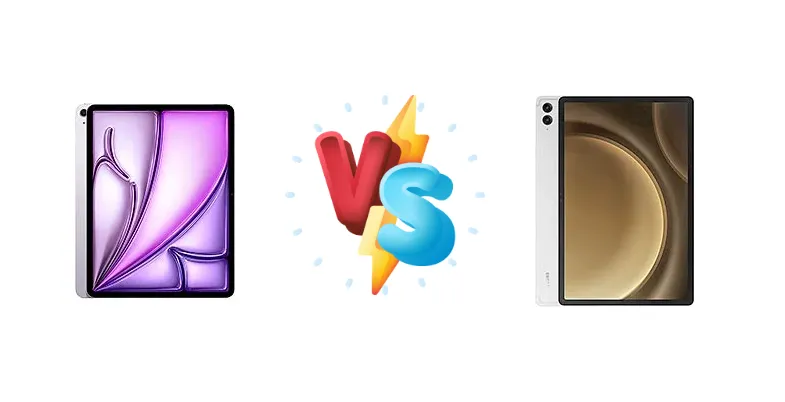
Apple iPad Air 13 (2024) vs Samsung Galaxy Tab S9 FE+: Which Tablet Reigns Supreme?
| Phones Images | |||||
|---|---|---|---|---|---|
|
🏆 Quick Verdict
For users prioritizing raw performance and a streamlined ecosystem, the Apple iPad Air 13 (2024) is the clear winner, thanks to the M2 chip. However, the Samsung Galaxy Tab S9 FE+ offers compelling value with its 45W charging and competitive feature set, making it ideal for budget-conscious buyers.
| PHONES | ||
|---|---|---|
| Phone Names | Apple iPad Air 13 (2024) | Samsung Galaxy Tab S9 FE+ |
| Network | ||
|---|---|---|
| 2G bands | GSM 850 / 900 / 1800 / 1900 | GSM 850 / 900 / 1800 / 1900 |
| 3G bands | HSDPA 850 / 900 / 1700(AWS) / 1900 / 2100 | HSDPA 850 / 900 / 1700(AWS) / 1900 / 2100 |
| 4G bands | 1, 2, 3, 4, 5, 7, 8, 11, 12, 13, 14, 17, 18, 19, 20, 21, 25, 26, 28, 29, 30, 32, 34, 38, 39, 40, 41, 42, 48, 66, 71 - A2899 | 1, 2, 3, 4, 5, 7, 8, 12, 13, 17, 20, 26, 28, 32, 38, 40, 41, 66 |
| 5G bands | 1, 2, 3, 5, 7, 8, 12, 14, 20, 25, 26, 28, 29, 30, 38, 40, 41, 48, 66, 70, 71, 75, 76, 77, 78, 79 SA/NSA/Sub6 - A2899, A2900 | 1, 3, 5, 7, 8, 20, 28, 38, 40, 41, 66, 77, 78 SA/NSA/Sub6 |
| Speed | HSPA, LTE, 5G - cellular model only | HSPA, LTE, 5G - cellular model only |
| Technology | GSM / HSPA / LTE / 5G | GSM / HSPA / LTE / 5G |
| Launch | ||
|---|---|---|
| Announced | 2024, May 07 | 2023, October 04 |
| Status | Available. Released 2024, May 15 | Available. Released 2023, October 16 |
| Body | ||
|---|---|---|
| Build | Glass front, aluminum back, aluminum frame | Glass front, aluminum back, aluminum frame |
| Dimensions | 280.6 x 214.9 x 6.1 mm (11.05 x 8.46 x 0.24 in) | 285.4 x 185.4 x 6.5 mm (11.24 x 7.30 x 0.26 in) |
| SIM | eSIM (cellular model only) | Nano-SIM + eSIM (cellular model only) |
| Weight | 617 g (Wi-Fi) / 618 g (5G) (1.36 lb) | 627 g or 628 g (1.38 lb) |
| Display | ||
|---|---|---|
| Protection | Scratch-resistant glass, oleophobic coating | - |
| Resolution | 2048 x 2732 pixels, 4:3 ratio (~264 ppi density) | 1600 x 2560 pixels, 16:10 ratio (~243 ppi density) |
| Size | 13.0 inches, 519.3 cm2 (~86.1% screen-to-body ratio) | 12.4 inches, 445.8 cm2 (~84.3% screen-to-body ratio) |
| Type | Liquid Retina IPS LCD, 600 nits (typ) | IPS LCD, 90Hz |
| Platform | ||
|---|---|---|
| CPU | Octa-core (4x3.46 GHz performance cores and 4 efficiency cores) | Octa-core (4x2.4 GHz Cortex-A78 & 4x2.0 GHz Cortex-A55) |
| Chipset | Apple M2 | Exynos 1380 (5 nm) |
| GPU | Apple GPU (9-core graphics) | Mali-G68 MP5 |
| OS | iPadOS 17.5.1, upgradable to iPadOS 26.1 | Android 13, up to 4 major Android upgrades, One UI 6 |
| Memory | ||
|---|---|---|
| Card slot | No | microSDXC (dedicated slot) |
| Internal | 128GB 8GB RAM, 256GB 8GB RAM, 512GB 8GB RAM, 1TB 8GB RAM | 128GB 6GB RAM, 128GB 8GB RAM, 256GB 8GB RAM, 256GB 12GB RAM |
| Main Camera | ||
|---|---|---|
| Dual | - | 8 MP, (wide) 8 MP, (ultrawide) |
| Features | HDR | - |
| Single | 12 MP, f/1.8, (wide), 1/3.0", 1.22µm, dual pixel PDAF | - |
| Video | 4K@24/25/30/60fps, 1080p@25/30/60/120/240fps; gyro-EIS | 4K@30fps, 1080p@30fps |
| Selfie camera | ||
|---|---|---|
| Features | HDR | - |
| Single | 12 MP, f/2.0, 122˚ (ultrawide) | 12 MP, (ultrawide) |
| Video | 1080p@25/30/60fps; gyro-EIS | Yes |
| Sound | ||
|---|---|---|
| 35mm jack | No | No |
| Loudspeaker | Yes, with stereo speakers | Yes, with stereo speakers |
| Comms | ||
|---|---|---|
| Bluetooth | 5.3, A2DP, LE | 5.3, A2DP, LE |
| NFC | No | No |
| Positioning | GPS, GLONASS (5G model only) | GPS, GALILEO, GLONASS, BDS, QZSS - cellular model only |
| Radio | No | No |
| USB | USB Type-C 3.1 Gen2, DisplayPort, magnetic connector | USB Type-C 2.0, magnetic connector |
| WLAN | Wi-Fi 802.11 a/b/g/n/ac/6e, dual-band, hotspot | Wi-Fi 802.11 a/b/g/n/ac/6, dual-band, Wi-Fi Direct |
| Features | ||
|---|---|---|
| Sensors | Fingerprint (top-mounted), accelerometer, gyro, compass, barometer | Fingerprint (side-mounted), accelerometer, gyro, compass, proximity (accessories only) |
| Battery | ||
|---|---|---|
| Charging | 45W wired | 45W wired, QC2.0 |
| Type | Li-Po 9705 mAh (36.59 Wh) | Li-Po 10090 mAh |
| Misc | ||
|---|---|---|
| Colors | Space Gray, Starlight, Purple, Blue | Mint, Silver, Gray, Lavender |
| Models | A2898, A2899, A2900, iPad14,10, iPad14,11 | SM-X610, SM-X616B |
| Price | About 950 EUR | About 770 EUR |
| SAR | - | 0.77 W/kg (body) |
| SAR EU | - | 0.50 W/kg (body) |
Apple iPad Air 13 (2024)
- Significantly faster M2 chip for demanding tasks
- Optimized iPadOS ecosystem and software support
- Likely superior color accuracy and display calibration
- Potentially higher price point
- Accessories (Apple Pencil, Magic Keyboard) sold separately
Samsung Galaxy Tab S9 FE+
- More affordable price
- Included S Pen for note-taking and creative tasks
- 45W charging with QC2.0 for broader compatibility
- Less powerful Exynos 1380 chip
- Potentially less refined software experience compared to iPadOS
Display Comparison
While both tablets likely feature LCD panels (data not provided), the display experience will differ. The iPad Air 13’s display benefits from Apple’s color calibration and potentially higher peak brightness. The Tab S9 FE+’s larger screen size (assumed, based on 'FE+' designation) is advantageous for multitasking and media viewing. The inclusion of QC2.0 in the Tab S9 FE+’s charging suggests a focus on fast charging compatibility, potentially offering quicker top-ups with compatible chargers, though both support 45W wired charging.
Camera Comparison
Camera performance is likely a secondary consideration for both tablets, but differences exist. While specific sensor details are unavailable, Apple typically prioritizes image processing quality. The Tab S9 FE+ may offer features like Single Take, leveraging Samsung’s software expertise. However, without detailed sensor specifications, it’s difficult to definitively assess the image quality gap. We anticipate both tablets will perform adequately in well-lit conditions, but struggle in low light.
Performance
The core differentiator lies in the chipsets. Apple’s M2, built on a second-generation 5nm process, delivers significantly higher CPU and GPU performance compared to Samsung’s Exynos 1380 (5nm). The M2’s octa-core configuration with 4 performance cores clocked at 3.46 GHz provides a substantial advantage in multi-threaded workloads. The Exynos 1380, while capable, is geared towards efficiency and everyday tasks. This translates to smoother performance in demanding applications and games on the iPad Air 13. The iPad Air’s likely use of LPDDR5x RAM further enhances memory bandwidth, contributing to a more responsive experience.
Battery Life
Both tablets support 45W wired charging, offering relatively fast charging speeds. However, the actual battery life will depend on capacity (data not provided) and power efficiency. The M2 chip’s efficiency gains may partially offset the iPad Air 13’s potentially smaller battery size. The Tab S9 FE+’s Exynos 1380 is designed for efficiency, potentially leading to longer battery life during typical usage scenarios. The inclusion of QC2.0 on the Tab S9 FE+ provides broader charger compatibility.
Buying Guide
Buy the Apple iPad Air 13 (2024) if you require a tablet capable of handling demanding tasks like video editing, graphic design, or intensive gaming, and if you’re invested in the Apple ecosystem. Buy the Samsung Galaxy Tab S9 FE+ if you prioritize a larger screen for media consumption, note-taking with the included S Pen, and a more affordable price without sacrificing core functionality.