
Apple iPad Air 13 (2024) vs Lenovo Tab P12 Pro: Which Tablet Delivers More?
| Phones Images | |||||
|---|---|---|---|---|---|
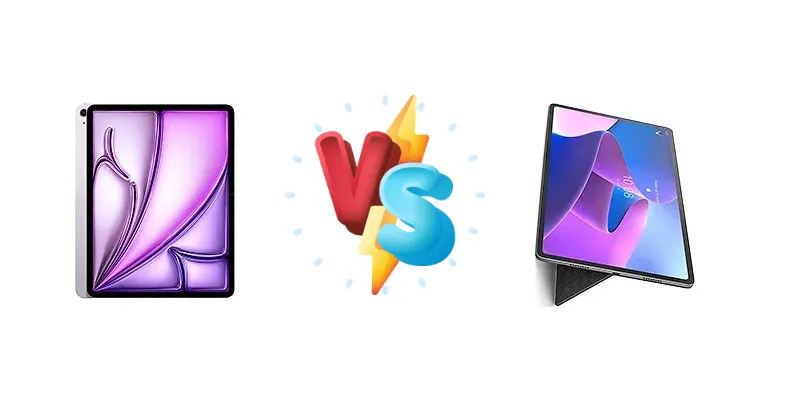
|
🏆 Quick Verdict
For most users prioritizing raw performance and long-term software support, the Apple iPad Air 13 (2024) is the clear winner thanks to the M2 chip. However, the Lenovo Tab P12 Pro offers a compelling alternative with its 5G connectivity and potentially lower price point, making it ideal for users needing mobile data and a more open ecosystem.
| PHONES | ||
|---|---|---|
| Phone Names | Apple iPad Air 13 (2024) | Lenovo Tab P12 Pro |
| Network | ||
|---|---|---|
| 2G bands | GSM 850 / 900 / 1800 / 1900 | GSM 850 / 900 / 1800 / 1900 |
| 3G bands | HSDPA 850 / 900 / 1700(AWS) / 1900 / 2100 | HSDPA 850 / 900 / 1900 / 2100 |
| 4G bands | 1, 2, 3, 4, 5, 7, 8, 11, 12, 13, 14, 17, 18, 19, 20, 21, 25, 26, 28, 29, 30, 32, 34, 38, 39, 40, 41, 42, 48, 66, 71 - A2899 | 1, 2, 3, 4, 5, 7, 8, 19, 20, 26, 28, 34, 38, 39, 40, 41 |
| 5G bands | 1, 2, 3, 5, 7, 8, 12, 14, 20, 25, 26, 28, 29, 30, 38, 40, 41, 48, 66, 70, 71, 75, 76, 77, 78, 79 SA/NSA/Sub6 - A2899, A2900 | 1, 3, 7, 8, 20, 28, 38, 41, 77, 78 SA/NSA/Sub6 |
| Speed | HSPA, LTE, 5G - cellular model only | HSPA, LTE, 5G - cellular model only |
| Technology | GSM / HSPA / LTE / 5G | GSM / HSPA / LTE / 5G |
| Launch | ||
|---|---|---|
| Announced | 2024, May 07 | 2021, September 08 |
| Status | Available. Released 2024, May 15 | Available. Released 2021, November 19 |
| Body | ||
|---|---|---|
| Build | Glass front, aluminum back, aluminum frame | - |
| Dimensions | 280.6 x 214.9 x 6.1 mm (11.05 x 8.46 x 0.24 in) | 285.6 x 184.5 x 5.6 mm (11.24 x 7.26 x 0.22 in) |
| SIM | eSIM (cellular model only) | Nano-SIM (cellular model only) |
| Weight | 617 g (Wi-Fi) / 618 g (5G) (1.36 lb) | 565 g (1.25 lb) |
| - | Stylus support | |
| Display | ||
|---|---|---|
| Protection | Scratch-resistant glass, oleophobic coating | - |
| Resolution | 2048 x 2732 pixels, 4:3 ratio (~264 ppi density) | 1600 x 2560 pixels, 16:10 ratio (~240 ppi density) |
| Size | 13.0 inches, 519.3 cm2 (~86.1% screen-to-body ratio) | 12.6 inches, 460.3 cm2 (~87.4% screen-to-body ratio) |
| Type | Liquid Retina IPS LCD, 600 nits (typ) | AMOLED, 120Hz, HDR10+, Dolby Vision, 600 nits (HBM) |
| Platform | ||
|---|---|---|
| CPU | Octa-core (4x3.46 GHz performance cores and 4 efficiency cores) | Octa-core (1x3.2 GHz Kryo 585 & 3x2.42 GHz Kryo 585 & 4x1.80 GHz Kryo 585) |
| Chipset | Apple M2 | Qualcomm SM8250-AC Snapdragon 870 5G (7 nm) |
| GPU | Apple GPU (9-core graphics) | Adreno 650 |
| OS | iPadOS 17.5.1, upgradable to iPadOS 26.1 | Android 11 |
| Memory | ||
|---|---|---|
| Card slot | No | microSDXC (dedicated slot) |
| Internal | 128GB 8GB RAM, 256GB 8GB RAM, 512GB 8GB RAM, 1TB 8GB RAM | 128GB 6GB RAM, 256GB 8GB RAM |
| Main Camera | ||
|---|---|---|
| Dual | - | 13 MP, (wide), AF 5 MP, (ultrawide) |
| Features | HDR | - |
| Single | 12 MP, f/1.8, (wide), 1/3.0", 1.22µm, dual pixel PDAF | - |
| Video | 4K@24/25/30/60fps, 1080p@25/30/60/120/240fps; gyro-EIS | 4K@30fps, 1080p@30fps |
| Selfie camera | ||
|---|---|---|
| Features | HDR | - |
| Single | 12 MP, f/2.0, 122˚ (ultrawide) | 8 MP, (wide) 8 MP, IR TOF 3D, (biometrics sensor only) |
| Video | 1080p@25/30/60fps; gyro-EIS | 1080p@30fps |
| Sound | ||
|---|---|---|
| 3.5mm jack | - | No |
| 35mm jack | No | No |
| Loudspeaker | Yes, with stereo speakers | Yes, with stereo speakers (4 speakers) |
| - | JBL speakers | |
| Comms | ||
|---|---|---|
| Bluetooth | 5.3, A2DP, LE | 5.2, A2DP, LE |
| NFC | No | Yes (wireless charging and data transfer only) |
| Positioning | GPS, GLONASS (5G model only) | GPS, GLONASS, BDS - cellular model only |
| Radio | No | Unspecified |
| USB | USB Type-C 3.1 Gen2, DisplayPort, magnetic connector | USB Type-C 3.1 |
| WLAN | Wi-Fi 802.11 a/b/g/n/ac/6e, dual-band, hotspot | Wi-Fi 802.11 a/b/g/n/ac/6, dual-band, Wi-Fi Direct |
| Features | ||
|---|---|---|
| Sensors | Fingerprint (top-mounted), accelerometer, gyro, compass, barometer | Fingerprint (side-mounted), accelerometer, gyro, proximity |
| Battery | ||
|---|---|---|
| Charging | 45W wired | 45W wired, QC4 |
| Type | Li-Po 9705 mAh (36.59 Wh) | Li-Po 10200 mAh |
| Misc | ||
|---|---|---|
| Colors | Space Gray, Starlight, Purple, Blue | Storm Grey |
| Models | A2898, A2899, A2900, iPad14,10, iPad14,11 | TB-Q706Z, TB-Q706F |
| Price | About 950 EUR | About 520 EUR |
Apple iPad Air 13 (2024)
- Significantly faster M2 chip for demanding tasks
- Superior image signal processor for better camera performance
- Long-term software support from Apple
- Optimized ecosystem integration
- Potentially higher price point
- Limited customization options compared to Android
Lenovo Tab P12 Pro
- 5G connectivity for on-the-go productivity
- Quick Charge 4 (QC4) support for faster charging
- Android operating system with greater customization
- Potentially more affordable price
- Less powerful Snapdragon 870 chip
- Shorter software update lifespan compared to Apple
Display Comparison
While both tablets likely feature high-quality displays, specific details like resolution and panel type are missing for the Lenovo Tab P12 Pro. The iPad Air 13’s display benefits from the M2’s image signal processor, potentially offering superior color accuracy and dynamic range. The Snapdragon 870, while capable, lacks the dedicated hardware for the same level of image processing. Bezels are a key consideration; a smaller bezel-to-body ratio on the iPad Air would enhance the immersive experience. The Lenovo Tab P12 Pro’s display likely benefits from its QC4 charging, allowing for faster top-ups during use.
Camera Comparison
Without specific camera specs for the Lenovo Tab P12 Pro, a direct comparison is limited. However, Apple typically prioritizes image quality and computational photography. The M2’s image signal processor will likely deliver superior image processing, even with similar sensor sizes. The iPad Air’s camera system will likely excel in low-light conditions and offer more advanced features like Cinematic mode. The Snapdragon 870’s ISP is competent, but it won’t match the M2’s capabilities. We can assume the Lenovo Tab P12 Pro will offer a versatile camera setup, but it’s unlikely to compete with the iPad Air in terms of overall image quality.
Performance
The Apple M2 chip represents a significant architectural leap over the Qualcomm Snapdragon 870. Built on a 4nm process, the M2’s octa-core CPU (4x3.46 GHz performance cores and 4 efficiency cores) delivers substantially higher single-core and multi-core performance compared to the Snapdragon 870’s octa-core configuration (1x3.2 GHz Kryo 585 & 3x2.42 GHz Kryo 585 & 4x1.80 GHz Kryo 585). This translates to faster app launch times, smoother multitasking, and improved performance in demanding applications. The M2’s integrated GPU also provides a considerable advantage in graphics-intensive tasks. While the Snapdragon 870 remains a capable performer, it will likely exhibit more thermal throttling under sustained load. The iPad Air’s LPDDR5 RAM, paired with the M2, further enhances memory bandwidth and responsiveness.
Battery Life
Both tablets support 45W wired charging, but the Lenovo Tab P12 Pro adds Quick Charge 4 (QC4) compatibility, potentially allowing for faster charging speeds with compatible chargers. Battery life will depend on usage patterns and battery capacity (which is currently unknown for both devices). The M2 chip’s power efficiency could offset a potentially smaller battery capacity in the iPad Air, resulting in comparable real-world battery life. The Snapdragon 870, while efficient, may consume more power under heavy load, impacting battery endurance during gaming or video editing.
Buying Guide
Buy the Apple iPad Air 13 (2024) if you need a tablet for demanding tasks like video editing, graphic design, or gaming, and value Apple’s ecosystem and long-term software updates. Buy the Lenovo Tab P12 Pro if you prioritize 5G connectivity for on-the-go productivity, prefer the Android operating system, and are looking for a potentially more affordable option with Quick Charge support.