
Apple iPad Air 11 (2024) vs Samsung Galaxy Tab S9 FE+: A Deep Dive Comparison
| Phones Images | |||||
|---|---|---|---|---|---|
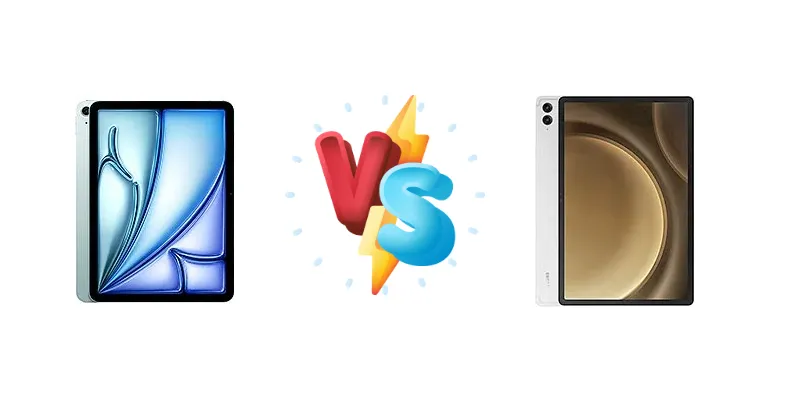
|
🏆 Quick Verdict
For users prioritizing raw performance and a refined software experience, the Apple iPad Air 11 (2024) is the clear winner, thanks to the M2 chip. However, the Samsung Galaxy Tab S9 FE+ provides excellent value, a larger screen, and expandable storage, making it ideal for media consumption and budget-conscious buyers.
| PHONES | ||
|---|---|---|
| Phone Names | Apple iPad Air 11 (2024) | Samsung Galaxy Tab S9 FE+ |
| Network | ||
|---|---|---|
| 2G bands | GSM 850 / 900 / 1800 / 1900 | GSM 850 / 900 / 1800 / 1900 |
| 3G bands | HSDPA 850 / 900 / 1700(AWS) / 1900 / 2100 | HSDPA 850 / 900 / 1700(AWS) / 1900 / 2100 |
| 4G bands | 1, 2, 3, 4, 5, 7, 8, 11, 12, 13, 14, 17, 18, 19, 20, 21, 25, 26, 28, 29, 30, 32, 34, 38, 39, 40, 41, 42, 48, 66, 71 - A2903 | 1, 2, 3, 4, 5, 7, 8, 12, 13, 17, 20, 26, 28, 32, 38, 40, 41, 66 |
| 5G bands | 1, 2, 3, 5, 7, 8, 12, 14, 20, 25, 26, 28, 29, 30, 38, 40, 41, 48, 66, 70, 71, 75, 76, 77, 78, 79 SA/NSA/Sub6 - A2903, A2904 | 1, 3, 5, 7, 8, 20, 28, 38, 40, 41, 66, 77, 78 SA/NSA/Sub6 |
| Speed | HSPA, LTE, 5G - cellular model only | HSPA, LTE, 5G - cellular model only |
| Technology | GSM / HSPA / LTE / 5G | GSM / HSPA / LTE / 5G |
| Launch | ||
|---|---|---|
| Announced | 2024, May 07 | 2023, October 04 |
| Status | Available. Released 2024, May 15 | Available. Released 2023, October 16 |
| Body | ||
|---|---|---|
| Build | Glass front, aluminum back, aluminum frame | Glass front, aluminum back, aluminum frame |
| Dimensions | 247.6 x 178.5 x 6.1 mm (9.75 x 7.03 x 0.24 in) | 285.4 x 185.4 x 6.5 mm (11.24 x 7.30 x 0.26 in) |
| SIM | eSIM (cellular model only) | Nano-SIM + eSIM (cellular model only) |
| Weight | 462 g (1.02 lb) | 627 g or 628 g (1.38 lb) |
| Display | ||
|---|---|---|
| Protection | Scratch-resistant glass, oleophobic coating | - |
| Resolution | 1640 x 2360 pixels (~264 ppi density) | 1600 x 2560 pixels, 16:10 ratio (~243 ppi density) |
| Size | 11.0 inches, 357.6 cm2 (~80.9% screen-to-body ratio) | 12.4 inches, 445.8 cm2 (~84.3% screen-to-body ratio) |
| Type | Liquid Retina IPS LCD, 500 nits (typ) | IPS LCD, 90Hz |
| Platform | ||
|---|---|---|
| CPU | Octa-core (4x3.48 GHz performance cores and 4 efficiency cores) | Octa-core (4x2.4 GHz Cortex-A78 & 4x2.0 GHz Cortex-A55) |
| Chipset | Apple M2 | Exynos 1380 (5 nm) |
| GPU | Apple GPU (9-core graphics) | Mali-G68 MP5 |
| OS | iPadOS 17.4, upgradable to iPadOS 26.1 | Android 13, up to 4 major Android upgrades, One UI 6 |
| Memory | ||
|---|---|---|
| Card slot | No | microSDXC (dedicated slot) |
| Internal | 128GB 8GB RAM, 256GB 8GB RAM, 512GB 8GB RAM, 1TB 8GB RAM | 128GB 6GB RAM, 128GB 8GB RAM, 256GB 8GB RAM, 256GB 12GB RAM |
| Main Camera | ||
|---|---|---|
| Dual | - | 8 MP, (wide) 8 MP, (ultrawide) |
| Features | HDR | - |
| Single | 12 MP, f/1.8, (wide), 1/3.0", 1.22µm, dual pixel PDAF | - |
| Video | 4K@24/25/30/60fps, 1080p@25/30/60/120/240fps; gyro-EIS | 4K@30fps, 1080p@30fps |
| Selfie camera | ||
|---|---|---|
| Features | HDR | - |
| Single | 12 MP, f/2.0, 122˚ (ultrawide) | 12 MP, (ultrawide) |
| Video | 1080p@25/30/60fps; gyro-EIS | Yes |
| Sound | ||
|---|---|---|
| 35mm jack | No | No |
| Loudspeaker | Yes, with stereo speakers | Yes, with stereo speakers |
| Comms | ||
|---|---|---|
| Bluetooth | 5.3, A2DP, LE | 5.3, A2DP, LE |
| NFC | No | No |
| Positioning | GPS, GLONASS (cellular model only) | GPS, GALILEO, GLONASS, BDS, QZSS - cellular model only |
| Radio | No | No |
| USB | USB Type-C 3.1 Gen2, DisplayPort, magnetic connector | USB Type-C 2.0, magnetic connector |
| WLAN | Wi-Fi 802.11 a/b/g/n/ac/6e, dual-band, hotspot | Wi-Fi 802.11 a/b/g/n/ac/6, dual-band, Wi-Fi Direct |
| Features | ||
|---|---|---|
| Sensors | Fingerprint (top-mounted), accelerometer, gyro, compass, barometer | Fingerprint (side-mounted), accelerometer, gyro, compass, proximity (accessories only) |
| Battery | ||
|---|---|---|
| Charging | 45W wired | 45W wired, QC2.0 |
| Type | Li-Po 7606 mAh (28.93 Wh) | Li-Po 10090 mAh |
| Misc | ||
|---|---|---|
| Colors | Space Gray, Starlight, Purple, Blue | Mint, Silver, Gray, Lavender |
| Models | A2902, A2903, A2904, iPad14,8, iPad14,9 | SM-X610, SM-X616B |
| Price | About 700 EUR | About 770 EUR |
| SAR | - | 0.77 W/kg (body) |
| SAR EU | - | 0.50 W/kg (body) |
Apple iPad Air 11 (2024)
- Significantly faster M2 chip for demanding tasks
- Superior software ecosystem and app optimization
- Likely higher display quality (color accuracy, brightness)
- Higher price point
- Limited storage options without cloud reliance
Samsung Galaxy Tab S9 FE+
- Larger display for enhanced media consumption
- Expandable storage via microSD card
- More affordable price point
- Less powerful Exynos 1380 chip
- Potentially lower display quality
Display Comparison
While both tablets feature LCD panels, detailed display specs are missing. However, given Apple’s history, the iPad Air 11 likely boasts superior color accuracy and potentially higher peak brightness compared to the Tab S9 FE+. The Tab S9 FE+’s larger screen size is a significant advantage for multitasking and media viewing. The 45W charging is common to both, but the Samsung benefits from QC2.0 support for potentially faster charging with compatible adapters.
Camera Comparison
Camera performance is unlikely to be a primary concern for most tablet users. Detailed camera specs are unavailable, but both tablets likely feature modest camera setups. The focus should be on video conferencing capabilities, where both should perform adequately. The absence of detailed sensor information suggests neither tablet prioritizes photography.
Performance
The core differentiator lies in the chipsets. Apple’s M2, built on a second-generation 5nm process, delivers substantially higher CPU and GPU performance than Samsung’s Exynos 1380 (5nm). The M2’s octa-core configuration with 4 performance cores clocked at 3.48 GHz provides a significant advantage in multi-threaded workloads. The Exynos 1380, while capable, is geared towards efficiency and everyday tasks. This translates to smoother performance in demanding applications and games on the iPad Air 11. The iPad Air’s LPDDR5x RAM further enhances performance, offering faster data transfer speeds than the Tab S9 FE+'s likely LPDDR4x configuration.
Battery Life
Battery capacity details are missing for both devices. However, the Exynos 1380’s 5nm process generally offers better power efficiency than older nodes. The 45W wired charging, coupled with QC2.0 support on the Tab S9 FE+, suggests potentially faster charging times, especially with a compatible charger. Real-world battery life will depend heavily on usage patterns, but the Tab S9 FE+ may offer slightly longer endurance due to its larger size and potentially larger battery capacity.
Buying Guide
Buy the Apple iPad Air 11 (2024) if you need a tablet for demanding tasks like video editing, graphic design, or gaming, and value the seamless integration within the Apple ecosystem. Buy the Samsung Galaxy Tab S9 FE+ if you prefer a larger display for media consumption, require expandable storage via microSD, and prioritize affordability without sacrificing core tablet functionality.