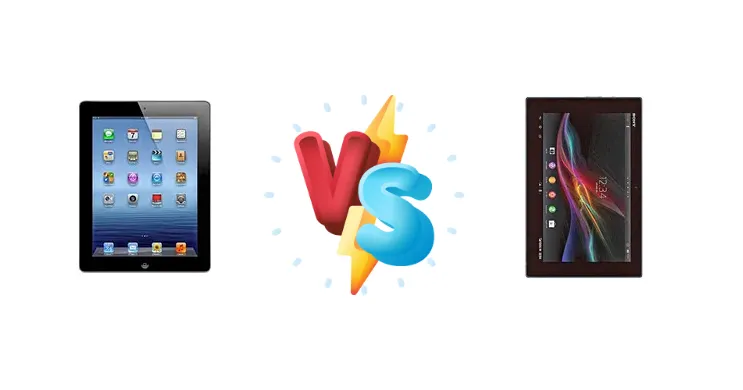
Released in late 2012 and early 2013 respectively, the Apple iPad 4 and Sony Xperia Tablet Z represent distinct approaches to the tablet experience. The iPad 4 continued Apple’s dominance with its refined ecosystem, while the Xperia Tablet Z aimed to challenge with a sleek design and Qualcomm’s processing power. This comparison dissects their key differences to help you determine which tablet holds up better today.
🏆 Quick Verdict
For the average user prioritizing a polished ecosystem and consistent performance, the iPad 4 remains a strong choice. While the Xperia Tablet Z boasts a slightly superior contrast ratio and a quad-core processor, the iPad 4’s optimized software and established app support provide a more seamless overall experience.
| Network |
|---|
| 2G bands | GSM 850 / 900 / 1800 / 1900 - A1459/ A1460 | GSM 850 / 900 / 1800 / 1900 |
| 3G bands | HSDPA 850 / 900 / 1900 / 2100 - A1459/ A1460 | HSDPA 850 / 900 / 2100 - SGP321 |
| 4G bands | 4, 17 - A1459 | 1, 3, 5, 7, 8, 20 - SGP321 |
| Speed | HSPA, LTE, EV-DO Rev.A 3.1 Mbps | HSPA 42.2/5.76 Mbps, LTE Cat3 100/50 Mbps |
| Technology | GSM / CDMA / HSPA / EVDO / LTE | GSM / HSPA / LTE |
| | - | 4 - SGP351 |
| Launch |
|---|
| Announced | 2012, October. Released 2012, November | 2013, February. Released 2013, May |
| Status | Discontinued | Discontinued |
| Body |
|---|
| Dimensions | 241.2 x 185.7 x 9.4 mm (9.50 x 7.31 x 0.37 in) | 266 x 172 x 6.9 mm (10.47 x 6.77 x 0.27 in) |
| SIM | Micro-SIM | Micro-SIM |
| Weight | 662 g (1.46 lb) | 495 g (1.09 lb) |
| | - | IP57 dust proof and water resistant |
| Display |
|---|
| Protection | Scratch-resistant glass, oleophobic coating | Shatter proof glass |
| Resolution | 1536 x 2048 pixels, 4:3 ratio (~264 ppi density) | 1200 x 1920 pixels, 16:10 ratio (~224 ppi density) |
| Size | 9.7 inches, 291.4 cm2 (~65.1% screen-to-body ratio) | 10.1 inches, 295.8 cm2 (~64.7% screen-to-body ratio) |
| Type | IPS LCD | LED-backlit LCD, |
| Platform |
|---|
| CPU | Dual-core 1.4 GHz | Quad-core 1.5 GHz Krait |
| Chipset | Apple A6X (32 nm) | Qualcomm APQ8064 Snapdragon S4 Pro |
| GPU | PowerVR SGX554MP4 (quad-core graphics) | Adreno 320 |
| OS | iOS 6, upgradable to iOS 10.3 | Android 4.1.2 (Jelly Bean), upgradable to 5.1.1 (Lollipop) |
| Memory |
|---|
| Card slot | No | microSDXC (dedicated slot); microSDHC (SGP351) |
| Internal | 16GB 1GB RAM, 32GB 1GB RAM, 64GB 1GB RAM, 128GB 1GB RAM | 16GB 2GB RAM |
| Main Camera |
|---|
| Features | - | HDR, panorama |
| Single | 5 MP, AF | 8.1 MP, AF |
| Video | 1080p@30fps | 1080p@30fps, HDR |
| Selfie camera |
|---|
| Features | face detection, FaceTime over Wi-Fi or Cellular | - |
| Single | 1.2 MP | 2.2 MP |
| Video | 720p@30fps | 1080p@30fps |
| Sound |
|---|
| 3.5mm jack | - | Yes |
| 35mm jack | Yes | Yes |
| Loudspeaker | Yes | Yes, with stereo speakers |
| | - | 3D surround sound |
| Comms |
|---|
| Bluetooth | 4.0, A2DP | 4.0, A2DP |
| Infrared port | - | Yes |
| NFC | No | Yes |
| Positioning | GPS, GLONASS | GPS, GLONASS |
| Radio | No | Stereo FM radio, RDS |
| USB | Lightning, USB 2.0 | microUSB 2.0 (MHL TV-out) |
| WLAN | Wi-Fi 802.11 a/b/g/n, dual-band, hotspot | Wi-Fi 802.11 a/b/g/n, dual-band, Wi-Fi Direct, DLNA, hotspot |
| Features |
|---|
| Sensors | Accelerometer, gyro, compass | Accelerometer, gyro, compass |
| Battery |
|---|
| Music play | - | Up to 110 h |
| Stand-by | Up to 720 h | Up to 1230 h (2G) / Up to 1270 h (3G) |
| Talk time | Up to 9 h | Up to 10 h (multimedia) |
| Type | Li-Po 11560 mAh, non-removable (42.5 Wh) | Li-Po 6000 mAh, non-removable |
| Misc |
|---|
| Colors | Black, White | Black, White |
| Models | A1459, A1460, iPad3,5, iPad3,6 | SGP321, SO-03E, SGP351 |
| Price | About 500 EUR | About 350 EUR |
| SAR EU | - | 1.69 W/kg (body) |
| Tests |
|---|
| Audio quality | - |
Noise -87.0dB / Crosstalk -87.8dB |
| Camera | - |
Photo / Video |
| Display | - |
Contrast ratio: 996:1 (nominal) |
| Loudspeaker | - |
Voice 66dB / Noise 64dB / Ring 70dB
|
Apple iPad 4 Wi-Fi + Cellular
- Optimized iOS ecosystem for smooth performance
- Strong app support and long-term software updates
- Potentially better color accuracy
- Lacks integrated camera
- Lower nominal display contrast ratio
Sony Xperia Tablet Z LTE
- Integrated camera for basic photography
- Slightly higher display contrast ratio
- Lighter and more portable design
- Android’s multitasking can lead to performance hiccups
- Potentially shorter battery life
Display Comparison
Both tablets feature nominal contrast ratios around 996:1 for the Xperia Tablet Z and 762:1 for the iPad 4. While the Xperia Tablet Z edges out the iPad 4 in contrast, the difference is unlikely to be dramatically noticeable in everyday use. Neither manufacturer specified panel technology beyond 'LCD', meaning neither benefits from the improved viewing angles or power efficiency of IPS or OLED. Bezels were relatively substantial on both devices by modern standards, impacting the overall screen-to-body ratio. Color accuracy data is unavailable, but Apple historically prioritizes color calibration, suggesting a potentially more accurate display on the iPad 4.
Camera Comparison
The Xperia Tablet Z includes a photo/video camera, a feature the iPad 4’s specifications omit. While neither tablet was designed for serious photography, the inclusion of a camera on the Xperia Tablet Z provides basic functionality for quick snapshots and video calls. Without specific sensor size or aperture information, it’s difficult to assess image quality, but it’s reasonable to assume both cameras deliver adequate performance for casual use. The lack of camera details for the iPad 4 suggests Apple prioritized other features over integrated photography.
Performance
The Sony Xperia Tablet Z’s Qualcomm APQ8064 Snapdragon S4 Pro, with its quad-core 1.5 GHz Krait architecture, appears to have a raw clock speed advantage over the Apple iPad 4’s dual-core 1.4 GHz A6X. However, the A6X, built on a 32nm process, benefits from Apple’s tight hardware-software integration and optimized architecture. This often translates to smoother performance in real-world tasks despite the lower core count. The Snapdragon S4 Pro’s performance will be more heavily reliant on Android’s multitasking capabilities, potentially leading to more noticeable slowdowns under heavy load. RAM specifications are not provided, but both tablets likely utilized a similar amount for their time.
Battery Life
Battery capacity data is unavailable for both devices. However, the Xperia Tablet Z’s lighter weight suggests a potentially smaller battery. The absence of fast charging specifications for either tablet indicates relatively slow charging times. Real-world battery life will depend heavily on usage patterns, but the iPad 4’s optimized software and potentially more efficient processor could translate to longer runtimes, even with a comparable battery capacity.
Buying Guide
Buy the Apple iPad 4 Wi-Fi + Cellular if you need a tablet deeply integrated with the Apple ecosystem, value consistent performance across a wide range of applications, and prioritize long-term software support. Buy the Sony Xperia Tablet Z LTE if you prefer a lighter, more portable design, require LTE connectivity as a primary feature, and appreciate a slightly higher display contrast ratio for media viewing.
Frequently Asked Questions
❓ Does the Snapdragon S4 Pro in the Xperia Tablet Z offer a significant performance advantage over the A6X in the iPad 4 for gaming?
While the Snapdragon S4 Pro has more cores, Apple’s A6X chip is highly optimized for iOS. In practice, the A6X often delivers smoother gaming performance due to its efficient architecture and tight software integration. The difference may not be dramatic, but the iPad 4 is likely to provide a more consistent gaming experience.
❓ Is the camera on the Sony Xperia Tablet Z useful for anything beyond basic video calls?
The camera on the Xperia Tablet Z is a basic inclusion, suitable for quick snapshots and video conferencing. It’s unlikely to compete with dedicated cameras or even modern smartphone cameras in terms of image quality. However, it provides a convenient option for capturing occasional photos or videos when a separate camera isn't available.
❓ Which tablet is better suited for reading e-books and watching videos?
Both tablets are suitable for these tasks. The Xperia Tablet Z’s slightly higher contrast ratio may offer a marginally better viewing experience for videos, while the iPad 4’s potentially more accurate display could be beneficial for reading. Ultimately, personal preference and the user’s existing ecosystem will be the deciding factors.