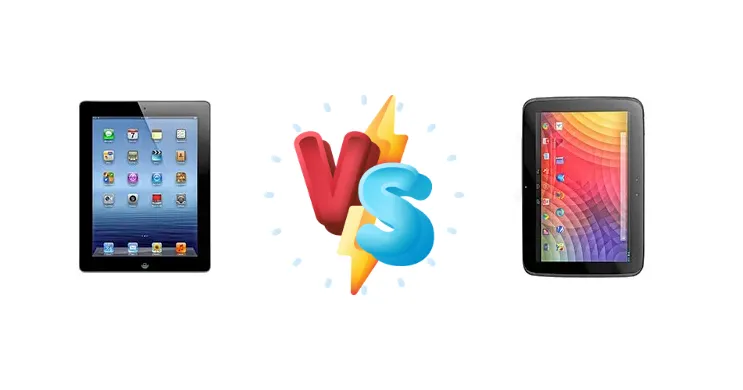
Released in late 2012, the Apple iPad 4 and the Samsung Google Nexus 10 represented distinct approaches to the burgeoning tablet market. The iPad 4 continued Apple’s refinement of the premium tablet experience, while the Nexus 10 aimed to deliver a high-end experience at a more competitive price point, leveraging Samsung’s display expertise. This comparison revisits these devices, analyzing their strengths and weaknesses in a modern context.
🏆 Quick Verdict
For the average user seeking longevity and ecosystem support, the iPad 4 remains the stronger choice despite its age. While the Nexus 10 boasts a superior contrast ratio, the iPad 4’s optimized chipset and continued software updates provide a more reliable and versatile experience.
| Network |
|---|
| 2G bands | GSM 850 / 900 / 1800 / 1900 - A1459/ A1460 | N/A |
| 3G bands | HSDPA 850 / 900 / 1900 / 2100 - A1459/ A1460 | - |
| 4G bands | 4, 17 - A1459 | - |
| EDGE | - | No |
| GPRS | - | No |
| Speed | HSPA, LTE, EV-DO Rev.A 3.1 Mbps | - |
| Technology | GSM / CDMA / HSPA / EVDO / LTE | No cellular connectivity |
| Launch |
|---|
| Announced | 2012, October. Released 2012, November | 2012, October. Released 2012, November |
| Status | Discontinued | Discontinued |
| Body |
|---|
| Dimensions | 241.2 x 185.7 x 9.4 mm (9.50 x 7.31 x 0.37 in) | 263.9 x 177.6 x 8.9 mm (10.39 x 6.99 x 0.35 in) |
| SIM | Micro-SIM | No |
| Weight | 662 g (1.46 lb) | 603 g (1.33 lb) |
| Display |
|---|
| Protection | Scratch-resistant glass, oleophobic coating | Corning Gorilla Glass 2 |
| Resolution | 1536 x 2048 pixels, 4:3 ratio (~264 ppi density) | 2560 x 1600 pixels, 16:10 ratio (~299 ppi density) |
| Size | 9.7 inches, 291.4 cm2 (~65.1% screen-to-body ratio) | 10.1 inches, 295.8 cm2 (~63.1% screen-to-body ratio) |
| Type | IPS LCD | PLS LCD |
| Platform |
|---|
| CPU | Dual-core 1.4 GHz | Dual-core 1.7 GHz Cortex-A15 |
| Chipset | Apple A6X (32 nm) | Exynos 5250 Dual |
| GPU | PowerVR SGX554MP4 (quad-core graphics) | Mali-T604 MP4 |
| OS | iOS 6, upgradable to iOS 10.3 | Android 4.2 (Jelly Bean), upgradable to 5.1 (Lollipop) |
| Memory |
|---|
| Card slot | No | No |
| Internal | 16GB 1GB RAM, 32GB 1GB RAM, 64GB 1GB RAM, 128GB 1GB RAM | 16GB 2GB RAM, 32GB 2GB RAM |
| Main Camera |
|---|
| Features | - | LED flash |
| Single | 5 MP, AF | 5 MP, AF |
| Video | 1080p@30fps | 1080p@30fps |
| Selfie camera |
|---|
| Features | face detection, FaceTime over Wi-Fi or Cellular | - |
| Single | 1.2 MP | 1.9 MP |
| Video | 720p@30fps | - |
| Sound |
|---|
| 35mm jack | Yes | Yes |
| Loudspeaker | Yes | Yes, with stereo speakers |
| Comms |
|---|
| Bluetooth | 4.0, A2DP | 3.0, A2DP |
| NFC | No | Yes, dual side |
| Positioning | GPS, GLONASS | GPS, GLONASS |
| Radio | No | No |
| USB | Lightning, USB 2.0 | microUSB 2.0 |
| WLAN | Wi-Fi 802.11 a/b/g/n, dual-band, hotspot | Wi-Fi 802.11 b/g/n, Wi-Fi Direct, DLNA |
| Features |
|---|
| Sensors | Accelerometer, gyro, compass | Accelerometer, gyro, proximity, compass, barometer |
| Battery |
|---|
| Stand-by | Up to 720 h | Up to 500 h |
| Talk time | Up to 9 h | Up to 9 h (multimedia) |
| Type | Li-Po 11560 mAh, non-removable (42.5 Wh) | Li-Po 9000 mAh, non-removable |
| Misc |
|---|
| Colors | Black, White | Black |
| Models | A1459, A1460, iPad3,5, iPad3,6 | GT-P8110 |
| Price | About 500 EUR | About 260 EUR |
| SAR | - | 1.38 W/kg (body) |
| SAR EU | - | 0.21 W/kg (body) |
Apple iPad 4 Wi-Fi + Cellular
- Stronger ecosystem support and app availability
- Optimized chipset for smooth performance
- Likely better camera quality (based on Apple’s history)
- Lower contrast ratio compared to Nexus 10
- Older device with limited future software updates
Samsung Google Nexus 10 P8110
- Superior contrast ratio for a more vibrant display
- Larger screen size for immersive media consumption
- Competitive price point at launch
- Potentially lower sustained performance due to chipset thermal limitations
- Limited software support and app ecosystem
- Camera likely inferior to iPad 4
Display Comparison
The Samsung Nexus 10 distinguishes itself with a nominal contrast ratio of 878, exceeding the iPad 4’s 762:1. This suggests deeper blacks and a more vibrant image on the Nexus 10. However, the iPad 4’s display benefits from Apple’s color calibration and image processing, potentially offering more accurate colors. Neither device specifies resolution, but the Nexus 10’s larger 10.1-inch screen likely results in a lower pixel density than the iPad 4’s 9.7-inch display. The lack of information on panel technology (IPS, TFT) prevents a deeper analysis of viewing angles and color shift.
Camera Comparison
The Nexus 10 includes a camera for photo and video, but specific details regarding sensor size, aperture, or image quality are absent. Given the Nexus 10’s focus on media consumption, the camera was likely not a primary design consideration. The iPad 4’s camera specifications are also unavailable, but Apple historically prioritized camera quality in its tablets. Without detailed specs, it’s difficult to assess the relative camera performance, but it’s reasonable to assume the iPad 4 offered a more capable camera experience.
Performance
The Nexus 10’s Exynos 5250 dual-core 1.7 GHz Cortex-A15 chipset appears to have a clock speed advantage over the iPad 4’s Apple A6X 1.4 GHz dual-core processor. However, architectural differences are crucial. Apple’s A6X, built on a 32nm process, is known for its efficient design and strong single-core performance, which is vital for responsive UI and app loading. The Exynos 5250, while faster on paper, may struggle with sustained performance due to potential thermal limitations. The A6X’s tight integration with iOS also provides a performance advantage not reflected in raw clock speed.
Battery Life
Battery life is difficult to assess without capacity (mAh) data for either device. However, the Exynos 5250’s potentially higher power consumption, coupled with the Nexus 10’s larger display, could lead to shorter battery life compared to the iPad 4. Charging wattage is also unknown, making it impossible to compare 0-100% charging times. The iPad 4’s optimized software and efficient A6X chip likely contribute to better overall battery management.
Buying Guide
Buy the Apple iPad 4 Wi-Fi + Cellular if you prioritize a polished user experience, access to a vast app ecosystem, and long-term software support. It’s ideal for users deeply invested in the Apple ecosystem. Buy the Samsung Google Nexus 10 P8110 if you value display quality above all else, particularly its higher contrast ratio, and are comfortable with a device that may have limited software support and a less refined app selection.
Frequently Asked Questions
❓ Does the Exynos 5250 chip in the Nexus 10 overheat during prolonged use?
Given the Exynos 5250’s architecture and the Nexus 10’s larger display, it’s plausible that the chip could experience thermal throttling during extended gaming or video editing sessions. The A6X in the iPad 4, with its more efficient design, is less likely to suffer from overheating.
❓ Is the lack of current software updates a significant drawback for the Nexus 10 in 2024?
Yes, the Nexus 10 has likely reached its end-of-life in terms of software updates. This means it won’t receive security patches or new features, making it vulnerable to security threats and limiting its functionality over time. The iPad 4, while also an older device, may still receive occasional updates or have a more active community for custom firmware.
❓ How does the iPad 4's cellular connectivity compare to the Nexus 10's in terms of network compatibility?
The iPad 4's cellular modem likely supports a wider range of network bands and technologies due to Apple's global distribution and carrier partnerships. The Nexus 10's cellular compatibility may be limited to specific regions and carriers, potentially causing issues when traveling internationally.