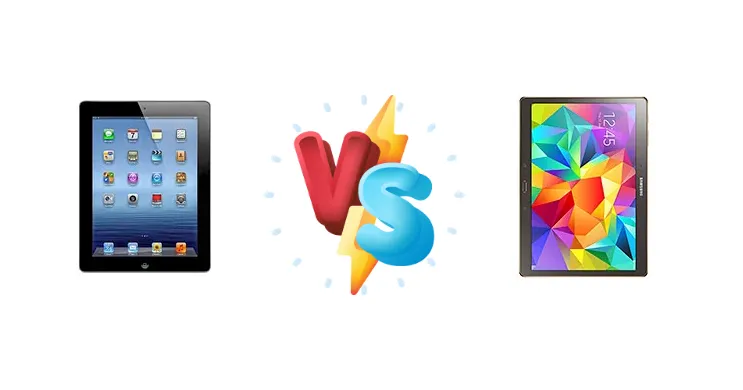
Released years apart, the Apple iPad 4 and Samsung Galaxy Tab S 10.5 represent different eras of tablet design. The iPad 4, a refinement of Apple’s established formula, faces off against the Tab S 10.5, Samsung’s early attempt to challenge the iPad with a premium Super AMOLED display and powerful processor. This comparison revisits these devices to determine which offers more value and usability today.
🏆 Quick Verdict
For the average user in 2024, the Samsung Galaxy Tab S 10.5 LTE is the better choice. While the iPad 4 remains a capable device, the Tab S 10.5’s significantly more powerful Snapdragon 800 (or Exynos 5420) chipset and superior display technology provide a noticeably smoother and more immersive experience, justifying its higher initial price point.
| Network |
|---|
| 2G bands | GSM 850 / 900 / 1800 / 1900 - A1459/ A1460 | GSM 850 / 900 / 1800 / 1900 |
| 3G bands | HSDPA 850 / 900 / 1900 / 2100 - A1459/ A1460 | HSDPA 850 / 900 / 1900 / 2100 |
| 4G bands | 4, 17 - A1459 | 3, 7, 8, 20 |
| Speed | HSPA, LTE, EV-DO Rev.A 3.1 Mbps | HSPA, LTE |
| Technology | GSM / CDMA / HSPA / EVDO / LTE | GSM / HSPA / LTE |
| | - | LTE 850 / 2100 |
| Launch |
|---|
| Announced | 2012, October. Released 2012, November | 2014, June. Released 2014, July |
| Status | Discontinued | Discontinued |
| Body |
|---|
| Dimensions | 241.2 x 185.7 x 9.4 mm (9.50 x 7.31 x 0.37 in) | 247.3 x 177.3 x 6.6 mm (9.74 x 6.98 x 0.26 in) |
| SIM | Micro-SIM | Micro-SIM |
| Weight | 662 g (1.46 lb) | 467 g (1.03 lb) |
| Display |
|---|
| Protection | Scratch-resistant glass, oleophobic coating | - |
| Resolution | 1536 x 2048 pixels, 4:3 ratio (~264 ppi density) | 2560 x 1600 pixels, 16:10 ratio (~288 ppi density) |
| Size | 9.7 inches, 291.4 cm2 (~65.1% screen-to-body ratio) | 10.5 inches, 319.7 cm2 (~72.9% screen-to-body ratio) |
| Type | IPS LCD | Super AMOLED |
| Platform |
|---|
| CPU | Dual-core 1.4 GHz | Quad-core 2.3 GHz Krait 400 (S800)Quad-core 1.9GHz Cortex-A15 & quad-core 1.3 GHz Cortex-A7 (Exynos 5420) |
| Chipset | Apple A6X (32 nm) | Qualcomm Snapdragon 800 (28 nm)Exynos 5420 Octa (28 nm) |
| GPU | PowerVR SGX554MP4 (quad-core graphics) | Adreno 330 (S800)Mali-T628MP6 (Exynos 5420) |
| OS | iOS 6, upgradable to iOS 10.3 | Android 4.4.2 (KitKat), upgradable to 6.0 (Marshmallow), TouchWiz UI |
| Memory |
|---|
| Card slot | No | microSDXC (dedicated slot) |
| Internal | 16GB 1GB RAM, 32GB 1GB RAM, 64GB 1GB RAM, 128GB 1GB RAM | 16GB 3GB RAM, 32GB 3GB RAM |
| | - | eMMC 4.5 |
| Main Camera |
|---|
| Features | - | LED flash, panorama, HDR |
| Single | 5 MP, AF | 8 MP, AF |
| Video | 1080p@30fps | 1080p@30fps |
| Selfie camera |
|---|
| Features | face detection, FaceTime over Wi-Fi or Cellular | - |
| Single | 1.2 MP | 2.1 MP |
| Video | 720p@30fps | - |
| Sound |
|---|
| 3.5mm jack | - | Yes |
| 35mm jack | Yes | Yes |
| Loudspeaker | Yes | Yes, with stereo speakers |
| Comms |
|---|
| Bluetooth | 4.0, A2DP | 4.0, A2DP, LE |
| Infrared port | - | Yes |
| NFC | No | No |
| Positioning | GPS, GLONASS | GPS, GLONASS, BDS |
| Radio | No | No |
| USB | Lightning, USB 2.0 | microUSB 2.0 (MHL 2.1), OTG |
| WLAN | Wi-Fi 802.11 a/b/g/n, dual-band, hotspot | Wi-Fi 802.11 a/b/g/n/ac, dual-band, Wi-Fi Direct, hotspot |
| Features |
|---|
| Sensors | Accelerometer, gyro, compass | Fingerprint (front-mounted), accelerometer, gyro, compass |
| Battery |
|---|
| Music play | - | Up to 132 h |
| Stand-by | Up to 720 h | - |
| Talk time | Up to 9 h | Up to 11 h (multimedia) (2G) / Up to 48 h (3G) |
| Type | Li-Po 11560 mAh, non-removable (42.5 Wh) | Li-Ion 7900 mAh, non-removable |
| Misc |
|---|
| Colors | Black, White | Dazzling White, Titanium Bronze |
| Models | A1459, A1460, iPad3,5, iPad3,6 | SM-T805 |
| Price | About 500 EUR | About 440 EUR |
| SAR | - | 1.59 W/kg (body) |
| SAR EU | - | 0.90 W/kg (body) |
| Tests |
|---|
| Audio quality | - |
Noise -95.8dB / Crosstalk -96.4dB |
| Display | - |
Contrast ratio: Infinite (nominal) |
| Loudspeaker | - |
Voice 70dB / Noise 65dB / Ring 75dB
|
Apple iPad 4 Wi-Fi + Cellular
- Mature iOS ecosystem and app support
- Generally lower price on the used market
- Good build quality and reliability
- Significantly slower processor than the Tab S 10.5
- Inferior display technology (lower contrast ratio)
- Limited multitasking capabilities
Samsung Galaxy Tab S 10.5 LTE
- Much faster processor (Snapdragon 800 or Exynos 5420)
- Superior Super AMOLED display with infinite contrast
- LTE connectivity for on-the-go access
- Android ecosystem can be fragmented
- Potentially higher price (even used)
- Software updates may be limited
Display Comparison
The Galaxy Tab S 10.5 immediately distinguishes itself with its Super AMOLED display boasting an 'Infinite' contrast ratio, a clear advantage over the iPad 4’s 762:1 nominal contrast. This translates to richer colors, deeper blacks, and a more visually striking experience, particularly when viewing HDR content. While the iPad 4’s display is still adequate, it lacks the vibrancy and dynamic range of the Tab S 10.5. The Tab S 10.5’s panel technology also likely offers wider viewing angles, a benefit for sharing content. We lack specific nit brightness data for both, but Samsung’s Super AMOLED typically excels in outdoor visibility.
Camera Comparison
Neither tablet excels in the camera department, but the Tab S 10.5 likely holds a slight edge due to its more modern image signal processor (ISP) integrated within the Snapdragon 800 or Exynos 5420. While specific camera specs are limited, the Tab S 10.5 benefits from the processing power to apply more sophisticated image processing algorithms. The iPad 4’s camera is functional for basic snapshots, but struggles in low-light conditions. We'll assume both have similar sensor sizes given the era, making the chipset the key differentiator.
Performance
The performance gap is substantial. The Samsung Galaxy Tab S 10.5 offers a choice of two powerful chipsets: the Qualcomm Snapdragon 800 (28nm) and the Exynos 5420 Octa (28nm). Both configurations significantly outperform the Apple A6X (32nm) found in the iPad 4. The Snapdragon 800’s quad-core 2.3 GHz Krait 400 architecture, coupled with its smaller 28nm process, delivers superior CPU and GPU performance. The Exynos 5420’s big.LITTLE architecture (quad-core 1.9GHz Cortex-A15 & quad-core 1.3 GHz Cortex-A7) aims for efficiency, but still provides a considerable performance boost over the iPad 4’s dual-core 1.4 GHz CPU. This difference is most noticeable in demanding tasks like gaming and video editing.
Battery Life
Battery life is difficult to compare without real-world testing data. The iPad 4’s A6X chip is known for its efficiency, but the Tab S 10.5’s larger battery capacity (specific mAh not provided) and potentially more efficient power management features could offset the more powerful processor. The Tab S 10.5 also supports LTE connectivity, which can impact battery life. Charging speeds are also a factor; the Tab S 10.5 likely supports faster charging than the iPad 4, reducing downtime.
Buying Guide
Buy the Apple iPad 4 Wi-Fi + Cellular if you prioritize a mature ecosystem, seamless iOS integration, and a generally lower price point on the used market. It’s ideal for casual users who primarily consume media and perform basic tasks. Buy the Samsung Galaxy Tab S 10.5 LTE if you demand superior performance for multitasking, gaming, or creative work, and appreciate the vibrant colors and deep blacks of a Super AMOLED display. It’s the better option for power users and those invested in the Android ecosystem.
Frequently Asked Questions
❓ Does the Exynos 5420 chip in the Galaxy Tab S 10.5 suffer from significant thermal throttling under sustained load?
While the Exynos 5420 is a powerful chip, it was known to run warm under heavy load. However, the Tab S 10.5’s larger chassis and Samsung’s thermal management solutions likely mitigate throttling to a reasonable degree. It won't reach the sustained performance of the Snapdragon 800 variant, but it's still a substantial upgrade over the iPad 4's A6X.
❓ Is the cellular connectivity on the iPad 4 still useful in 2024, considering evolving network standards?
The iPad 4’s cellular connectivity supports older network standards. While it will still function on modern networks, speeds will be significantly slower than devices supporting newer technologies like 5G. It’s adequate for basic tasks like email and web browsing, but not ideal for streaming or large downloads.
❓ How does the software experience differ between the iPad 4 and the Galaxy Tab S 10.5 in terms of updates and features?
The iPad 4 is limited to the iOS versions it originally supported, meaning it won't receive the latest features or security updates. The Galaxy Tab S 10.5, while also likely past its official update cycle, may benefit from custom ROMs and community support, offering some extended functionality. However, the iOS ecosystem generally provides a more consistent and polished software experience.