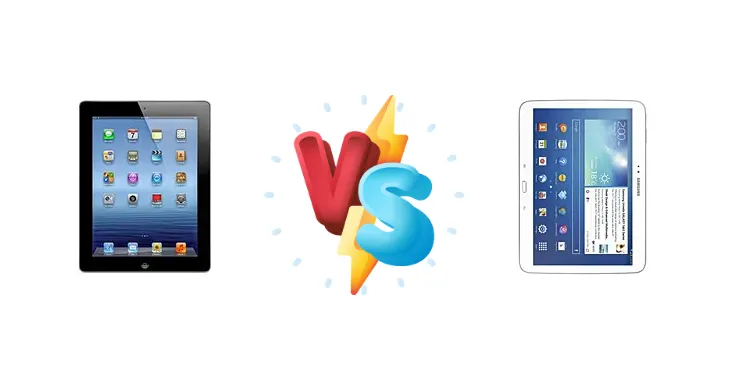
The Apple iPad 4 and Samsung Galaxy Tab 3 10.1 represent a fascinating snapshot of the tablet market circa 2012-2013. While long superseded by newer models, these devices remain relevant for users seeking affordable, functional tablets. This comparison dissects their core components to determine which offers the better experience in 2024, considering their age and original market positioning.
🏆 Quick Verdict
For the average user in 2024, the Apple iPad 4 edges out the Samsung Galaxy Tab 3 10.1. While the Tab 3 boasts a slightly higher contrast ratio, the iPad 4’s A6X chip provides a more responsive and generally smoother user experience, benefiting from Apple’s continued software support, even for older devices.
| Network |
|---|
| 2G bands | GSM 850 / 900 / 1800 / 1900 - A1459/ A1460 | N/A |
| 3G bands | HSDPA 850 / 900 / 1900 / 2100 - A1459/ A1460 | - |
| 4G bands | 4, 17 - A1459 | - |
| EDGE | - | No |
| GPRS | - | No |
| Speed | HSPA, LTE, EV-DO Rev.A 3.1 Mbps | - |
| Technology | GSM / CDMA / HSPA / EVDO / LTE | No cellular connectivity |
| Launch |
|---|
| Announced | 2012, October. Released 2012, November | 2013, June. Released 2013, July |
| Status | Discontinued | Discontinued |
| Body |
|---|
| Dimensions | 241.2 x 185.7 x 9.4 mm (9.50 x 7.31 x 0.37 in) | 243.1 x 176.1 x 8 mm (9.57 x 6.93 x 0.31 in) |
| SIM | Micro-SIM | No |
| Weight | 662 g (1.46 lb) | 510 g (1.12 lb) |
| Display |
|---|
| Protection | Scratch-resistant glass, oleophobic coating | Corning Gorilla Glass |
| Resolution | 1536 x 2048 pixels, 4:3 ratio (~264 ppi density) | 1280 x 800 pixels, 16:10 ratio (~149 ppi density) |
| Size | 9.7 inches, 291.4 cm2 (~65.1% screen-to-body ratio) | 10.1 inches, 295.8 cm2 (~69.1% screen-to-body ratio) |
| Type | IPS LCD | TFT |
| Platform |
|---|
| CPU | Dual-core 1.4 GHz | Dual-core 1.6 GHz |
| Chipset | Apple A6X (32 nm) | Intel Atom Z2560 |
| GPU | PowerVR SGX554MP4 (quad-core graphics) | PowerVR SGX544MP2 |
| OS | iOS 6, upgradable to iOS 10.3 | Android 4.2.2 (Jelly Bean), TouchWiz UI |
| Memory |
|---|
| Card slot | No | microSDXC (dedicated slot) |
| Internal | 16GB 1GB RAM, 32GB 1GB RAM, 64GB 1GB RAM, 128GB 1GB RAM | 16GB 1GB RAM, 32GB 1GB RAM |
| Main Camera |
|---|
| Single | 5 MP, AF | 3.15 MP |
| Video | 1080p@30fps | 720p |
| Selfie camera |
|---|
| Features | face detection, FaceTime over Wi-Fi or Cellular | - |
| Single | 1.2 MP | 1.3 MP |
| Video | 720p@30fps | - |
| Sound |
|---|
| 3.5mm jack | - | Yes |
| 35mm jack | Yes | Yes |
| Loudspeaker | Yes | Yes, with stereo speakers |
| Comms |
|---|
| Bluetooth | 4.0, A2DP | 4.0, A2DP |
| NFC | No | No |
| Positioning | GPS, GLONASS | GPS, GLONASS |
| Radio | No | No |
| USB | Lightning, USB 2.0 | microUSB 2.0, OTG |
| WLAN | Wi-Fi 802.11 a/b/g/n, dual-band, hotspot | Wi-Fi 802.11 a/b/g/n, dual-band, Wi-Fi Direct, hotspot |
| Features |
|---|
| Sensors | Accelerometer, gyro, compass | Accelerometer, compass |
| | - | TV-out |
| Battery |
|---|
| Stand-by | Up to 720 h | - |
| Talk time | Up to 9 h | - |
| Type | Li-Po 11560 mAh, non-removable (42.5 Wh) | Li-Po 6800 mAh, non-removable |
| Misc |
|---|
| Colors | Black, White | Black, White |
| Models | A1459, A1460, iPad3,5, iPad3,6 | GT-P5210 |
| Price | About 500 EUR | About 260 EUR |
| SAR | - | 0.83 W/kg (body) |
| Tests |
|---|
| Audio quality | - |
Noise -91.5dB / Crosstalk -90.5dB |
| Display | - |
Contrast ratio: 917 (nominal) |
| Loudspeaker | - |
Voice 71dB / Noise 73dB / Ring 75dB |
Apple iPad 4 Wi-Fi + Cellular
- Superior processor performance with the Apple A6X.
- Better software support and ecosystem integration.
- Generally smoother user experience.
- Lower contrast ratio compared to the Galaxy Tab 3.
- Older device with potentially degraded battery health.
Samsung Galaxy Tab 3 10.1 P5210
- Higher contrast ratio for potentially more vibrant visuals.
- Intel Atom Z2560 offers decent power efficiency.
- Android ecosystem flexibility.
- Slower processor performance compared to the A6X.
- Potentially limited software updates and app compatibility.
Display Comparison
Both tablets feature 10.1-inch displays, but diverge in contrast ratios. The Samsung Galaxy Tab 3 10.1 achieves a nominal contrast ratio of 917:1, exceeding the iPad 4’s 762:1. This suggests deeper blacks and potentially more vibrant colors on the Tab 3, though subjective viewing conditions heavily influence perceived quality. Neither device boasts advanced display technologies like LTPO or high refresh rates, common in modern tablets. Bezels are substantial on both, reflective of the design trends of their era.
Camera Comparison
Camera performance is largely irrelevant on these devices, given their age and intended use cases. Both tablets feature basic cameras suitable for casual snapshots. Detailed specifications are unavailable, but it’s safe to assume image quality is significantly inferior to modern smartphone cameras. Focusing on camera capabilities would be a misdirection; these tablets were not designed for photography.
Performance
The core performance difference lies in the chipsets. The iPad 4 utilizes Apple’s A6X, a 32nm dual-core 1.4 GHz processor. The Galaxy Tab 3 10.1 employs the Intel Atom Z2560, a dual-core 1.6 GHz chip. While the Intel chip has a higher clock speed, the A6X benefits from Apple’s tight hardware-software integration and superior single-core performance. This translates to snappier app launches and smoother multitasking on the iPad 4. The A6X’s architecture is more efficient, potentially leading to better sustained performance under load. RAM specifications are not provided, but both likely feature 2GB, typical for the time.
Battery Life
Battery capacity figures are not provided. However, real-world battery life will depend heavily on usage patterns and battery health, given the age of these devices. The Intel Atom Z2560 is generally known for its power efficiency, potentially giving the Tab 3 an edge in longevity under light workloads. Charging speeds were slow by today’s standards for both tablets, likely taking several hours to fully charge from 0-100%.
Buying Guide
Buy the Apple iPad 4 Wi-Fi + Cellular if you prioritize a more fluid user experience, benefit from Apple’s ecosystem, and value long-term software support, even for older hardware. Buy the Samsung Galaxy Tab 3 10.1 P5210 if you prefer a slightly higher contrast display and are heavily invested in the Android ecosystem, or if you find a significantly lower price point.
Frequently Asked Questions
❓ Will the iPad 4 still receive software updates in 2024?
While Apple no longer provides major iOS updates for the iPad 4, it still receives security updates, offering a degree of protection against vulnerabilities. This is a significant advantage over the Galaxy Tab 3, which likely has ceased receiving updates from Samsung.
❓ Is the Intel Atom Z2560 in the Galaxy Tab 3 10.1 powerful enough for modern apps?
The Intel Atom Z2560 struggles with many modern, resource-intensive apps. While basic tasks like web browsing and video playback are manageable, expect significant slowdowns and potential crashes with demanding applications. The A6X in the iPad 4 generally handles these tasks more gracefully.
❓ Can I reliably use either of these tablets for video conferencing?
Video conferencing is possible on both, but the experience will be limited by the age of the cameras and processors. Expect lower video quality and potential performance issues, especially with multiple participants or background noise cancellation features.