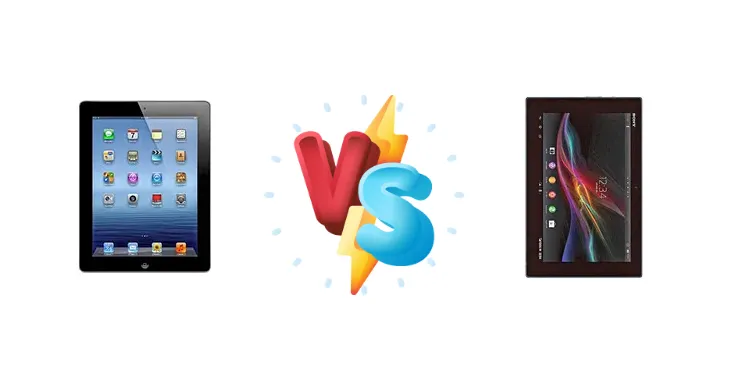
Released in 2012 and 2013 respectively, the Apple iPad 3 and Sony Xperia Tablet Z represent pivotal moments in tablet evolution. The iPad 3 refined Apple’s tablet formula, while the Xperia Tablet Z aimed to deliver a premium Android experience with a focus on portability and power. This comparison revisits these devices, analyzing their strengths and weaknesses in a modern context.
🏆 Quick Verdict
For the average user seeking a tablet with a mature ecosystem and continued software support (albeit limited), the iPad 3 remains a viable, if aging, option. However, the Sony Xperia Tablet Z LTE’s quad-core Snapdragon S4 Pro chipset provides a noticeable performance advantage, making it the better choice for users prioritizing processing power.
| Network |
|---|
| 2G bands | GSM 850 / 900 / 1800 / 1900 | GSM 850 / 900 / 1800 / 1900 |
| 3G bands | HSDPA 850 / 900 / 1900 / 2100 | HSDPA 850 / 900 / 2100 - SGP321 |
| 4G bands | 4, 17 - AT&T | 1, 3, 5, 7, 8, 20 - SGP321 |
| Speed | HSPA, LTE, EV-DO Rev.A 3.1 Mbps | HSPA 42.2/5.76 Mbps, LTE Cat3 100/50 Mbps |
| Technology | GSM / CDMA / HSPA / EVDO / LTE | GSM / HSPA / LTE |
| | - | 4 - SGP351 |
| Launch |
|---|
| Announced | 2012, March. Released 2012, March 16 | 2013, February. Released 2013, May |
| Status | Discontinued | Discontinued |
| Body |
|---|
| Dimensions | 241.2 x 185.7 x 9.4 mm (9.50 x 7.31 x 0.37 in) | 266 x 172 x 6.9 mm (10.47 x 6.77 x 0.27 in) |
| SIM | Micro-SIM | Micro-SIM |
| Weight | 662 g (1.46 lb) | 495 g (1.09 lb) |
| | - | IP57 dust proof and water resistant |
| Display |
|---|
| Protection | Scratch-resistant glass, oleophobic coating | Shatter proof glass |
| Resolution | 1536 x 2048 pixels, 4:3 ratio (~264 ppi density) | 1200 x 1920 pixels, 16:10 ratio (~224 ppi density) |
| Size | 9.7 inches, 291.4 cm2 (~65.1% screen-to-body ratio) | 10.1 inches, 295.8 cm2 (~64.7% screen-to-body ratio) |
| Type | IPS LCD | LED-backlit LCD, |
| Platform |
|---|
| CPU | Dual-core 1.0 GHz Cortex-A9 | Quad-core 1.5 GHz Krait |
| Chipset | Apple A5X (45 nm) | Qualcomm APQ8064 Snapdragon S4 Pro |
| GPU | PowerVR SGX543MP4 (quad-core graphics) | Adreno 320 |
| OS | iOS 5.1, upgradable to iOS 9.3.5 | Android 4.1.2 (Jelly Bean), upgradable to 5.1.1 (Lollipop) |
| Memory |
|---|
| Card slot | No | microSDXC (dedicated slot); microSDHC (SGP351) |
| Internal | 16GB 1GB RAM, 32GB 1GB RAM, 64GB 1GB RAM | 16GB 2GB RAM |
| Main Camera |
|---|
| Features | - | HDR, panorama |
| Single | 5 MP, AF | 8.1 MP, AF |
| Video | 1080p@30fps | 1080p@30fps, HDR |
| Selfie camera |
|---|
| Single | VGA, videocalling over Wi-Fi only | 2.2 MP |
| Video | 480p@30fps | 1080p@30fps |
| Sound |
|---|
| 3.5mm jack | - | Yes |
| 35mm jack | Yes | Yes |
| Loudspeaker | Yes | Yes, with stereo speakers |
| | - | 3D surround sound |
| Comms |
|---|
| Bluetooth | 4.0, A2DP | 4.0, A2DP |
| Infrared port | - | Yes |
| NFC | - | Yes |
| Positioning | GPS, A-GPS | GPS, GLONASS |
| Radio | No | Stereo FM radio, RDS |
| USB | 2.0 | microUSB 2.0 (MHL TV-out) |
| WLAN | Wi-Fi 802.11 a/b/g/n, dual-band, hotspot | Wi-Fi 802.11 a/b/g/n, dual-band, Wi-Fi Direct, DLNA, hotspot |
| Features |
|---|
| Sensors | Accelerometer, gyro, compass | Accelerometer, gyro, compass |
| Battery |
|---|
| Music play | - | Up to 110 h |
| Stand-by | Up to 720 h | Up to 1230 h (2G) / Up to 1270 h (3G) |
| Talk time | Up to 9 h | Up to 10 h (multimedia) |
| Type | Non-removable Li-Po 11560 mAh battery (42.5 Wh) | Li-Po 6000 mAh, non-removable |
| Misc |
|---|
| Colors | Black, White | Black, White |
| Models | A1430, A1403, iPad3,2, iPad3,3 | SGP321, SO-03E, SGP351 |
| Price | About 400 EUR | About 350 EUR |
| SAR EU | - | 1.69 W/kg (body) |
| Tests |
|---|
| Audio quality | - |
Noise -87.0dB / Crosstalk -87.8dB |
| Camera | - |
Photo / Video |
| Display | - |
Contrast ratio: 996:1 (nominal) |
| Loudspeaker | - |
Voice 66dB / Noise 64dB / Ring 70dB
|
Apple iPad 3 Wi-Fi + Cellular
- Mature iOS ecosystem and app availability
- Higher display resolution for sharper visuals
- Strong resale value (despite age)
- Older, less powerful processor
- Limited software updates
- Thicker and heavier design compared to the Xperia Z
Sony Xperia Tablet Z LTE
- Faster quad-core Snapdragon S4 Pro processor
- LTE connectivity for on-the-go access
- Thinner and lighter design
- Android ecosystem fragmentation and update issues
- Lower display resolution
- Potentially less reliable long-term software support
Display Comparison
Both tablets share a contrast ratio of 996:1, indicating similar levels of black depth and color vibrancy. However, the iPad 3’s display resolution (2048 x 1536) is significantly higher than the Xperia Tablet Z’s (1920 x 1080) on its 10.1-inch screen, resulting in a sharper image. While neither device boasts modern display technologies like OLED or high refresh rates, the iPad 3’s higher pixel density provides a more detailed visual experience. The Xperia Tablet Z’s design prioritized thinness, potentially impacting viewing angles compared to the iPad 3’s slightly thicker form factor.
Camera Comparison
Both the iPad 3 and Xperia Tablet Z feature basic photo and video capabilities, but neither device excels in this area. Given the limited information, a detailed comparison is difficult. However, the era of these devices saw tablet cameras primarily used for quick snapshots and video calls, rather than serious photography. The image processing algorithms of both devices would likely exhibit similar limitations in low-light conditions and dynamic range. The absence of specific sensor details makes it impossible to determine a clear winner.
Performance
The Sony Xperia Tablet Z LTE’s Qualcomm APQ8064 Snapdragon S4 Pro, featuring a quad-core 1.5 GHz Krait processor, demonstrably outperforms the Apple iPad 3’s dual-core 1.0 GHz Cortex-A9 CPU and Apple A5X chipset. The Krait architecture, built on a 28nm process, offers superior per-clock performance and efficiency compared to the A5X’s 45nm fabrication. This translates to faster app loading times, smoother multitasking, and improved performance in graphically intensive applications on the Xperia Tablet Z. While the A5X includes a quad-core GPU, the Snapdragon S4 Pro’s Adreno 320 GPU provides a more modern and capable graphics solution.
Battery Life
Battery life is difficult to assess without detailed testing data. The iPad 3’s battery capacity was approximately 42.5 Wh, while the Xperia Tablet Z’s was 6000 mAh (approximately 22.2 Wh). Despite the lower capacity, the Xperia Tablet Z’s more efficient Snapdragon S4 Pro chipset could potentially deliver comparable or even superior battery life under certain workloads. The Xperia Tablet Z also supports fast charging, a feature absent on the iPad 3, allowing for quicker top-ups when needed.
Buying Guide
Buy the Apple iPad 3 Wi-Fi + Cellular if you prioritize a well-established app ecosystem, seamless integration with other Apple devices, and a generally polished user experience, even with its older hardware. Buy the Sony Xperia Tablet Z LTE if you prefer the Android operating system, require LTE connectivity for on-the-go use, and value the superior processing capabilities of the Qualcomm Snapdragon S4 Pro chipset for demanding tasks.
Frequently Asked Questions
❓ Is the Snapdragon S4 Pro in the Xperia Tablet Z still capable of running modern Android apps?
While the Snapdragon S4 Pro was a flagship processor in its time, running the latest Android versions on the Xperia Tablet Z will likely result in performance limitations and compatibility issues. Older apps will function adequately, but demanding games and applications may experience lag or crashes.
❓ Does the iPad 3 still receive software updates from Apple?
No, the iPad 3 is no longer supported by Apple and will not receive any further software updates. This means it is vulnerable to security risks and may not be compatible with the latest apps.
❓ Which tablet is better for media consumption – watching videos and browsing the web?
The iPad 3’s higher resolution display provides a slightly more detailed viewing experience. However, the Xperia Tablet Z’s faster processor ensures smoother video playback and web browsing, particularly with complex websites and streaming services.
❓ Is the LTE connectivity on the Xperia Tablet Z still functional on modern cellular networks?
LTE standards have evolved since the Xperia Tablet Z’s release. While it will likely connect to 4G networks, it may not support the fastest LTE speeds available today, and compatibility with newer 5G networks is nonexistent.