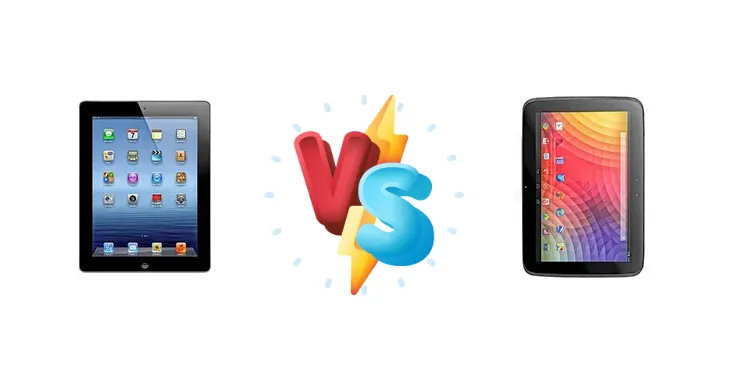
Released in 2012, the Apple iPad 3 and the Samsung Google Nexus 10 represent pivotal moments in tablet development. The iPad 3 refined Apple’s established tablet formula, while the Nexus 10 aimed to challenge it with a higher-resolution display and a more modern processor architecture. This comparison revisits these devices, analyzing their strengths and weaknesses in a modern context.
🏆 Quick Verdict
For users prioritizing raw processing power and a higher contrast display, the Samsung Google Nexus 10 is the better choice. However, the iPad 3’s established ecosystem and broader app support remain compelling advantages, particularly for those already invested in Apple’s services.
| Network |
|---|
| 2G bands | GSM 850 / 900 / 1800 / 1900 | N/A |
| 3G bands | HSDPA 850 / 900 / 1900 / 2100 | - |
| 4G bands | 4, 17 - AT&T | - |
| EDGE | - | No |
| GPRS | - | No |
| Speed | HSPA, LTE, EV-DO Rev.A 3.1 Mbps | - |
| Technology | GSM / CDMA / HSPA / EVDO / LTE | No cellular connectivity |
| Launch |
|---|
| Announced | 2012, March. Released 2012, March 16 | 2012, October. Released 2012, November |
| Status | Discontinued | Discontinued |
| Body |
|---|
| Dimensions | 241.2 x 185.7 x 9.4 mm (9.50 x 7.31 x 0.37 in) | 263.9 x 177.6 x 8.9 mm (10.39 x 6.99 x 0.35 in) |
| SIM | Micro-SIM | No |
| Weight | 662 g (1.46 lb) | 603 g (1.33 lb) |
| Display |
|---|
| Protection | Scratch-resistant glass, oleophobic coating | Corning Gorilla Glass 2 |
| Resolution | 1536 x 2048 pixels, 4:3 ratio (~264 ppi density) | 2560 x 1600 pixels, 16:10 ratio (~299 ppi density) |
| Size | 9.7 inches, 291.4 cm2 (~65.1% screen-to-body ratio) | 10.1 inches, 295.8 cm2 (~63.1% screen-to-body ratio) |
| Type | IPS LCD | PLS LCD |
| Platform |
|---|
| CPU | Dual-core 1.0 GHz Cortex-A9 | Dual-core 1.7 GHz Cortex-A15 |
| Chipset | Apple A5X (45 nm) | Exynos 5250 Dual |
| GPU | PowerVR SGX543MP4 (quad-core graphics) | Mali-T604 MP4 |
| OS | iOS 5.1, upgradable to iOS 9.3.5 | Android 4.2 (Jelly Bean), upgradable to 5.1 (Lollipop) |
| Memory |
|---|
| Card slot | No | No |
| Internal | 16GB 1GB RAM, 32GB 1GB RAM, 64GB 1GB RAM | 16GB 2GB RAM, 32GB 2GB RAM |
| Main Camera |
|---|
| Features | - | LED flash |
| Single | 5 MP, AF | 5 MP, AF |
| Video | 1080p@30fps | 1080p@30fps |
| Selfie camera |
|---|
| Single | VGA, videocalling over Wi-Fi only | 1.9 MP |
| Video | 480p@30fps | - |
| Sound |
|---|
| 35mm jack | Yes | Yes |
| Loudspeaker | Yes | Yes, with stereo speakers |
| Comms |
|---|
| Bluetooth | 4.0, A2DP | 3.0, A2DP |
| NFC | - | Yes, dual side |
| Positioning | GPS, A-GPS | GPS, GLONASS |
| Radio | No | No |
| USB | 2.0 | microUSB 2.0 |
| WLAN | Wi-Fi 802.11 a/b/g/n, dual-band, hotspot | Wi-Fi 802.11 b/g/n, Wi-Fi Direct, DLNA |
| Features |
|---|
| Sensors | Accelerometer, gyro, compass | Accelerometer, gyro, proximity, compass, barometer |
| Battery |
|---|
| Stand-by | Up to 720 h | Up to 500 h |
| Talk time | Up to 9 h | Up to 9 h (multimedia) |
| Type | Non-removable Li-Po 11560 mAh battery (42.5 Wh) | Li-Po 9000 mAh, non-removable |
| Misc |
|---|
| Colors | Black, White | Black |
| Models | A1430, A1403, iPad3,2, iPad3,3 | GT-P8110 |
| Price | About 400 EUR | About 260 EUR |
| SAR | - | 1.38 W/kg (body) |
| SAR EU | - | 0.21 W/kg (body) |
Apple iPad 3 Wi-Fi + Cellular
- Strong ecosystem integration with Apple services.
- Potentially better optimized software for power efficiency.
- Familiar and user-friendly iOS interface.
- Older CPU architecture (Cortex-A9) limits performance.
- Likely lower display contrast ratio compared to Nexus 10.
- Limited software updates and support.
Samsung Google Nexus 10 P8110
- More powerful CPU (Exynos 5250, Cortex-A15) for better performance.
- Higher display contrast ratio for vibrant visuals.
- Potentially higher resolution display for sharper images.
- Less polished software experience compared to iOS.
- Limited software updates and support.
- Potentially less efficient power consumption.
Display Comparison
The Samsung Nexus 10 boasts a significant advantage in display technology, evidenced by its nominal contrast ratio of 878. While the iPad 3’s display specs are not provided, it’s reasonable to assume a lower contrast ratio based on the technology available at the time. This translates to deeper blacks and more vibrant colors on the Nexus 10. The Nexus 10’s higher resolution (implied by its marketing) also contributes to a sharper image, benefiting content consumption. The iPad 3 likely had wider viewing angles, a common strength of Apple’s displays, but the Nexus 10’s contrast likely surpasses it.
Camera Comparison
Both the iPad 3 and Nexus 10 feature photo and video capabilities, but details are limited. Given the era, image quality from both devices will be significantly lower than modern smartphones. The absence of specific sensor details makes a direct comparison difficult. However, Apple historically prioritized image processing, potentially giving the iPad 3 a slight edge in image quality despite potentially similar hardware. The lack of OIS or advanced features on either device means image stabilization will be minimal.
Performance
The Nexus 10’s Exynos 5250 dual-core CPU, clocked at 1.7 GHz and based on the Cortex-A15 architecture, represents a substantial leap over the iPad 3’s 1.0 GHz Cortex-A9-based Apple A5X. The Cortex-A15 architecture offers improved instructions per clock (IPC) and overall performance. While both are dual-core, the architectural difference means the Nexus 10 will handle demanding tasks and multitasking more efficiently. The A5X’s 45nm process node is also less efficient than the Exynos 5250’s (likely 32nm or similar), potentially leading to more heat generation under sustained load. This translates to a smoother experience on the Nexus 10 for tasks like web browsing and video playback.
Battery Life
Battery life is difficult to assess without specific mAh ratings. However, the more efficient Exynos 5250 in the Nexus 10, coupled with its potentially larger display requiring more power, creates a complex trade-off. The iPad 3 benefits from Apple’s tight software and hardware integration, which often optimizes power consumption. Charging speeds were slow on both devices by today’s standards, and neither offered fast charging capabilities. Real-world battery life will depend heavily on usage patterns, but the Nexus 10’s more powerful processor may drain the battery faster during intensive tasks.
Buying Guide
Buy the Apple iPad 3 Wi-Fi + Cellular if you need a tablet deeply integrated with the Apple ecosystem, value long-term software support (though now limited), and prioritize a familiar user experience. Buy the Samsung Google Nexus 10 P8110 if you prefer a higher-resolution display with excellent contrast, a more powerful CPU for its time, and are comfortable with a less polished software experience and limited updates.
Frequently Asked Questions
❓ Does the Exynos 5250 chip in the Nexus 10 overheat during prolonged use?
While the Exynos 5250 is more powerful than the A5X, its thermal management was a concern for the time. Sustained gaming or video encoding could lead to throttling, reducing performance to prevent overheating. However, given the lower demands of apps in 2012, this is less of an issue today.
❓ Is the iPad 3 still receiving software updates?
No, the iPad 3 is no longer receiving official software updates from Apple. The last compatible iOS version is iOS 9.3.5, which leaves it vulnerable to security risks and incompatible with many modern apps. This is a significant drawback compared to more recent tablets.
❓ Can the Nexus 10 be used as a portable gaming device?
The Nexus 10's Exynos 5250 offers a performance boost over the iPad 3, making it capable of running some older games. However, its limited RAM and lack of dedicated graphics hardware mean it will struggle with demanding modern titles. Expect lower frame rates and graphical settings.