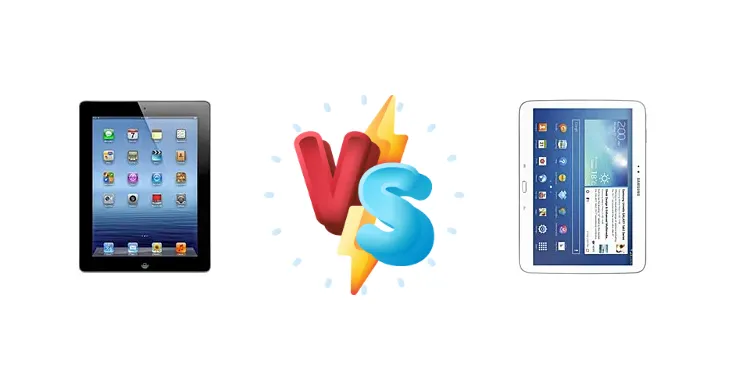
The Apple iPad 3 and Samsung Galaxy Tab 3 10.1 represent pivotal moments in the early tablet landscape. Released within a similar timeframe, these devices battled for dominance, showcasing different approaches to mobile computing. Today, we revisit these tablets to assess their strengths and weaknesses, considering their original context and how they fare in a modern light.
🏆 Quick Verdict
For the average user seeking a functional, albeit dated, tablet experience, the Samsung Galaxy Tab 3 10.1 offers a slight edge. Its 1.6 GHz dual-core Intel Atom Z2560 processor provides a noticeable performance uplift over the iPad 3’s 1.0 GHz Apple A5X, making it more responsive for basic tasks. However, the iPad 3’s ecosystem and build quality remain compelling.
| Network |
|---|
| 2G bands | GSM 850 / 900 / 1800 / 1900 | N/A |
| 3G bands | HSDPA 850 / 900 / 1900 / 2100 | - |
| 4G bands | 4, 17 - AT&T | - |
| EDGE | - | No |
| GPRS | - | No |
| Speed | HSPA, LTE, EV-DO Rev.A 3.1 Mbps | - |
| Technology | GSM / CDMA / HSPA / EVDO / LTE | No cellular connectivity |
| Launch |
|---|
| Announced | 2012, March. Released 2012, March 16 | 2013, June. Released 2013, July |
| Status | Discontinued | Discontinued |
| Body |
|---|
| Dimensions | 241.2 x 185.7 x 9.4 mm (9.50 x 7.31 x 0.37 in) | 243.1 x 176.1 x 8 mm (9.57 x 6.93 x 0.31 in) |
| SIM | Micro-SIM | No |
| Weight | 662 g (1.46 lb) | 510 g (1.12 lb) |
| Display |
|---|
| Protection | Scratch-resistant glass, oleophobic coating | Corning Gorilla Glass |
| Resolution | 1536 x 2048 pixels, 4:3 ratio (~264 ppi density) | 1280 x 800 pixels, 16:10 ratio (~149 ppi density) |
| Size | 9.7 inches, 291.4 cm2 (~65.1% screen-to-body ratio) | 10.1 inches, 295.8 cm2 (~69.1% screen-to-body ratio) |
| Type | IPS LCD | TFT |
| Platform |
|---|
| CPU | Dual-core 1.0 GHz Cortex-A9 | Dual-core 1.6 GHz |
| Chipset | Apple A5X (45 nm) | Intel Atom Z2560 |
| GPU | PowerVR SGX543MP4 (quad-core graphics) | PowerVR SGX544MP2 |
| OS | iOS 5.1, upgradable to iOS 9.3.5 | Android 4.2.2 (Jelly Bean), TouchWiz UI |
| Memory |
|---|
| Card slot | No | microSDXC (dedicated slot) |
| Internal | 16GB 1GB RAM, 32GB 1GB RAM, 64GB 1GB RAM | 16GB 1GB RAM, 32GB 1GB RAM |
| Main Camera |
|---|
| Single | 5 MP, AF | 3.15 MP |
| Video | 1080p@30fps | 720p |
| Selfie camera |
|---|
| Single | VGA, videocalling over Wi-Fi only | 1.3 MP |
| Video | 480p@30fps | - |
| Sound |
|---|
| 3.5mm jack | - | Yes |
| 35mm jack | Yes | Yes |
| Loudspeaker | Yes | Yes, with stereo speakers |
| Comms |
|---|
| Bluetooth | 4.0, A2DP | 4.0, A2DP |
| NFC | - | No |
| Positioning | GPS, A-GPS | GPS, GLONASS |
| Radio | No | No |
| USB | 2.0 | microUSB 2.0, OTG |
| WLAN | Wi-Fi 802.11 a/b/g/n, dual-band, hotspot | Wi-Fi 802.11 a/b/g/n, dual-band, Wi-Fi Direct, hotspot |
| Features |
|---|
| Sensors | Accelerometer, gyro, compass | Accelerometer, compass |
| | - | TV-out |
| Battery |
|---|
| Stand-by | Up to 720 h | - |
| Talk time | Up to 9 h | - |
| Type | Non-removable Li-Po 11560 mAh battery (42.5 Wh) | Li-Po 6800 mAh, non-removable |
| Misc |
|---|
| Colors | Black, White | Black, White |
| Models | A1430, A1403, iPad3,2, iPad3,3 | GT-P5210 |
| Price | About 400 EUR | About 260 EUR |
| SAR | - | 0.83 W/kg (body) |
| Tests |
|---|
| Audio quality | - |
Noise -91.5dB / Crosstalk -90.5dB |
| Display | - |
Contrast ratio: 917 (nominal) |
| Loudspeaker | - |
Voice 71dB / Noise 73dB / Ring 75dB |
Apple iPad 3 Wi-Fi + Cellular
- Mature iOS ecosystem with a wider range of optimized apps.
- Potentially longer software support (though increasingly limited).
- Apple’s build quality and design aesthetic.
- Slower processor compared to the Galaxy Tab 3 10.1.
- Limited camera capabilities.
- Lack of detailed specifications for display quality.
Samsung Galaxy Tab 3 10.1 P5210
- Faster 1.6 GHz Intel Atom Z2560 processor for improved responsiveness.
- Reported contrast ratio of 917 suggests better display quality.
- More affordable price point on the used market.
- Less refined software experience compared to iOS.
- Potentially shorter software support lifecycle.
- Camera quality likely similar to the iPad 3 – basic at best.
Display Comparison
The Samsung Galaxy Tab 3 10.1 boasts a contrast ratio of 917 (nominal), a specification absent for the iPad 3. While both tablets likely utilized IPS LCD panels common for the era, the reported contrast ratio suggests the Samsung device offers deeper blacks and more vibrant colors. However, without knowing the iPad 3’s contrast ratio, a direct comparison is difficult. Both tablets likely featured similar resolutions for their respective screen sizes, prioritizing readability over pixel density, a common trade-off in early tablet designs. Bezels were substantial on both devices, reflecting the design language of the time.
Camera Comparison
Both tablets feature basic camera capabilities, with the iPad 3 simply listed as having 'Photo / Video' functionality. This suggests a focus on convenience rather than photographic excellence. The Galaxy Tab 3 10.1’s camera specifications are also limited, making a detailed comparison challenging. Given the era, image quality on both devices would be subpar by modern standards, suitable for casual snapshots but not serious photography. The absence of detailed camera specs highlights that these tablets weren’t marketed as camera replacements.
Performance
The core difference lies in the chipsets: Apple’s A5X (45nm) in the iPad 3 versus Intel’s Atom Z2560 in the Galaxy Tab 3 10.1. While both are dual-core processors, the Intel Atom operates at a higher clock speed of 1.6 GHz compared to the iPad 3’s 1.0 GHz. This translates to a tangible performance advantage for the Samsung tablet in tasks like web browsing and app loading. The A5X, however, benefited from Apple’s tight software integration, potentially optimizing performance within the iOS ecosystem. The A5X’s GPU was also more powerful, but the Atom’s CPU speed is the key differentiator for general responsiveness.
Battery Life
Battery life is difficult to assess without standardized testing data. The iPad 3, with its Apple-designed chipset, likely benefited from efficient power management. However, the Galaxy Tab 3 10.1’s Intel Atom processor, while faster, may have been less power-efficient. Real-world battery performance would depend heavily on usage patterns. Charging times would also have been significantly slower compared to modern tablets, reflecting the slower charging technologies available at the time.
Buying Guide
Buy the Apple iPad 3 Wi-Fi + Cellular if you prioritize a mature app ecosystem and a potentially longer lifespan due to Apple’s continued software support (though limited). Buy the Samsung Galaxy Tab 3 10.1 P5210 if you prefer a more responsive user experience for everyday tasks, given its faster processor, and are comfortable with a less refined software environment.
Frequently Asked Questions
❓ Is the Intel Atom Z2560 in the Galaxy Tab 3 10.1 prone to overheating under sustained load?
While the Intel Atom Z2560 was a step up in performance, it was known to generate more heat than some competing ARM-based processors. Prolonged gaming or demanding tasks could lead to thermal throttling, reducing performance to prevent overheating. However, for typical tablet usage like web browsing and video playback, overheating is unlikely to be a significant issue.
❓ Can the iPad 3 be updated to the latest version of iPadOS?
No, the iPad 3 is no longer supported by Apple’s latest iPadOS updates. The last compatible version is iOS 9.3.5. While it can still function with older apps, compatibility with newer applications is limited, and security updates are no longer provided, posing a potential risk.
❓ Does the Galaxy Tab 3 10.1 support expandable storage via microSD card?
Yes, the Samsung Galaxy Tab 3 10.1 P5210 features a microSD card slot, allowing users to expand the internal storage capacity. This is a significant advantage over the iPad 3, which does not offer expandable storage.