
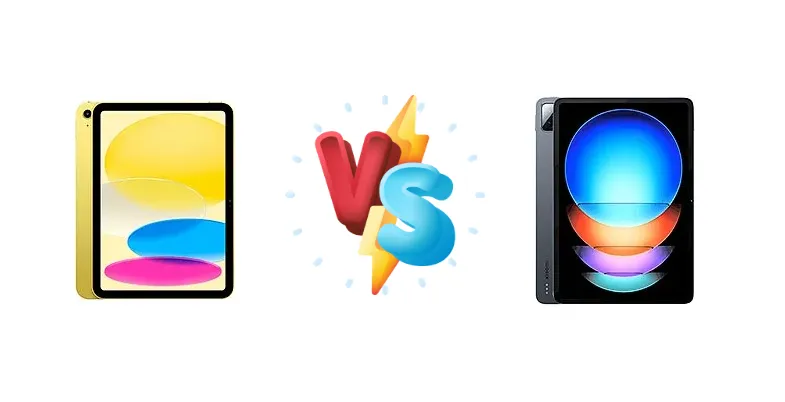
iPad (2025) vs Xiaomi Pad 6S Pro 12.4: A Deep Dive Comparison
| Phones Images | |||||
|---|---|---|---|---|---|
|
🏆 Quick Verdict
For the average user prioritizing ecosystem integration and a refined software experience, the Apple iPad (2025) remains a strong choice. However, the Xiaomi Pad 6S Pro 12.4 delivers superior battery life and significantly faster charging, making it the better option for power users and those frequently on the go.
| PHONES | ||
|---|---|---|
| Phone Names | Apple iPad (2025) | Xiaomi Pad 6S Pro 12.4 |
| Network | ||
|---|---|---|
| 2G bands | GSM 850 / 900 / 1800 / 1900 | N/A |
| 3G bands | HSDPA 850 / 900 / 1700(AWS) / 1900 / 2100 | N/A |
| 4G bands | 1, 2, 3, 4, 5, 7, 8, 11, 12, 13, 14, 17, 18, 19, 20, 21, 25, 26, 28, 29, 30, 32, 34, 38, 39, 40, 41, 42, 48, 66, 71 - A3355 | - |
| 5G bands | 1, 2, 3, 5, 7, 8, 12, 14, 20, 25, 26, 28, 29, 30, 38, 40, 41, 48, 66, 70, 71, 75, 76, 77, 78, 79 SA/NSA/Sub6 - A3355, A3356 | - |
| EDGE | - | N/A |
| GPRS | - | N/A |
| Speed | HSPA, LTE, 5G - cellular model only | - |
| Technology | GSM / HSPA / LTE / 5G | No cellular connectivity |
| Launch | ||
|---|---|---|
| Announced | 2025, March 04 | 2024, February 22 |
| Status | Available. Released 2025, March 12 | Available. Released 2024, February 22 |
| Body | ||
|---|---|---|
| Build | Glass front, aluminum back, aluminum frame | Glass front (Gorilla Glass 5), aluminum frame, aluminum back |
| Dimensions | 248.6 x 179.5 x 7 mm (9.79 x 7.07 x 0.28 in) | 278.7 x 191.6 x 6.3 mm (10.97 x 7.54 x 0.25 in) |
| SIM | eSIM (cellular model only) | No |
| Weight | 477 g (Wi-Fi) / 481 g (LTE) (1.05 lb) | 590 g (1.30 lb) |
| Display | ||
|---|---|---|
| Protection | Scratch-resistant glass, oleophobic coating, Mohs level 4 | Corning Gorilla Glass 5 |
| Resolution | 1640 x 2360 pixels (~264 ppi density) | 2032 x 3048 pixels, 3:2 ratio (~295 ppi density) |
| Size | 11.0 inches, 357.6 cm2 (~80.1% screen-to-body ratio) | 12.4 inches, 457.8 cm2 (~85.7% screen-to-body ratio) |
| Type | Liquid Retina IPS LCD, 500 nits (typ) | IPS LCD, 68B colors, 144Hz, HDR10, Dolby Vision, 900 nits (peak) |
| Platform | ||
|---|---|---|
| CPU | 5-core | Octa-core (1x3.2 GHz Cortex-X3 & 2x2.8 GHz Cortex-A715 & 2x2.8 GHz Cortex-A710 & 3x2.0 GHz Cortex-A510) |
| Chipset | Apple A16 Bionic (4 nm) | Qualcomm SM8550-AB Snapdragon 8 Gen 2 (4 nm) |
| GPU | Apple GPU (4-core graphics) | Adreno 740 |
| OS | iPadOS 18.3.2, upgradable to iPadOS 26.1 | Android 14, up to 3 major Android upgrades, HyperOS |
| Memory | ||
|---|---|---|
| Card slot | No | No |
| Internal | 128GB 6GB RAM, 256GB 6GB RAM, 512GB 6GB RAM | 256GB 8GB RAM, 256GB 12GB RAM, 512GB 12GB RAM, 1TB 16GB RAM |
| Main Camera | ||
|---|---|---|
| Dual | - | 50 MP, f/1.8, (wide), 1/2.76", 0.64µm, PDAF Auxiliary lens |
| Features | HDR, panorama | LED flash, HDR, panorama |
| Single | 12 MP, f/1.8, (wide), PDAF | - |
| Video | 4K@24/25/30/60fps, 1080p@25/30/60/120/240fps, gyro-EIS | 4K@30/60fps, 1080p@30/60fps |
| Selfie camera | ||
|---|---|---|
| Features | HDR | - |
| Single | 12 MP, f/2.4, 122˚ (ultrawide) | 32 MP, f/2.2, (wide), 1/3.6", 0.61µm |
| Video | 1080p@25/30/60fps, gyro-EIS | 1080p@30fps |
| Sound | ||
|---|---|---|
| 35mm jack | No | No |
| Loudspeaker | Yes, with stereo speakers | Yes, with stereo speakers (6 speakers) |
| Comms | ||
|---|---|---|
| Bluetooth | 5.3, A2DP, EDR, LE | 5.3, A2DP, LE, LHDC |
| NFC | No | Yes (file transfer only) |
| Positioning | GPS, GLONASS (Wi‑Fi + Cellular model only) | No |
| Radio | No | No |
| USB | USB Type-C 2.0, DisplayPort; magnetic connector | USB Type-C 3.2, accessory connector |
| WLAN | Wi-Fi 802.11 a/b/g/n/ac/6, dual-band, hotspot | Wi-Fi 802.11 a/b/g/n/a/6/7, dual-band, Wi-Fi Direct |
| Features | ||
|---|---|---|
| Sensors | Fingerprint (top-mounted), accelerometer, gyro, compass, barometer | Fingerprint (side-mounted), accelerometer, gyro, proximity (accessories only), compass |
| Battery | ||
|---|---|---|
| Charging | 45W wired, PD | 120W wired, PD3.0, QC4, 45% in 10 min, 100% in 35 min |
| Type | Li-Po (28.93 Wh) | 10000 mAh |
| Misc | ||
|---|---|---|
| Colors | Silver, Blue, Pink, Yellow | Black, Blue, Green |
| Models | A3355, A3356, A3354 | 24018RPACG |
| Price | About 400 EUR | About 700 EUR |
| SAR | 1.19 W/kg (body) | - |
| SAR EU | 1.47 W/kg (body) | 0.99 W/kg (body) |
| EU LABEL | ||
|---|---|---|
| Battery | 67:00h endurance, 1000 cycles | - |
| Energy | Class G | - |
| Free fall | Class E (0 falls) | - |
| Repairability | Class C | - |
Apple iPad (2025)
- Seamless Apple ecosystem integration
- Optimized software experience (iPadOS)
- Long-term software support
- Lower peak display brightness
- Slower charging speeds
- Potentially lower peak performance
Xiaomi Pad 6S Pro 12.4
- Significantly brighter display (848 nits)
- Ultra-fast 120W charging
- Stronger CPU performance (Snapdragon 8 Gen 2)
- Android tablet ecosystem limitations
- Potential for software bloat
- Less refined user interface compared to iPadOS
Display Comparison
The Xiaomi Pad 6S Pro 12.4 immediately stands out with its significantly brighter display, reaching 848 nits compared to the iPad (2025)’s 466 nits. This makes the Xiaomi tablet far more usable outdoors or in brightly lit environments. Furthermore, the Xiaomi boasts a 1378:1 contrast ratio, suggesting deeper blacks and a more vibrant image. While Apple doesn’t disclose contrast ratios, the difference in peak brightness is a clear advantage for the Xiaomi. We anticipate the iPad (2025) will utilize a high-quality IPS panel, but it will likely lack the visual punch of the Xiaomi’s display. The larger screen size of the Xiaomi (12.4 inches vs. assumed 11-inch for the iPad) also contributes to a more immersive viewing experience.
Camera Comparison
Given the tablet form factor, camera performance isn’t a primary concern for most users. However, the Xiaomi Pad 6S Pro 12.4 is likely to feature a more robust camera system than the iPad (2025), based on Xiaomi’s smartphone offerings. Apple typically prioritizes front-facing cameras for video conferencing on iPads. Without specific details on the iPad (2025)’s camera specs, it’s safe to assume the Xiaomi will offer a more versatile photography experience, though image processing philosophies will differ significantly between the two brands.
Performance
On paper, the Xiaomi Pad 6S Pro 12.4 holds a performance edge with its Qualcomm Snapdragon 8 Gen 2 (4nm) chipset, an octa-core processor featuring a Cortex-X3 prime core clocked at 3.2 GHz. This contrasts with the Apple A16 Bionic (4nm) in the iPad (2025), a 5-core CPU. While Apple’s silicon is renowned for its efficiency and optimized software integration, the Snapdragon 8 Gen 2 generally offers higher peak performance in raw benchmarks. The Xiaomi’s CPU architecture – incorporating Cortex-A715 and A710 cores alongside A510 efficiency cores – provides a broader range of processing capabilities. However, Apple’s tight control over hardware and software often translates to smoother real-world performance, despite potentially lower theoretical numbers. Both devices utilize a 4nm process, suggesting comparable thermal efficiency, but the Xiaomi’s more complex CPU design may generate more heat under sustained load.
Battery Life
The Xiaomi Pad 6S Pro 12.4 shines in battery performance, achieving an active use score of 11:14h, significantly exceeding the iPad (2025)’s 9:26h. This difference is further amplified by the Xiaomi’s blazing-fast 120W wired charging, capable of reaching 45% charge in just 10 minutes and 100% in 35 minutes. The iPad (2025) is limited to 45W PD charging, a considerably slower pace. While the iPad boasts a claimed 1000 charge cycles, the Xiaomi’s superior charging speed and longer active use time provide a more practical advantage for users who frequently need to top up their device. The iPad’s 67:00h endurance rating is a long-term metric, but the Xiaomi’s daily usability is demonstrably better.
Buying Guide
Buy the Apple iPad (2025) if you need seamless integration with other Apple devices, prioritize a polished user interface, and value long-term software support. Buy the Xiaomi Pad 6S Pro 12.4 if you prefer a brighter display, require faster charging speeds, and want a tablet optimized for extended use away from a power outlet, all while potentially saving money.