
Apple iPad (2025) vs Samsung Galaxy Tab S9+: A Deep Dive Comparison
| Phones Images | |||||
|---|---|---|---|---|---|
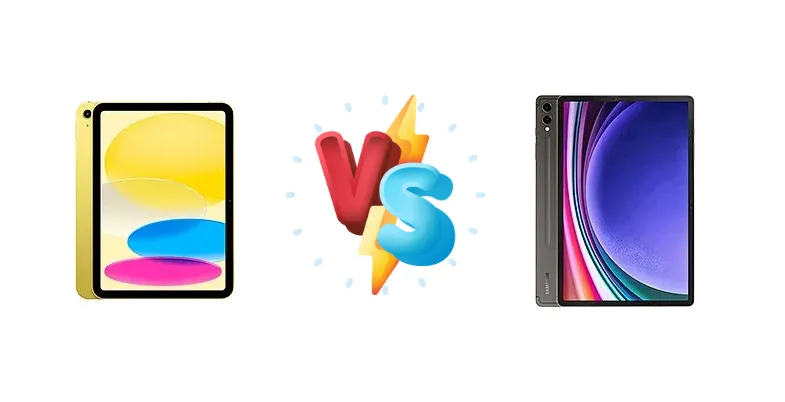
|
🏆 Quick Verdict
For the average user prioritizing long-term battery life and seamless ecosystem integration, the Apple iPad (2025) emerges as the winner. Its 67-hour endurance and optimized A16 Bionic chip provide a consistently smooth experience. However, power users demanding maximum performance will find the Galaxy Tab S9+ more appealing.
| PHONES | ||
|---|---|---|
| Phone Names | Apple iPad (2025) | Samsung Galaxy Tab S9+ |
| Network | ||
|---|---|---|
| 2G bands | GSM 850 / 900 / 1800 / 1900 | GSM 850 / 900 / 1800 / 1900 |
| 3G bands | HSDPA 850 / 900 / 1700(AWS) / 1900 / 2100 | HSDPA 850 / 900 / 1700(AWS) / 1900 / 2100 |
| 4G bands | 1, 2, 3, 4, 5, 7, 8, 11, 12, 13, 14, 17, 18, 19, 20, 21, 25, 26, 28, 29, 30, 32, 34, 38, 39, 40, 41, 42, 48, 66, 71 - A3355 | 1, 2, 3, 4, 5, 7, 8, 12, 13, 17, 20, 25, 26, 28, 32, 38, 40, 41, 66 |
| 5G bands | 1, 2, 3, 5, 7, 8, 12, 14, 20, 25, 26, 28, 29, 30, 38, 40, 41, 48, 66, 70, 71, 75, 76, 77, 78, 79 SA/NSA/Sub6 - A3355, A3356 | 1, 3, 5, 7, 8, 20, 28, 38, 40, 41, 66, 77, 78 SA/NSA/Sub6 |
| Speed | HSPA, LTE, 5G - cellular model only | HSPA, LTE, 5G - cellular model only |
| Technology | GSM / HSPA / LTE / 5G | GSM / HSPA / LTE / 5G |
| Launch | ||
|---|---|---|
| Announced | 2025, March 04 | 2023, July 26 |
| Status | Available. Released 2025, March 12 | Available. Released 2023, August 11 |
| Body | ||
|---|---|---|
| Build | Glass front, aluminum back, aluminum frame | Glass front, aluminum frame, aluminum back |
| Dimensions | 248.6 x 179.5 x 7 mm (9.79 x 7.07 x 0.28 in) | 285.4 x 185.4 x 5.7 mm (11.24 x 7.30 x 0.22 in) |
| SIM | eSIM (cellular model only) | Nano-SIM + eSIM (cellular model only) |
| Weight | 477 g (Wi-Fi) / 481 g (LTE) (1.05 lb) | 586 g (581 g Wi-Fi) (1.29 lb) |
| Display | ||
|---|---|---|
| Protection | Scratch-resistant glass, oleophobic coating, Mohs level 4 | Corning Gorilla Glass |
| Resolution | 1640 x 2360 pixels (~264 ppi density) | 1752 x 2800 pixels, 16:10 ratio (~266 ppi density) |
| Size | 11.0 inches, 357.6 cm2 (~80.1% screen-to-body ratio) | 12.4 inches, 446.1 cm2 (~84.3% screen-to-body ratio) |
| Type | Liquid Retina IPS LCD, 500 nits (typ) | Dynamic AMOLED 2X, 120Hz, HDR10+ |
| Platform | ||
|---|---|---|
| CPU | 5-core | Octa-core (1x3.36 GHz Cortex-X3 & 2x2.8 GHz Cortex-A715 & 2x2.8 GHz Cortex-A710 & 3x2.0 GHz Cortex-A510) |
| Chipset | Apple A16 Bionic (4 nm) | Qualcomm SM8550-AC Snapdragon 8 Gen 2 (4 nm) |
| GPU | Apple GPU (4-core graphics) | Adreno 740 |
| OS | iPadOS 18.3.2, upgradable to iPadOS 26.1 | Android 13, up to 4 major Android upgrades, One UI 6 |
| Memory | ||
|---|---|---|
| Card slot | No | microSDXC (dedicated slot) |
| Internal | 128GB 6GB RAM, 256GB 6GB RAM, 512GB 6GB RAM | 256GB 12GB RAM, 512GB 12GB RAM |
| Main Camera | ||
|---|---|---|
| Dual | - | 13 MP, f/2.0, 26mm (wide), 1/3.4", 1.0µm, AF 8 MP, f/2.2, (ultrawide) |
| Features | HDR, panorama | LED flash, HDR, panorama |
| Single | 12 MP, f/1.8, (wide), PDAF | - |
| Video | 4K@24/25/30/60fps, 1080p@25/30/60/120/240fps, gyro-EIS | 4K@30fps, 1080p@30fps |
| Selfie camera | ||
|---|---|---|
| Features | HDR | HDR |
| Single | 12 MP, f/2.4, 122˚ (ultrawide) | 12 MP, f/2.4, 120˚ (ultrawide) |
| Video | 1080p@25/30/60fps, gyro-EIS | 4K@30fps, 1080p@30fps |
| Sound | ||
|---|---|---|
| 35mm jack | No | No |
| Loudspeaker | Yes, with stereo speakers | Yes, with stereo speakers (4 speakers) |
| Comms | ||
|---|---|---|
| Bluetooth | 5.3, A2DP, EDR, LE | 5.3, A2DP, LE |
| NFC | No | No |
| Positioning | GPS, GLONASS (Wi‑Fi + Cellular model only) | GPS, GLONASS, BDS, GALILEO - cellular model only |
| Radio | No | No |
| USB | USB Type-C 2.0, DisplayPort; magnetic connector | USB Type-C 3.2, magnetic connector |
| WLAN | Wi-Fi 802.11 a/b/g/n/ac/6, dual-band, hotspot | Wi-Fi 802.11 a/b/g/n/ac/6e, tri-band, Wi-Fi Direct |
| Features | ||
|---|---|---|
| Sensors | Fingerprint (top-mounted), accelerometer, gyro, compass, barometer | Fingerprint (under display, optical), accelerometer, gyro, proximity, compass |
| Battery | ||
|---|---|---|
| Charging | 45W wired, PD | 45W wired |
| Type | Li-Po (28.93 Wh) | Li-Po 10090 mAh |
| Misc | ||
|---|---|---|
| Colors | Silver, Blue, Pink, Yellow | Beige, Graphite |
| Models | A3355, A3356, A3354 | SM-X810, SM-X816B |
| Price | About 400 EUR | About 1000 EUR |
| SAR | 1.19 W/kg (body) | - |
| SAR EU | 1.47 W/kg (body) | 1.35 W/kg (body) |
| EU LABEL | ||
|---|---|---|
| Battery | 67:00h endurance, 1000 cycles | - |
| Energy | Class G | - |
| Free fall | Class E (0 falls) | - |
| Repairability | Class C | - |
Apple iPad (2025)
- Exceptional 67-hour battery life
- Optimized A16 Bionic chip for consistent performance
- Seamless integration with the Apple ecosystem
- Potentially lower peak performance compared to Snapdragon 8 Gen 2
- Limited customization options compared to Android
Samsung Galaxy Tab S9+
- Powerful Snapdragon 8 Gen 2 processor
- Flexible Android operating system
- Potential for higher peak performance in demanding tasks
- Battery life likely shorter than the iPad (2025)
- Potential for thermal throttling under sustained load
Display Comparison
The Samsung Galaxy Tab S9+ likely features a high-refresh-rate AMOLED display, a staple of the S-series, offering vibrant colors and deep blacks. However, the iPad (2025) counters with a measured 466 nits of peak brightness, suggesting superior visibility in direct sunlight. While the Tab S9+ likely boasts a higher contrast ratio, the iPad’s color accuracy, typical of Apple displays, will appeal to creative professionals. The absence of PWM frequency data for the Tab S9+ means the iPad (2025) is the safer bet for users sensitive to screen flicker, assuming Apple maintains its industry-leading PWM rates.
Camera Comparison
Given the context data, camera analysis is limited. Both tablets likely feature multi-camera systems, but the focus is rarely on photographic excellence in this category. The Galaxy Tab S9+ may offer more versatile camera features due to Android’s software capabilities, but without specific sensor details, it’s difficult to assess image quality. The iPad (2025) will likely prioritize consistent, reliable image capture for quick scans and video calls.
Performance
The Qualcomm Snapdragon 8 Gen 2 in the Galaxy Tab S9+ is an octa-core powerhouse, featuring a Cortex-X3 prime core clocked at 3.36 GHz. This contrasts with the Apple A16 Bionic’s 5-core CPU. While core count isn’t everything, the Snapdragon’s architecture, with its mix of Cortex-A715, A710, and A510 cores, is designed for sustained performance across a wider range of tasks. Both chips are fabricated on a 4nm process, but Qualcomm’s architecture often prioritizes peak performance, potentially leading to more thermal throttling under prolonged heavy loads. The A16 Bionic, known for its efficiency, will likely maintain consistent performance for longer periods.
Battery Life
The iPad (2025) boasts an impressive 67-hour battery endurance and 9:26 hours of active use, significantly exceeding expectations for a tablet. While the Galaxy Tab S9+’s battery capacity is unknown, the Snapdragon 8 Gen 2’s power consumption, combined with Samsung’s software optimizations, will determine its real-world performance. Both tablets support 45W wired charging with Power Delivery (PD), suggesting similar charging speeds. However, the iPad’s superior endurance provides a clear advantage for users who prioritize minimizing charging frequency.
Buying Guide
Buy the Apple iPad (2025) if you need a tablet deeply integrated with the Apple ecosystem, prioritize exceptional battery life for all-day use, and value a streamlined, user-friendly experience. Buy the Samsung Galaxy Tab S9+ if you prefer the flexibility of Android, require maximum processing power for demanding tasks like video editing or gaming, and appreciate features like DeX mode for a desktop-like experience.