
Apple iPad (2025) vs Samsung Galaxy Tab S9 FE+: Which Tablet Reigns Supreme?
| Phones Images | |||||
|---|---|---|---|---|---|
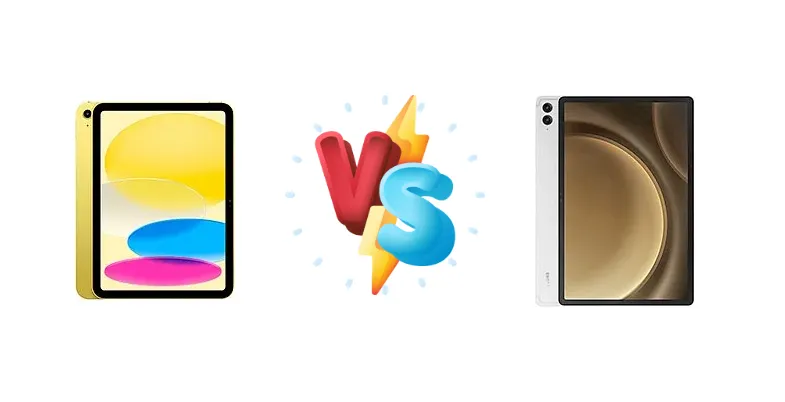
|
🏆 Quick Verdict
For users prioritizing raw performance and long-term battery health, the Apple iPad (2025) is the clear winner. Its A16 Bionic chip and 1000-cycle battery longevity offer a premium experience. However, the Galaxy Tab S9 FE+ provides excellent value and fast charging for those on a tighter budget.
| PHONES | ||
|---|---|---|
| Phone Names | Apple iPad (2025) | Samsung Galaxy Tab S9 FE+ |
| Network | ||
|---|---|---|
| 2G bands | GSM 850 / 900 / 1800 / 1900 | GSM 850 / 900 / 1800 / 1900 |
| 3G bands | HSDPA 850 / 900 / 1700(AWS) / 1900 / 2100 | HSDPA 850 / 900 / 1700(AWS) / 1900 / 2100 |
| 4G bands | 1, 2, 3, 4, 5, 7, 8, 11, 12, 13, 14, 17, 18, 19, 20, 21, 25, 26, 28, 29, 30, 32, 34, 38, 39, 40, 41, 42, 48, 66, 71 - A3355 | 1, 2, 3, 4, 5, 7, 8, 12, 13, 17, 20, 26, 28, 32, 38, 40, 41, 66 |
| 5G bands | 1, 2, 3, 5, 7, 8, 12, 14, 20, 25, 26, 28, 29, 30, 38, 40, 41, 48, 66, 70, 71, 75, 76, 77, 78, 79 SA/NSA/Sub6 - A3355, A3356 | 1, 3, 5, 7, 8, 20, 28, 38, 40, 41, 66, 77, 78 SA/NSA/Sub6 |
| Speed | HSPA, LTE, 5G - cellular model only | HSPA, LTE, 5G - cellular model only |
| Technology | GSM / HSPA / LTE / 5G | GSM / HSPA / LTE / 5G |
| Launch | ||
|---|---|---|
| Announced | 2025, March 04 | 2023, October 04 |
| Status | Available. Released 2025, March 12 | Available. Released 2023, October 16 |
| Body | ||
|---|---|---|
| Build | Glass front, aluminum back, aluminum frame | Glass front, aluminum back, aluminum frame |
| Dimensions | 248.6 x 179.5 x 7 mm (9.79 x 7.07 x 0.28 in) | 285.4 x 185.4 x 6.5 mm (11.24 x 7.30 x 0.26 in) |
| SIM | eSIM (cellular model only) | Nano-SIM + eSIM (cellular model only) |
| Weight | 477 g (Wi-Fi) / 481 g (LTE) (1.05 lb) | 627 g or 628 g (1.38 lb) |
| Display | ||
|---|---|---|
| Protection | Scratch-resistant glass, oleophobic coating, Mohs level 4 | - |
| Resolution | 1640 x 2360 pixels (~264 ppi density) | 1600 x 2560 pixels, 16:10 ratio (~243 ppi density) |
| Size | 11.0 inches, 357.6 cm2 (~80.1% screen-to-body ratio) | 12.4 inches, 445.8 cm2 (~84.3% screen-to-body ratio) |
| Type | Liquid Retina IPS LCD, 500 nits (typ) | IPS LCD, 90Hz |
| Platform | ||
|---|---|---|
| CPU | 5-core | Octa-core (4x2.4 GHz Cortex-A78 & 4x2.0 GHz Cortex-A55) |
| Chipset | Apple A16 Bionic (4 nm) | Exynos 1380 (5 nm) |
| GPU | Apple GPU (4-core graphics) | Mali-G68 MP5 |
| OS | iPadOS 18.3.2, upgradable to iPadOS 26.1 | Android 13, up to 4 major Android upgrades, One UI 6 |
| Memory | ||
|---|---|---|
| Card slot | No | microSDXC (dedicated slot) |
| Internal | 128GB 6GB RAM, 256GB 6GB RAM, 512GB 6GB RAM | 128GB 6GB RAM, 128GB 8GB RAM, 256GB 8GB RAM, 256GB 12GB RAM |
| Main Camera | ||
|---|---|---|
| Dual | - | 8 MP, (wide) 8 MP, (ultrawide) |
| Features | HDR, panorama | - |
| Single | 12 MP, f/1.8, (wide), PDAF | - |
| Video | 4K@24/25/30/60fps, 1080p@25/30/60/120/240fps, gyro-EIS | 4K@30fps, 1080p@30fps |
| Selfie camera | ||
|---|---|---|
| Features | HDR | - |
| Single | 12 MP, f/2.4, 122˚ (ultrawide) | 12 MP, (ultrawide) |
| Video | 1080p@25/30/60fps, gyro-EIS | Yes |
| Sound | ||
|---|---|---|
| 35mm jack | No | No |
| Loudspeaker | Yes, with stereo speakers | Yes, with stereo speakers |
| Comms | ||
|---|---|---|
| Bluetooth | 5.3, A2DP, EDR, LE | 5.3, A2DP, LE |
| NFC | No | No |
| Positioning | GPS, GLONASS (Wi‑Fi + Cellular model only) | GPS, GALILEO, GLONASS, BDS, QZSS - cellular model only |
| Radio | No | No |
| USB | USB Type-C 2.0, DisplayPort; magnetic connector | USB Type-C 2.0, magnetic connector |
| WLAN | Wi-Fi 802.11 a/b/g/n/ac/6, dual-band, hotspot | Wi-Fi 802.11 a/b/g/n/ac/6, dual-band, Wi-Fi Direct |
| Features | ||
|---|---|---|
| Sensors | Fingerprint (top-mounted), accelerometer, gyro, compass, barometer | Fingerprint (side-mounted), accelerometer, gyro, compass, proximity (accessories only) |
| Battery | ||
|---|---|---|
| Charging | 45W wired, PD | 45W wired, QC2.0 |
| Type | Li-Po (28.93 Wh) | Li-Po 10090 mAh |
| Misc | ||
|---|---|---|
| Colors | Silver, Blue, Pink, Yellow | Mint, Silver, Gray, Lavender |
| Models | A3355, A3356, A3354 | SM-X610, SM-X616B |
| Price | About 400 EUR | About 770 EUR |
| SAR | 1.19 W/kg (body) | 0.77 W/kg (body) |
| SAR EU | 1.47 W/kg (body) | 0.50 W/kg (body) |
| EU LABEL | ||
|---|---|---|
| Battery | 67:00h endurance, 1000 cycles | - |
| Energy | Class G | - |
| Free fall | Class E (0 falls) | - |
| Repairability | Class C | - |
Apple iPad (2025)
- Superior performance with the A16 Bionic chip
- Exceptional battery life and 1000 charge cycles
- Likely superior display color accuracy
- Potentially higher price point
- PD charging may be slightly slower than QC2.0
Samsung Galaxy Tab S9 FE+
- Faster charging with QC2.0 support
- Potentially more affordable price
- Large display ideal for media consumption
- Lower performance compared to the A16 Bionic
- Unknown battery cycle life, potentially shorter lifespan
Display Comparison
The iPad (2025) boasts a measured peak brightness of 466 nits, providing a vibrant viewing experience. While the S9 FE+’s display specifications aren’t provided, Samsung typically excels in display technology. However, without comparable brightness data, the iPad holds an advantage in outdoor visibility. Both tablets likely utilize LCD panels, but the iPad’s color accuracy, historically a strength for Apple, is expected to be superior. The absence of LTPO technology in either device suggests standard refresh rates, impacting smoothness compared to higher-end tablets.
Camera Comparison
Given the tablet form factor, camera performance isn't a primary concern. However, the lack of detailed camera specifications for both devices suggests a focus on basic functionality. It's reasonable to assume both tablets feature similar camera setups geared towards video calls and casual snapshots. Without sensor size or aperture information, a direct comparison is impossible, but Apple’s image processing algorithms generally provide more consistent results.
Performance
The core of the difference lies in the chipsets. Apple’s A16 Bionic, fabricated on a 4nm process, delivers significantly higher single-core performance than the Samsung Galaxy Tab S9 FE+'s Exynos 1380 (5nm). The A16’s 5-core CPU architecture is optimized for efficiency and speed, while the Exynos 1380’s octa-core configuration, with its Cortex-A78 and A55 cores, focuses on multi-tasking. The 4nm node of the A16 Bionic translates to better thermal efficiency, potentially reducing throttling during sustained workloads compared to the 5nm Exynos 1380. This means the iPad (2025) will likely maintain peak performance for longer periods.
Battery Life
The iPad (2025) claims an impressive 67-hour endurance and a 9:26-hour active use score, indicating exceptional battery life. Crucially, Apple specifies 1000 battery cycles, suggesting long-term battery health. The S9 FE+’s battery capacity is unknown, but its 45W charging with QC2.0 offers faster charging speeds than the iPad’s 45W PD charging. While the S9 FE+ may charge quicker, the iPad’s superior endurance and cycle count provide a more sustainable long-term battery experience.
Buying Guide
Buy the Apple iPad (2025) if you need uncompromising performance for demanding tasks like video editing, graphic design, or gaming, and value a tablet that will maintain its battery health for years. Buy the Samsung Galaxy Tab S9 FE+ if you prioritize affordability, a larger screen for media consumption, and quick charging capabilities, making it ideal for students or casual users.