
Apple iPad (2025) vs Lenovo Tab P12 Pro: A Deep Dive Comparison
| Phones Images | |||||
|---|---|---|---|---|---|
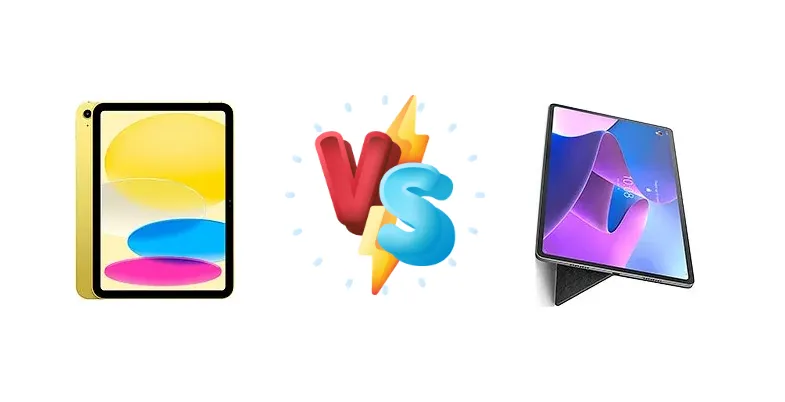
|
🏆 Quick Verdict
For most users, the Apple iPad (2025) emerges as the superior choice. Its A16 Bionic chip delivers demonstrably better performance, and the 67-hour battery endurance provides exceptional longevity. While the Lenovo Tab P12 Pro is a capable device, it falls behind in raw processing power and overall efficiency.
| PHONES | ||
|---|---|---|
| Phone Names | Apple iPad (2025) | Lenovo Tab P12 Pro |
| Network | ||
|---|---|---|
| 2G bands | GSM 850 / 900 / 1800 / 1900 | GSM 850 / 900 / 1800 / 1900 |
| 3G bands | HSDPA 850 / 900 / 1700(AWS) / 1900 / 2100 | HSDPA 850 / 900 / 1900 / 2100 |
| 4G bands | 1, 2, 3, 4, 5, 7, 8, 11, 12, 13, 14, 17, 18, 19, 20, 21, 25, 26, 28, 29, 30, 32, 34, 38, 39, 40, 41, 42, 48, 66, 71 - A3355 | 1, 2, 3, 4, 5, 7, 8, 19, 20, 26, 28, 34, 38, 39, 40, 41 |
| 5G bands | 1, 2, 3, 5, 7, 8, 12, 14, 20, 25, 26, 28, 29, 30, 38, 40, 41, 48, 66, 70, 71, 75, 76, 77, 78, 79 SA/NSA/Sub6 - A3355, A3356 | 1, 3, 7, 8, 20, 28, 38, 41, 77, 78 SA/NSA/Sub6 |
| Speed | HSPA, LTE, 5G - cellular model only | HSPA, LTE, 5G - cellular model only |
| Technology | GSM / HSPA / LTE / 5G | GSM / HSPA / LTE / 5G |
| Launch | ||
|---|---|---|
| Announced | 2025, March 04 | 2021, September 08 |
| Status | Available. Released 2025, March 12 | Available. Released 2021, November 19 |
| Body | ||
|---|---|---|
| Build | Glass front, aluminum back, aluminum frame | - |
| Dimensions | 248.6 x 179.5 x 7 mm (9.79 x 7.07 x 0.28 in) | 285.6 x 184.5 x 5.6 mm (11.24 x 7.26 x 0.22 in) |
| SIM | eSIM (cellular model only) | Nano-SIM (cellular model only) |
| Weight | 477 g (Wi-Fi) / 481 g (LTE) (1.05 lb) | 565 g (1.25 lb) |
| - | Stylus support | |
| Display | ||
|---|---|---|
| Protection | Scratch-resistant glass, oleophobic coating, Mohs level 4 | - |
| Resolution | 1640 x 2360 pixels (~264 ppi density) | 1600 x 2560 pixels, 16:10 ratio (~240 ppi density) |
| Size | 11.0 inches, 357.6 cm2 (~80.1% screen-to-body ratio) | 12.6 inches, 460.3 cm2 (~87.4% screen-to-body ratio) |
| Type | Liquid Retina IPS LCD, 500 nits (typ) | AMOLED, 120Hz, HDR10+, Dolby Vision, 600 nits (HBM) |
| Platform | ||
|---|---|---|
| CPU | 5-core | Octa-core (1x3.2 GHz Kryo 585 & 3x2.42 GHz Kryo 585 & 4x1.80 GHz Kryo 585) |
| Chipset | Apple A16 Bionic (4 nm) | Qualcomm SM8250-AC Snapdragon 870 5G (7 nm) |
| GPU | Apple GPU (4-core graphics) | Adreno 650 |
| OS | iPadOS 18.3.2, upgradable to iPadOS 26.1 | Android 11 |
| Memory | ||
|---|---|---|
| Card slot | No | microSDXC (dedicated slot) |
| Internal | 128GB 6GB RAM, 256GB 6GB RAM, 512GB 6GB RAM | 128GB 6GB RAM, 256GB 8GB RAM |
| Main Camera | ||
|---|---|---|
| Dual | - | 13 MP, (wide), AF 5 MP, (ultrawide) |
| Features | HDR, panorama | - |
| Single | 12 MP, f/1.8, (wide), PDAF | - |
| Video | 4K@24/25/30/60fps, 1080p@25/30/60/120/240fps, gyro-EIS | 4K@30fps, 1080p@30fps |
| Selfie camera | ||
|---|---|---|
| Features | HDR | - |
| Single | 12 MP, f/2.4, 122˚ (ultrawide) | 8 MP, (wide) 8 MP, IR TOF 3D, (biometrics sensor only) |
| Video | 1080p@25/30/60fps, gyro-EIS | 1080p@30fps |
| Sound | ||
|---|---|---|
| 3.5mm jack | - | No |
| 35mm jack | No | No |
| Loudspeaker | Yes, with stereo speakers | Yes, with stereo speakers (4 speakers) |
| - | JBL speakers | |
| Comms | ||
|---|---|---|
| Bluetooth | 5.3, A2DP, EDR, LE | 5.2, A2DP, LE |
| NFC | No | Yes (wireless charging and data transfer only) |
| Positioning | GPS, GLONASS (Wi‑Fi + Cellular model only) | GPS, GLONASS, BDS - cellular model only |
| Radio | No | Unspecified |
| USB | USB Type-C 2.0, DisplayPort; magnetic connector | USB Type-C 3.1 |
| WLAN | Wi-Fi 802.11 a/b/g/n/ac/6, dual-band, hotspot | Wi-Fi 802.11 a/b/g/n/ac/6, dual-band, Wi-Fi Direct |
| Features | ||
|---|---|---|
| Sensors | Fingerprint (top-mounted), accelerometer, gyro, compass, barometer | Fingerprint (side-mounted), accelerometer, gyro, proximity |
| Battery | ||
|---|---|---|
| Charging | 45W wired, PD | 45W wired, QC4 |
| Type | Li-Po (28.93 Wh) | Li-Po 10200 mAh |
| Misc | ||
|---|---|---|
| Colors | Silver, Blue, Pink, Yellow | Storm Grey |
| Models | A3355, A3356, A3354 | TB-Q706Z, TB-Q706F |
| Price | About 400 EUR | About 520 EUR |
| SAR | 1.19 W/kg (body) | - |
| SAR EU | 1.47 W/kg (body) | - |
| EU LABEL | ||
|---|---|---|
| Battery | 67:00h endurance, 1000 cycles | - |
| Energy | Class G | - |
| Free fall | Class E (0 falls) | - |
| Repairability | Class C | - |
Apple iPad (2025)
- Superior performance with the A16 Bionic chip
- Exceptional battery life (67 hours endurance)
- Long-term battery health (1000 cycles)
- Potentially higher price point
- Limited customization options compared to Android
Lenovo Tab P12 Pro
- 5G connectivity for on-the-go access
- Android operating system offers greater flexibility
- Potentially more affordable price
- Less powerful processor (Snapdragon 870)
- Shorter battery life compared to the iPad
Display Comparison
The Apple iPad (2025) boasts a display capable of 466 nits of peak brightness, ensuring excellent visibility even in bright outdoor conditions. While the Lenovo Tab P12 Pro’s display specifications aren’t provided, Lenovo typically focuses on vibrant color reproduction. The iPad’s likely use of an advanced panel technology, potentially LTPO, would contribute to improved power efficiency compared to a standard LCD panel, though this is speculative without further data on the Lenovo device. The absence of detailed display specs for the Lenovo tablet makes a direct comparison challenging, but Apple’s measured brightness provides a concrete benchmark.
Camera Comparison
Without camera specifications for either device, a detailed comparison is impossible. However, Apple generally prioritizes image processing and computational photography, often achieving excellent results even with modest hardware. The Lenovo Tab P12 Pro, being an Android device, may offer more manual control over camera settings. The absence of information prevents a meaningful assessment of image quality or low-light performance.
Performance
The core difference lies in the chipsets. Apple’s A16 Bionic, fabricated on a 4nm process, offers a significant advantage in performance and efficiency over the Lenovo’s Qualcomm Snapdragon 870 5G (7nm). The A16’s 5-core CPU is likely to outperform the Snapdragon 870’s octa-core configuration in single-core tasks, crucial for responsiveness. While the Snapdragon 870 is a capable chip, the smaller node size of the A16 translates to lower power consumption and reduced thermal throttling during sustained workloads. This means the iPad (2025) will maintain higher performance levels for longer periods, particularly beneficial for demanding applications.
Battery Life
The Apple iPad (2025) shines with a remarkable 67-hour endurance and a 9:26-hour active use score. This suggests exceptional power efficiency, likely stemming from the A16 Bionic’s 4nm architecture and optimized software. Both tablets support 45W wired charging, but the Lenovo Tab P12 Pro utilizes Quick Charge 4 (QC4), while the iPad uses Power Delivery (PD). While both are fast charging standards, PD is more universally compatible. The iPad’s 1000 cycle battery lifespan also indicates superior long-term battery health compared to a typical tablet battery.
Buying Guide
Buy the Apple iPad (2025) if you prioritize seamless performance for demanding tasks like video editing, graphic design, or gaming, and value the longevity of a well-optimized ecosystem. Buy the Lenovo Tab P12 Pro if you prefer the flexibility of Android, require 5G connectivity, and are seeking a high-quality tablet experience at a potentially lower price point, accepting a performance trade-off.