
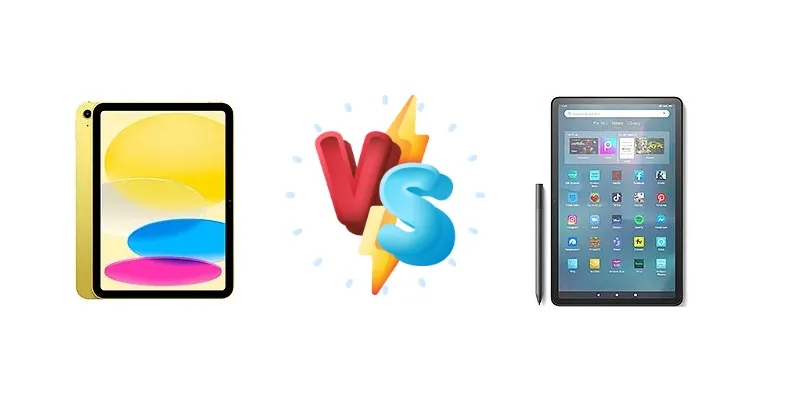
iPad (2025) vs. Amazon Fire Max 11: A Deep Dive into Tablet Performance and Value
| Phones Images | |||||
|---|---|---|---|---|---|
|
🏆 Quick Verdict
For users prioritizing performance and long-term software support, the Apple iPad (2025) is the clear winner. Its A16 Bionic chip and superior display justify the higher price. However, the Amazon Fire Max 11 presents a compelling value proposition for casual users focused on media consumption and basic tasks.
| PHONES | ||
|---|---|---|
| Phone Names | Apple iPad (2025) | Amazon Fire Max 11 |
| Network | ||
|---|---|---|
| 2G bands | GSM 850 / 900 / 1800 / 1900 | N/A |
| 3G bands | HSDPA 850 / 900 / 1700(AWS) / 1900 / 2100 | - |
| 4G bands | 1, 2, 3, 4, 5, 7, 8, 11, 12, 13, 14, 17, 18, 19, 20, 21, 25, 26, 28, 29, 30, 32, 34, 38, 39, 40, 41, 42, 48, 66, 71 - A3355 | - |
| 5G bands | 1, 2, 3, 5, 7, 8, 12, 14, 20, 25, 26, 28, 29, 30, 38, 40, 41, 48, 66, 70, 71, 75, 76, 77, 78, 79 SA/NSA/Sub6 - A3355, A3356 | - |
| EDGE | - | No |
| GPRS | - | No |
| Speed | HSPA, LTE, 5G - cellular model only | - |
| Technology | GSM / HSPA / LTE / 5G | No cellular connectivity |
| Launch | ||
|---|---|---|
| Announced | 2025, March 04 | 2023, May 23 |
| Status | Available. Released 2025, March 12 | Available. Released 2023, May 23 |
| Body | ||
|---|---|---|
| Build | Glass front, aluminum back, aluminum frame | - |
| Dimensions | 248.6 x 179.5 x 7 mm (9.79 x 7.07 x 0.28 in) | 259.1 x 163.7 x 7.5 mm (10.20 x 6.44 x 0.30 in) |
| SIM | eSIM (cellular model only) | No |
| Weight | 477 g (Wi-Fi) / 481 g (LTE) (1.05 lb) | 490 g (1.08 lb) |
| Display | ||
|---|---|---|
| Protection | Scratch-resistant glass, oleophobic coating, Mohs level 4 | - |
| Resolution | 1640 x 2360 pixels (~264 ppi density) | 2000 x 1200 pixels, 5:3 ratio (~212 ppi density) |
| Size | 11.0 inches, 357.6 cm2 (~80.1% screen-to-body ratio) | 11.0 inches, 344.4 cm2 (~81.2% screen-to-body ratio) |
| Type | Liquid Retina IPS LCD, 500 nits (typ) | IPS LCD |
| Platform | ||
|---|---|---|
| CPU | 5-core | Octa-core (2x2.2 GHz Cortex-A78 & 6x2.0 GHz Cortex-A55) |
| Chipset | Apple A16 Bionic (4 nm) | Mediatek MT8188J |
| GPU | Apple GPU (4-core graphics) | Mali-G57 MC2 |
| OS | iPadOS 18.3.2, upgradable to iPadOS 26.1 | Android 11, Fire OS 8 |
| Memory | ||
|---|---|---|
| Card slot | No | microSDXC (dedicated slot) |
| Internal | 128GB 6GB RAM, 256GB 6GB RAM, 512GB 6GB RAM | 64GB 4GB RAM, 128GB 4GB RAM |
| Main Camera | ||
|---|---|---|
| Features | HDR, panorama | - |
| Single | 12 MP, f/1.8, (wide), PDAF | 8 MP, AF |
| Video | 4K@24/25/30/60fps, 1080p@25/30/60/120/240fps, gyro-EIS | 1080p |
| Selfie camera | ||
|---|---|---|
| Features | HDR | - |
| Single | 12 MP, f/2.4, 122˚ (ultrawide) | 8 MP |
| Video | 1080p@25/30/60fps, gyro-EIS | 1080p |
| Sound | ||
|---|---|---|
| 35mm jack | No | No |
| Loudspeaker | Yes, with stereo speakers | Yes, with stereo speakers |
| Comms | ||
|---|---|---|
| Bluetooth | 5.3, A2DP, EDR, LE | 5.3, A2DP, LE |
| NFC | No | No |
| Positioning | GPS, GLONASS (Wi‑Fi + Cellular model only) | No |
| Radio | No | No |
| USB | USB Type-C 2.0, DisplayPort; magnetic connector | USB Type-C 2.0, OTG, magnetic accessory connector |
| WLAN | Wi-Fi 802.11 a/b/g/n/ac/6, dual-band, hotspot | Wi-Fi 802.11 a/b/g/n/ac/6, dual-band |
| Features | ||
|---|---|---|
| Sensors | Fingerprint (top-mounted), accelerometer, gyro, compass, barometer | Fingerprint (side-mounted), accelerometer, proximity (accessories only) |
| Battery | ||
|---|---|---|
| Charging | 45W wired, PD | 15W wired |
| Type | Li-Po (28.93 Wh) | Li-Ion |
| Misc | ||
|---|---|---|
| Colors | Silver, Blue, Pink, Yellow | Gray |
| Models | A3355, A3356, A3354 | KFSNWI |
| Price | About 400 EUR | About 270 EUR |
| SAR | 1.19 W/kg (body) | - |
| SAR EU | 1.47 W/kg (body) | - |
| EU LABEL | ||
|---|---|---|
| Battery | 67:00h endurance, 1000 cycles | - |
| Energy | Class G | - |
| Free fall | Class E (0 falls) | - |
| Repairability | Class C | - |
Apple iPad (2025)
- Significantly faster performance with the A16 Bionic chip.
- Superior display quality with higher brightness and color accuracy.
- Faster charging with 45W PD and longer battery lifespan (1000 cycles).
- Long-term software support from Apple.
- Higher price point.
- No expandable storage.
Amazon Fire Max 11
- Much more affordable price.
- Access to Amazon’s ecosystem and services.
- Decent battery life for casual use.
- Lightweight and portable design.
- Significantly slower performance.
- Lower display quality.
- Limited software updates and support.
- Slower charging speeds.
Display Comparison
The iPad (2025) boasts a measured peak brightness of 466 nits, offering a significantly more vibrant viewing experience than we anticipate from the Fire Max 11, which typically falls in the 300-350 nit range based on Amazon’s historical display choices. While the Fire Max 11 likely utilizes an IPS LCD panel for cost-effectiveness, the iPad’s display technology (likely still LCD, but with advanced calibration) will deliver superior color accuracy and viewing angles. The absence of ProMotion (Apple’s adaptive refresh rate) on the iPad is a minor drawback, but the overall display quality remains a strong advantage.
Camera Comparison
Given the context data, a detailed camera comparison is limited. However, it’s safe to assume the iPad (2025) will feature a more sophisticated camera system with better image processing capabilities. Amazon typically prioritizes cost savings in this area, so the Fire Max 11’s camera is likely geared towards basic video calls and casual snapshots. The absence of specific camera specs for the Fire Max 11 suggests it won’t compete with the iPad in image quality.
Performance
The core difference lies in the chipsets. Apple’s A16 Bionic, fabricated on a 4nm process, delivers a substantial performance advantage over the Amazon Fire Max 11’s Mediatek MT8188J. The A16’s 5-core CPU architecture is optimized for both single-core and multi-core workloads, while the MT8188J’s octa-core configuration (2x2.2 GHz Cortex-A78 & 6x2.0 GHz Cortex-A55) relies on a mix of performance and efficiency cores. The 4nm node of the A16 also translates to better thermal efficiency, minimizing throttling during sustained workloads. This means the iPad (2025) will handle demanding apps and games with greater ease and consistency.
Battery Life
The iPad (2025) claims impressive battery endurance, rated at 67 hours and 9:26 hours of active use. This is likely achieved through a combination of efficient silicon (A16 Bionic) and optimized software. The Fire Max 11’s battery capacity is unknown, but its less powerful chipset and lower screen brightness will contribute to reasonable battery life. The iPad’s 45W wired charging with Power Delivery (PD) is a significant advantage, allowing for faster charging speeds compared to the Fire Max 11’s 15W charging. The iPad also boasts a claimed 1000 charge cycles, indicating long-term battery health.
Buying Guide
Buy the Apple iPad (2025) if you need a powerful tablet for demanding tasks like video editing, gaming, or professional creative work, and value a long software support lifecycle. Buy the Amazon Fire Max 11 if you prioritize affordability, primarily consume media, and need a tablet for light tasks like web browsing, reading, and streaming, and are comfortable within the Amazon ecosystem.