
iPad (2022) vs. Xiaomi Pad 6S Pro 12.4: A Deep Dive into Tablet Power and Value
| Phones Images | |||||
|---|---|---|---|---|---|
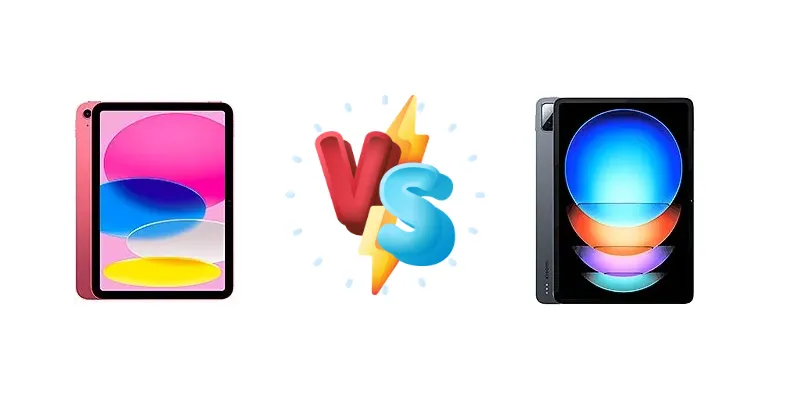
|
🏆 Quick Verdict
For the average user prioritizing seamless software integration and a mature app ecosystem, the Apple iPad (2022) remains a solid choice. However, the Xiaomi Pad 6S Pro 12.4 delivers significantly more raw performance and faster charging, making it the winner for power users and gamers.
| PHONES | ||
|---|---|---|
| Phone Names | Apple iPad (2022) | Xiaomi Pad 6S Pro 12.4 |
| Network | ||
|---|---|---|
| 2G bands | GSM 850 / 900 / 1800 / 1900 | N/A |
| 3G bands | HSDPA 850 / 900 / 1700(AWS) / 1900 / 2100 - A2757 | N/A |
| 4G bands | 1, 2, 3, 4, 5, 7, 8, 11, 12, 13, 14, 17, 18, 19, 20, 21, 25, 26, 28, 29, 30, 32, 34, 38, 39, 40, 41, 42, 46, 48, 66, 71 - A2757 | - |
| 5G bands | 1, 2, 3, 5, 7, 8, 12, 20, 25, 28, 29, 30, 38, 40, 41, 48, 66, 71, 77, 78, 79 SA/NSA/Sub6 - A2757, A2777 | - |
| EDGE | - | N/A |
| GPRS | - | N/A |
| Speed | HSPA, LTE, 5G - cellular model only | - |
| Technology | GSM / HSPA / LTE / 5G | No cellular connectivity |
| 1, 2, 3, 4, 5, 7, 8, 12, 13, 14, 17, 18, 19, 20, 25, 26, 28, 29, 30, 32, 34, 38, 39, 40, 41, 42, 46, 48, 66, 71 - A2777 | - | |
| Launch | ||
|---|---|---|
| Announced | 2022, October 18 | 2024, February 22 |
| Status | Available. Released 2022, October 26 | Available. Released 2024, February 22 |
| Body | ||
|---|---|---|
| Build | Glass front, aluminum back, aluminum frame | Glass front (Gorilla Glass 5), aluminum frame, aluminum back |
| Dimensions | 248.6 x 179.5 x 7 mm (9.79 x 7.07 x 0.28 in) | 278.7 x 191.6 x 6.3 mm (10.97 x 7.54 x 0.25 in) |
| SIM | Nano-SIM + eSIM (cellular model only) | No |
| Weight | 477 g (Wi-Fi) / 481 g (LTE) (1.05 lb) | 590 g (1.30 lb) |
| Stylus support (1st gen only) | - | |
| Display | ||
|---|---|---|
| Protection | Scratch-resistant glass, oleophobic coating | Corning Gorilla Glass 5 |
| Resolution | 1640 x 2360 pixels (~264 ppi density) | 2032 x 3048 pixels, 3:2 ratio (~295 ppi density) |
| Size | 10.9 inches, 359.2 cm2 (~80.5% screen-to-body ratio) | 12.4 inches, 457.8 cm2 (~85.7% screen-to-body ratio) |
| Type | Liquid Retina IPS LCD, 500 nits (typ) | IPS LCD, 68B colors, 144Hz, HDR10, Dolby Vision, 900 nits (peak) |
| Platform | ||
|---|---|---|
| CPU | Hexa-core (2x3.0 GHz Firestorm + 4x1.8 GHz Icestorm) | Octa-core (1x3.2 GHz Cortex-X3 & 2x2.8 GHz Cortex-A715 & 2x2.8 GHz Cortex-A710 & 3x2.0 GHz Cortex-A510) |
| Chipset | Apple A14 Bionic (5 nm) | Qualcomm SM8550-AB Snapdragon 8 Gen 2 (4 nm) |
| GPU | Apple GPU (4-core graphics) | Adreno 740 |
| OS | iPadOS 16.1, upgradable to iPadOS 26.1 | Android 14, up to 3 major Android upgrades, HyperOS |
| Memory | ||
|---|---|---|
| Card slot | No | No |
| Internal | 64GB 4GB RAM, 256GB 4GB RAM | 256GB 8GB RAM, 256GB 12GB RAM, 512GB 12GB RAM, 1TB 16GB RAM |
| Main Camera | ||
|---|---|---|
| Dual | - | 50 MP, f/1.8, (wide), 1/2.76", 0.64µm, PDAF Auxiliary lens |
| Features | HDR, panorama | LED flash, HDR, panorama |
| Single | 12 MP, f/1.8, (wide), PDAF | - |
| Video | 4K@24/25/30/60fps, 1080p@25/30/60/120/240fps | 4K@30/60fps, 1080p@30/60fps |
| Selfie camera | ||
|---|---|---|
| Features | HDR | - |
| Single | 12 MP, f/2.4, 122˚ (ultrawide) | 32 MP, f/2.2, (wide), 1/3.6", 0.61µm |
| Video | 1080p@25/30/60fps, gyro-EIS | 1080p@30fps |
| Sound | ||
|---|---|---|
| 3.5mm jack | No | - |
| 35mm jack | No | No |
| Loudspeaker | Yes, with stereo speakers | Yes, with stereo speakers (6 speakers) |
| Comms | ||
|---|---|---|
| Bluetooth | 5.2, A2DP, EDR, LE | 5.3, A2DP, LE, LHDC |
| NFC | No | Yes (file transfer only) |
| Positioning | GPS, GLONASS (Wi‑Fi + Cellular model only) | No |
| Radio | No | No |
| USB | USB Type-C 2.0, DisplayPort; magnetic connector | USB Type-C 3.2, accessory connector |
| WLAN | Wi-Fi 802.11 a/b/g/n/ac/6, dual-band, hotspot | Wi-Fi 802.11 a/b/g/n/a/6/7, dual-band, Wi-Fi Direct |
| Features | ||
|---|---|---|
| Sensors | Fingerprint (top-mounted), accelerometer, gyro, compass, barometer | Fingerprint (side-mounted), accelerometer, gyro, proximity (accessories only), compass |
| Battery | ||
|---|---|---|
| Charging | - | 120W wired, PD3.0, QC4, 45% in 10 min, 100% in 35 min |
| Type | Li-Po 7606 mAh (28.6 Wh) | 10000 mAh |
| Misc | ||
|---|---|---|
| Colors | Silver, Blue, Pink, Yellow | Black, Blue, Green |
| Models | A3162, A2757, A2777, A2696, iPad13,18, iPad13,19 | 24018RPACG |
| Price | About 430 EUR | About 700 EUR |
| SAR EU | - | 0.99 W/kg (body) |
Apple iPad (2022)
- Seamless Apple ecosystem integration
- Long-term software support
- Polished and user-friendly iPadOS
- Older A14 Bionic chip
- Slow charging speeds
- Higher price for comparable performance
Xiaomi Pad 6S Pro 12.4
- Powerful Snapdragon 8 Gen 2 processor
- Ultra-fast 120W charging
- Larger, brighter display
- Android tablet app ecosystem less mature
- Potential for software bloat
- Long-term software support less guaranteed
Display Comparison
The Xiaomi Pad 6S Pro 12.4 boasts a brighter display, reaching a measured 848 nits compared to the iPad (2022)'s unspecified peak brightness (typically around 500 nits). This translates to better visibility outdoors. Furthermore, the 1378:1 contrast ratio on the Xiaomi suggests deeper blacks and a more vibrant image. While the iPad’s display is known for its color accuracy, the larger 12.4-inch screen of the Xiaomi provides more screen real estate for multitasking and media consumption. The lack of LTPO on either device means refresh rates are fixed, impacting power consumption during static content viewing.
Camera Comparison
Neither tablet excels as a primary camera device, but the Xiaomi Pad 6S Pro 12.4 likely has an advantage due to its more modern chipset and image signal processor. While specific camera specs are unavailable for the iPad (2022), Xiaomi’s inclusion of a more advanced ISP within the Snapdragon 8 Gen 2 will result in better image processing, particularly in low-light conditions. The focus here isn’t photography prowess, but rather video conferencing and occasional document scanning.
Performance
The core difference lies in the chipsets. The Xiaomi Pad 6S Pro 12.4’s Snapdragon 8 Gen 2 (4nm) is a generational leap ahead of the iPad (2022)’s A14 Bionic (5nm). The Snapdragon’s octa-core configuration, featuring a Cortex-X3 prime core clocked at 3.2 GHz, provides significantly higher peak performance. While the A14 Bionic remains capable, the Snapdragon 8 Gen 2’s superior architecture and 4nm process offer better thermal efficiency, reducing throttling during sustained workloads. The Xiaomi’s likely LPDDR5x RAM further enhances memory bandwidth, benefiting multitasking and demanding applications. This difference is particularly noticeable in graphically intensive games and video editing.
Battery Life
The Xiaomi Pad 6S Pro 12.4’s active use score of 11:14 hours demonstrates impressive battery life, despite its powerful processor. Crucially, its 120W wired charging is a game-changer, achieving 45% charge in just 10 minutes and a full charge in 35 minutes. The iPad (2022) charges much slower via Lightning, typically taking over 2 hours for a full charge. While the iPad’s battery capacity might be comparable, the Xiaomi’s faster charging mitigates any potential runtime differences, offering greater convenience.
Buying Guide
Buy the Apple iPad (2022) if you need a tablet deeply integrated with the Apple ecosystem, prioritize long-term software support, and value a polished, user-friendly experience. Buy the Xiaomi Pad 6S Pro 12.4 if you prefer a more open operating system, demand maximum performance for demanding tasks like gaming or video editing, and appreciate incredibly fast charging capabilities.