
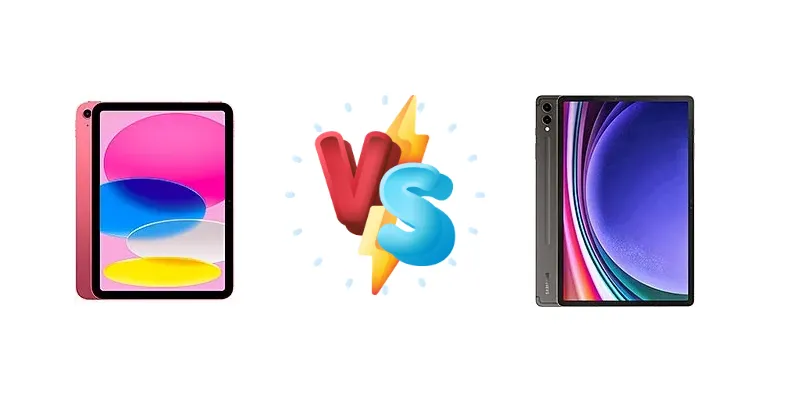
iPad (2022) vs. Samsung Galaxy Tab S9+: A Deep Dive Comparison
| Phones Images | |||||
|---|---|---|---|---|---|
|
🏆 Quick Verdict
For users prioritizing raw performance and faster charging, the Samsung Galaxy Tab S9+ is the clear winner. Its Snapdragon 8 Gen 2 offers a significant leap over the iPad (2022)'s A14 Bionic, especially for demanding tasks. However, the iPad (2022) remains a compelling option for those deeply embedded in the Apple ecosystem and seeking a more affordable entry point.
| PHONES | ||
|---|---|---|
| Phone Names | Apple iPad (2022) | Samsung Galaxy Tab S9+ |
| Network | ||
|---|---|---|
| 2G bands | GSM 850 / 900 / 1800 / 1900 | GSM 850 / 900 / 1800 / 1900 |
| 3G bands | HSDPA 850 / 900 / 1700(AWS) / 1900 / 2100 - A2757 | HSDPA 850 / 900 / 1700(AWS) / 1900 / 2100 |
| 4G bands | 1, 2, 3, 4, 5, 7, 8, 11, 12, 13, 14, 17, 18, 19, 20, 21, 25, 26, 28, 29, 30, 32, 34, 38, 39, 40, 41, 42, 46, 48, 66, 71 - A2757 | 1, 2, 3, 4, 5, 7, 8, 12, 13, 17, 20, 25, 26, 28, 32, 38, 40, 41, 66 |
| 5G bands | 1, 2, 3, 5, 7, 8, 12, 20, 25, 28, 29, 30, 38, 40, 41, 48, 66, 71, 77, 78, 79 SA/NSA/Sub6 - A2757, A2777 | 1, 3, 5, 7, 8, 20, 28, 38, 40, 41, 66, 77, 78 SA/NSA/Sub6 |
| Speed | HSPA, LTE, 5G - cellular model only | HSPA, LTE, 5G - cellular model only |
| Technology | GSM / HSPA / LTE / 5G | GSM / HSPA / LTE / 5G |
| 1, 2, 3, 4, 5, 7, 8, 12, 13, 14, 17, 18, 19, 20, 25, 26, 28, 29, 30, 32, 34, 38, 39, 40, 41, 42, 46, 48, 66, 71 - A2777 | - | |
| Launch | ||
|---|---|---|
| Announced | 2022, October 18 | 2023, July 26 |
| Status | Available. Released 2022, October 26 | Available. Released 2023, August 11 |
| Body | ||
|---|---|---|
| Build | Glass front, aluminum back, aluminum frame | Glass front, aluminum frame, aluminum back |
| Dimensions | 248.6 x 179.5 x 7 mm (9.79 x 7.07 x 0.28 in) | 285.4 x 185.4 x 5.7 mm (11.24 x 7.30 x 0.22 in) |
| SIM | Nano-SIM + eSIM (cellular model only) | Nano-SIM + eSIM (cellular model only) |
| Weight | 477 g (Wi-Fi) / 481 g (LTE) (1.05 lb) | 586 g (581 g Wi-Fi) (1.29 lb) |
| Stylus support (1st gen only) | - | |
| Display | ||
|---|---|---|
| Protection | Scratch-resistant glass, oleophobic coating | Corning Gorilla Glass |
| Resolution | 1640 x 2360 pixels (~264 ppi density) | 1752 x 2800 pixels, 16:10 ratio (~266 ppi density) |
| Size | 10.9 inches, 359.2 cm2 (~80.5% screen-to-body ratio) | 12.4 inches, 446.1 cm2 (~84.3% screen-to-body ratio) |
| Type | Liquid Retina IPS LCD, 500 nits (typ) | Dynamic AMOLED 2X, 120Hz, HDR10+ |
| Platform | ||
|---|---|---|
| CPU | Hexa-core (2x3.0 GHz Firestorm + 4x1.8 GHz Icestorm) | Octa-core (1x3.36 GHz Cortex-X3 & 2x2.8 GHz Cortex-A715 & 2x2.8 GHz Cortex-A710 & 3x2.0 GHz Cortex-A510) |
| Chipset | Apple A14 Bionic (5 nm) | Qualcomm SM8550-AC Snapdragon 8 Gen 2 (4 nm) |
| GPU | Apple GPU (4-core graphics) | Adreno 740 |
| OS | iPadOS 16.1, upgradable to iPadOS 26.1 | Android 13, up to 4 major Android upgrades, One UI 6 |
| Memory | ||
|---|---|---|
| Card slot | No | microSDXC (dedicated slot) |
| Internal | 64GB 4GB RAM, 256GB 4GB RAM | 256GB 12GB RAM, 512GB 12GB RAM |
| Main Camera | ||
|---|---|---|
| Dual | - | 13 MP, f/2.0, 26mm (wide), 1/3.4", 1.0µm, AF 8 MP, f/2.2, (ultrawide) |
| Features | HDR, panorama | LED flash, HDR, panorama |
| Single | 12 MP, f/1.8, (wide), PDAF | - |
| Video | 4K@24/25/30/60fps, 1080p@25/30/60/120/240fps | 4K@30fps, 1080p@30fps |
| Selfie camera | ||
|---|---|---|
| Features | HDR | HDR |
| Single | 12 MP, f/2.4, 122˚ (ultrawide) | 12 MP, f/2.4, 120˚ (ultrawide) |
| Video | 1080p@25/30/60fps, gyro-EIS | 4K@30fps, 1080p@30fps |
| Sound | ||
|---|---|---|
| 3.5mm jack | No | - |
| 35mm jack | No | No |
| Loudspeaker | Yes, with stereo speakers | Yes, with stereo speakers (4 speakers) |
| Comms | ||
|---|---|---|
| Bluetooth | 5.2, A2DP, EDR, LE | 5.3, A2DP, LE |
| NFC | No | No |
| Positioning | GPS, GLONASS (Wi‑Fi + Cellular model only) | GPS, GLONASS, BDS, GALILEO - cellular model only |
| Radio | No | No |
| USB | USB Type-C 2.0, DisplayPort; magnetic connector | USB Type-C 3.2, magnetic connector |
| WLAN | Wi-Fi 802.11 a/b/g/n/ac/6, dual-band, hotspot | Wi-Fi 802.11 a/b/g/n/ac/6e, tri-band, Wi-Fi Direct |
| Features | ||
|---|---|---|
| Sensors | Fingerprint (top-mounted), accelerometer, gyro, compass, barometer | Fingerprint (under display, optical), accelerometer, gyro, proximity, compass |
| Battery | ||
|---|---|---|
| Charging | - | 45W wired |
| Type | Li-Po 7606 mAh (28.6 Wh) | Li-Po 10090 mAh |
| Misc | ||
|---|---|---|
| Colors | Silver, Blue, Pink, Yellow | Beige, Graphite |
| Models | A3162, A2757, A2777, A2696, iPad13,18, iPad13,19 | SM-X810, SM-X816B |
| Price | About 430 EUR | About 1000 EUR |
| SAR EU | - | 1.35 W/kg (body) |
Apple iPad (2022)
- Seamless integration with Apple ecosystem
- Optimized iOS software experience
- Generally lower price point
- Older A14 Bionic chipset
- Slower charging speeds
- Potentially less versatile display
Samsung Galaxy Tab S9+
- Powerful Snapdragon 8 Gen 2 processor
- 45W fast charging
- Likely superior display quality
- Android OS may not appeal to all users
- Potentially higher price
- Samsung's software can be feature-rich but sometimes bloated
Display Comparison
While specific display specs for the iPad (2022) aren't provided, it's expected to feature a standard LCD panel. The Galaxy Tab S9+ likely boasts a superior display experience, benefiting from Samsung's display technology. The Snapdragon 8 Gen 2's image signal processor (ISP) will also contribute to better image quality. The S9+'s potential for a higher refresh rate (likely 120Hz) compared to the iPad's standard 60Hz will result in smoother scrolling and animations. The absence of LTPO in the iPad (2022) means it won't dynamically adjust refresh rates for power saving like the S9+ potentially could.
Camera Comparison
Without specific camera details for the iPad (2022), a direct comparison is limited. However, Samsung typically prioritizes camera quality in its tablets. The Snapdragon 8 Gen 2's ISP will likely enable superior image processing and potentially better low-light performance on the Tab S9+. The S9+ is expected to have a more advanced camera system overall, offering features like improved dynamic range and more accurate color reproduction. The iPad (2022) likely focuses on basic photography needs, while the S9+ caters to users who want a more capable camera experience.
Performance
The core difference lies in the chipsets. The Samsung Galaxy Tab S9+'s Snapdragon 8 Gen 2 (4nm) is a significant upgrade over the Apple iPad (2022)'s A14 Bionic (5nm). The Snapdragon 8 Gen 2's octa-core configuration, featuring a Cortex-X3 prime core, delivers superior multi-core performance. The 4nm process node of the Snapdragon 8 Gen 2 also offers improved thermal efficiency, reducing the likelihood of throttling during sustained workloads. While the A14 Bionic is still capable, the Snapdragon 8 Gen 2 provides a noticeable performance boost for demanding applications like video editing and high-end gaming. The S9+'s LPDDR5x RAM will also contribute to faster data transfer speeds.
Battery Life
The iPad (2022)'s battery capacity is unknown, but Apple typically optimizes its software for efficient power management. The Galaxy Tab S9+ benefits from 45W wired charging, significantly faster than the iPad's standard charging speeds. This means the S9+ can be rapidly topped up, minimizing downtime. While the iPad (2022) may offer comparable battery life in typical usage scenarios, the S9+'s faster charging is a significant convenience factor. The Snapdragon 8 Gen 2's improved efficiency also contributes to better battery life under heavy load.
Buying Guide
Buy the Apple iPad (2022) if you need a reliable tablet for everyday tasks, prioritize seamless integration with other Apple devices, and value a mature, optimized operating system. Buy the Samsung Galaxy Tab S9+ if you prefer Android, demand top-tier performance for gaming or creative work, and appreciate the convenience of 45W fast charging. The S9+ is also the better choice for users who frequently multitask or require a more versatile tablet experience.