
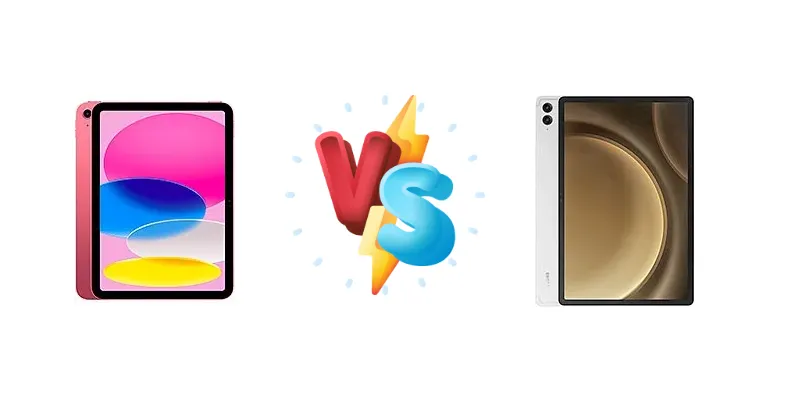
iPad (2022) vs. Samsung Galaxy Tab S9 FE+: Which Tablet Delivers the Best Value?
| Phones Images | |||||
|---|---|---|---|---|---|
|
🏆 Quick Verdict
For most users, the Samsung Galaxy Tab S9 FE+ offers a more compelling package. Its 45W charging and larger screen provide tangible benefits, while the Exynos 1380 delivers comparable performance to the A14 Bionic for everyday tasks. The iPad (2022) remains a solid choice within the Apple ecosystem, but the S9 FE+ provides superior value.
| PHONES | ||
|---|---|---|
| Phone Names | Apple iPad (2022) | Samsung Galaxy Tab S9 FE+ |
| Network | ||
|---|---|---|
| 2G bands | GSM 850 / 900 / 1800 / 1900 | GSM 850 / 900 / 1800 / 1900 |
| 3G bands | HSDPA 850 / 900 / 1700(AWS) / 1900 / 2100 - A2757 | HSDPA 850 / 900 / 1700(AWS) / 1900 / 2100 |
| 4G bands | 1, 2, 3, 4, 5, 7, 8, 11, 12, 13, 14, 17, 18, 19, 20, 21, 25, 26, 28, 29, 30, 32, 34, 38, 39, 40, 41, 42, 46, 48, 66, 71 - A2757 | 1, 2, 3, 4, 5, 7, 8, 12, 13, 17, 20, 26, 28, 32, 38, 40, 41, 66 |
| 5G bands | 1, 2, 3, 5, 7, 8, 12, 20, 25, 28, 29, 30, 38, 40, 41, 48, 66, 71, 77, 78, 79 SA/NSA/Sub6 - A2757, A2777 | 1, 3, 5, 7, 8, 20, 28, 38, 40, 41, 66, 77, 78 SA/NSA/Sub6 |
| Speed | HSPA, LTE, 5G - cellular model only | HSPA, LTE, 5G - cellular model only |
| Technology | GSM / HSPA / LTE / 5G | GSM / HSPA / LTE / 5G |
| 1, 2, 3, 4, 5, 7, 8, 12, 13, 14, 17, 18, 19, 20, 25, 26, 28, 29, 30, 32, 34, 38, 39, 40, 41, 42, 46, 48, 66, 71 - A2777 | - | |
| Launch | ||
|---|---|---|
| Announced | 2022, October 18 | 2023, October 04 |
| Status | Available. Released 2022, October 26 | Available. Released 2023, October 16 |
| Body | ||
|---|---|---|
| Build | Glass front, aluminum back, aluminum frame | Glass front, aluminum back, aluminum frame |
| Dimensions | 248.6 x 179.5 x 7 mm (9.79 x 7.07 x 0.28 in) | 285.4 x 185.4 x 6.5 mm (11.24 x 7.30 x 0.26 in) |
| SIM | Nano-SIM + eSIM (cellular model only) | Nano-SIM + eSIM (cellular model only) |
| Weight | 477 g (Wi-Fi) / 481 g (LTE) (1.05 lb) | 627 g or 628 g (1.38 lb) |
| Stylus support (1st gen only) | - | |
| Display | ||
|---|---|---|
| Protection | Scratch-resistant glass, oleophobic coating | - |
| Resolution | 1640 x 2360 pixels (~264 ppi density) | 1600 x 2560 pixels, 16:10 ratio (~243 ppi density) |
| Size | 10.9 inches, 359.2 cm2 (~80.5% screen-to-body ratio) | 12.4 inches, 445.8 cm2 (~84.3% screen-to-body ratio) |
| Type | Liquid Retina IPS LCD, 500 nits (typ) | IPS LCD, 90Hz |
| Platform | ||
|---|---|---|
| CPU | Hexa-core (2x3.0 GHz Firestorm + 4x1.8 GHz Icestorm) | Octa-core (4x2.4 GHz Cortex-A78 & 4x2.0 GHz Cortex-A55) |
| Chipset | Apple A14 Bionic (5 nm) | Exynos 1380 (5 nm) |
| GPU | Apple GPU (4-core graphics) | Mali-G68 MP5 |
| OS | iPadOS 16.1, upgradable to iPadOS 26.1 | Android 13, up to 4 major Android upgrades, One UI 6 |
| Memory | ||
|---|---|---|
| Card slot | No | microSDXC (dedicated slot) |
| Internal | 64GB 4GB RAM, 256GB 4GB RAM | 128GB 6GB RAM, 128GB 8GB RAM, 256GB 8GB RAM, 256GB 12GB RAM |
| Main Camera | ||
|---|---|---|
| Dual | - | 8 MP, (wide) 8 MP, (ultrawide) |
| Features | HDR, panorama | - |
| Single | 12 MP, f/1.8, (wide), PDAF | - |
| Video | 4K@24/25/30/60fps, 1080p@25/30/60/120/240fps | 4K@30fps, 1080p@30fps |
| Selfie camera | ||
|---|---|---|
| Features | HDR | - |
| Single | 12 MP, f/2.4, 122˚ (ultrawide) | 12 MP, (ultrawide) |
| Video | 1080p@25/30/60fps, gyro-EIS | Yes |
| Sound | ||
|---|---|---|
| 3.5mm jack | No | - |
| 35mm jack | No | No |
| Loudspeaker | Yes, with stereo speakers | Yes, with stereo speakers |
| Comms | ||
|---|---|---|
| Bluetooth | 5.2, A2DP, EDR, LE | 5.3, A2DP, LE |
| NFC | No | No |
| Positioning | GPS, GLONASS (Wi‑Fi + Cellular model only) | GPS, GALILEO, GLONASS, BDS, QZSS - cellular model only |
| Radio | No | No |
| USB | USB Type-C 2.0, DisplayPort; magnetic connector | USB Type-C 2.0, magnetic connector |
| WLAN | Wi-Fi 802.11 a/b/g/n/ac/6, dual-band, hotspot | Wi-Fi 802.11 a/b/g/n/ac/6, dual-band, Wi-Fi Direct |
| Features | ||
|---|---|---|
| Sensors | Fingerprint (top-mounted), accelerometer, gyro, compass, barometer | Fingerprint (side-mounted), accelerometer, gyro, compass, proximity (accessories only) |
| Battery | ||
|---|---|---|
| Charging | - | 45W wired, QC2.0 |
| Type | Li-Po 7606 mAh (28.6 Wh) | Li-Po 10090 mAh |
| Misc | ||
|---|---|---|
| Colors | Silver, Blue, Pink, Yellow | Mint, Silver, Gray, Lavender |
| Models | A3162, A2757, A2777, A2696, iPad13,18, iPad13,19 | SM-X610, SM-X616B |
| Price | About 430 EUR | About 770 EUR |
| SAR | - | 0.77 W/kg (body) |
| SAR EU | - | 0.50 W/kg (body) |
Apple iPad (2022)
- Strong single-core performance with the A14 Bionic.
- Seamless integration within the Apple ecosystem.
- Long-term software support from Apple.
- Slower charging speeds.
- Potentially smaller display size.
- Higher cost compared to the S9 FE+
Samsung Galaxy Tab S9 FE+
- 45W fast charging with QC2.0 support.
- Larger display for enhanced media consumption.
- More affordable price point.
- Potential for thermal throttling under sustained load.
- Android ecosystem fragmentation.
- Camera quality likely inferior to flagship tablets.
Display Comparison
While specific display specs (resolution, panel type) are missing for both, the Galaxy Tab S9 FE+’s larger screen size is a key differentiator. The iPad (2022) likely utilizes a standard LCD panel, while the S9 FE+ benefits from Samsung’s display expertise, potentially offering a wider color gamut and improved viewing angles. The absence of LTPO on either device suggests neither offers adaptive refresh rates, impacting smoothness during scrolling and gaming. Bezels are likely comparable, focusing on cost-effectiveness in this segment.
Camera Comparison
Neither tablet is positioned as a photography powerhouse. The iPad (2022) likely features a 12MP main camera, while the S9 FE+’s camera specs are unknown. Given the price point, image quality will be adequate for casual snapshots and video calls, but not competitive with dedicated cameras. The presence of a 2MP macro camera on the S9 FE+ is largely a marketing feature, offering limited practical benefit due to its low resolution and lack of optical image stabilization (OIS).
Performance
The Apple A14 Bionic, built on a 5nm process, features a hexa-core CPU with performance and efficiency cores. This architecture prioritizes single-core performance, beneficial for responsive app launching and general use. Conversely, the Samsung Galaxy Tab S9 FE+’s Exynos 1380, also 5nm, employs an octa-core configuration (4x2.4 GHz Cortex-A78 & 4x2.0 GHz Cortex-A55). While the Exynos has more cores, the A14’s Firestorm cores boast higher clock speeds. In real-world usage, the performance gap will be minimal for typical tasks, but the A14 may exhibit a slight edge in demanding applications. Thermal management is a question mark for the Exynos, as prolonged load could lead to throttling, potentially impacting sustained performance.
Battery Life
Battery capacity is unspecified for both devices. However, the Galaxy Tab S9 FE+’s 45W wired charging with QC2.0 support is a significant advantage. This allows for a much faster 0-100% charge compared to the iPad (2022), which typically supports slower charging speeds. While the iPad may offer slightly better battery optimization due to Apple’s software control, the S9 FE+’s faster charging mitigates concerns about battery life, allowing for quicker top-ups throughout the day.
Buying Guide
Buy the Apple iPad (2022) if you are deeply invested in the Apple ecosystem, prioritize seamless integration with other Apple devices, and value the long-term software support Apple provides. Buy the Samsung Galaxy Tab S9 FE+ if you prefer the flexibility of Android, need faster charging capabilities, and desire a larger display for media consumption and productivity without the premium price tag of Samsung's flagship tablets.