
iPad (2022) vs. Samsung Galaxy Tab S8+: Which Tablet Reigns Supreme?
| Phones Images | |||||
|---|---|---|---|---|---|
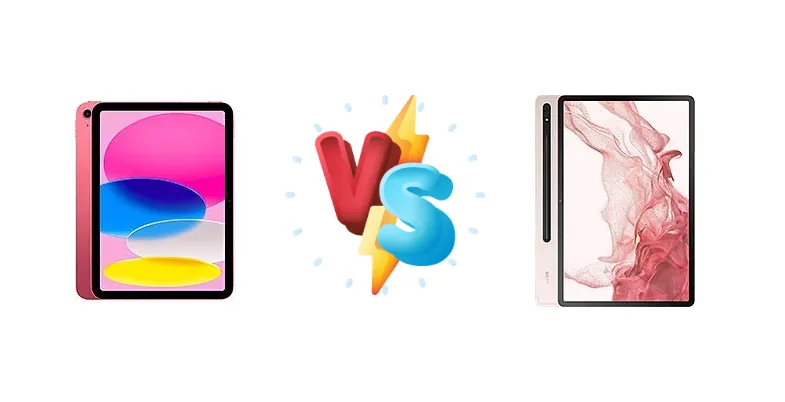
|
🏆 Quick Verdict
For most users, the Samsung Galaxy Tab S8+ emerges as the stronger choice. Its Snapdragon 8 Gen 1 chipset offers a noticeable performance advantage, particularly in demanding tasks, and the 45W charging significantly reduces downtime. While the iPad (2022) provides a streamlined experience, the Tab S8+ delivers more versatility.
| PHONES | ||
|---|---|---|
| Phone Names | Apple iPad (2022) | Samsung Galaxy Tab S8+ |
| Network | ||
|---|---|---|
| 2G bands | GSM 850 / 900 / 1800 / 1900 | GSM 850 / 900 / 1800 / 1900 |
| 3G bands | HSDPA 850 / 900 / 1700(AWS) / 1900 / 2100 - A2757 | HSDPA 850 / 900 / 1700(AWS) / 1900 / 2100 |
| 4G bands | 1, 2, 3, 4, 5, 7, 8, 11, 12, 13, 14, 17, 18, 19, 20, 21, 25, 26, 28, 29, 30, 32, 34, 38, 39, 40, 41, 42, 46, 48, 66, 71 - A2757 | LTE |
| 5G bands | 1, 2, 3, 5, 7, 8, 12, 20, 25, 28, 29, 30, 38, 40, 41, 48, 66, 71, 77, 78, 79 SA/NSA/Sub6 - A2757, A2777 | SA/NSA |
| Speed | HSPA, LTE, 5G - cellular model only | HSPA, LTE, 5G - cellular model only |
| Technology | GSM / HSPA / LTE / 5G | GSM / HSPA / LTE / 5G |
| 1, 2, 3, 4, 5, 7, 8, 12, 13, 14, 17, 18, 19, 20, 25, 26, 28, 29, 30, 32, 34, 38, 39, 40, 41, 42, 46, 48, 66, 71 - A2777 | - | |
| Launch | ||
|---|---|---|
| Announced | 2022, October 18 | 2022, February 09 |
| Status | Available. Released 2022, October 26 | Available. Released 2022, April 14 |
| Body | ||
|---|---|---|
| Build | Glass front, aluminum back, aluminum frame | - |
| Dimensions | 248.6 x 179.5 x 7 mm (9.79 x 7.07 x 0.28 in) | 285 x 185 x 5.7 mm (11.22 x 7.28 x 0.22 in) |
| SIM | Nano-SIM + eSIM (cellular model only) | Nano-SIM (cellular model only) |
| Weight | 477 g (Wi-Fi) / 481 g (LTE) (1.05 lb) | 567 g (Wi-Fi), 572 g (5G) (1.25 lb) |
| Stylus support (1st gen only) | Stylus, 6.2ms latency (Bluetooth integration, accelerometer, gyro) | |
| Display | ||
|---|---|---|
| Protection | Scratch-resistant glass, oleophobic coating | Corning Gorilla Glass 5 |
| Resolution | 1640 x 2360 pixels (~264 ppi density) | 1752 x 2800 pixels, 16:10 ratio (~266 ppi density) |
| Size | 10.9 inches, 359.2 cm2 (~80.5% screen-to-body ratio) | 12.4 inches, 446.1 cm2 (~84.6% screen-to-body ratio) |
| Type | Liquid Retina IPS LCD, 500 nits (typ) | Super AMOLED, 120Hz, HDR10+ |
| Platform | ||
|---|---|---|
| CPU | Hexa-core (2x3.0 GHz Firestorm + 4x1.8 GHz Icestorm) | Octa-core (1x3.00 GHz Cortex-X2 & 3x2.50 GHz Cortex-A710 & 4x1.80 GHz Cortex-A510) |
| Chipset | Apple A14 Bionic (5 nm) | Qualcomm SM8450 Snapdragon 8 Gen 1 (4 nm) |
| GPU | Apple GPU (4-core graphics) | Adreno 730 |
| OS | iPadOS 16.1, upgradable to iPadOS 26.1 | Android 12, up to 4 major Android upgrades, One UI 6.1.1 |
| Memory | ||
|---|---|---|
| Card slot | No | microSDXC (dedicated slot) |
| Internal | 64GB 4GB RAM, 256GB 4GB RAM | 128GB 8GB RAM, 256GB 8GB RAM, 256GB 12GB RAM, 512GB 8GB RAM, 512GB 16GB RAM |
| - | UFS | |
| Main Camera | ||
|---|---|---|
| Dual | - | 13 MP, f/2.0, 26mm (wide), 1/3.4", 1.0µm, AF 6 MP, f/2.2, (ultrawide) |
| Features | HDR, panorama | LED flash, HDR, panorama |
| Single | 12 MP, f/1.8, (wide), PDAF | - |
| Video | 4K@24/25/30/60fps, 1080p@25/30/60/120/240fps | 4K@30/60fps, 1080p@30fps |
| Selfie camera | ||
|---|---|---|
| Dual | - | 12 MP, f/2.4, 120˚ (ultrawide) |
| Features | HDR | HDR |
| Single | 12 MP, f/2.4, 122˚ (ultrawide) | - |
| Video | 1080p@25/30/60fps, gyro-EIS | 4K@30/60fps, 1080p@30fps |
| Sound | ||
|---|---|---|
| 3.5mm jack | No | No |
| 35mm jack | No | No |
| Loudspeaker | Yes, with stereo speakers | Yes, with stereo speakers (4 speakers) |
| - | Tuned by AKG | |
| Comms | ||
|---|---|---|
| Bluetooth | 5.2, A2DP, EDR, LE | 5.2, A2DP, LE |
| NFC | No | No |
| Positioning | GPS, GLONASS (Wi‑Fi + Cellular model only) | GPS, GLONASS, BDS, GALILEO - cellular model only |
| Radio | No | No |
| USB | USB Type-C 2.0, DisplayPort; magnetic connector | USB Type-C 3.2, magnetic connector |
| WLAN | Wi-Fi 802.11 a/b/g/n/ac/6, dual-band, hotspot | Wi-Fi 802.11 a/b/g/n/ac/6e, dual-band, Wi-Fi Direct |
| Features | ||
|---|---|---|
| Sensors | Fingerprint (top-mounted), accelerometer, gyro, compass, barometer | Fingerprint (under display, optical), accelerometer, gyro, proximity, compass |
| - | Wireless Samsung DeX | |
| Battery | ||
|---|---|---|
| Charging | - | 45W wired, 100% in 82 min |
| Type | Li-Po 7606 mAh (28.6 Wh) | Li-Po 10090 mAh |
| Misc | ||
|---|---|---|
| Colors | Silver, Blue, Pink, Yellow | Graphite, Silver, Pink Gold |
| Models | A3162, A2757, A2777, A2696, iPad13,18, iPad13,19 | SM-X800, SM-X806, SM-X806B, SM-X806U, SM-X806N |
| Price | About 430 EUR | About 950 EUR |
| SAR EU | - | 0.68 W/kg (body) |
Apple iPad (2022)
- Seamless Apple ecosystem integration
- User-friendly iPadOS interface
- Strong resale value
- Less powerful processor compared to Snapdragon 8 Gen 1
- Slower charging speeds
- Potentially limited multitasking capabilities
Samsung Galaxy Tab S8+
- Powerful Snapdragon 8 Gen 1 processor
- 45W fast charging (100% in 82 minutes)
- More versatile Android operating system
- Android tablet app ecosystem can be less optimized
- Potential for software bloatware
- May not integrate as seamlessly with Apple devices
Display Comparison
While both tablets likely feature high-quality displays, specific details like resolution and panel type are missing. However, the Tab S8+'s larger size suggests a more immersive viewing experience. The Snapdragon's superior GPU could translate to smoother visuals in graphically intensive applications. The iPad's display, while excellent, is likely to be a standard LCD, whereas Samsung often employs AMOLED technology in its high-end tablets, offering superior contrast and color vibrancy. Bezels are likely comparable, given both devices target a premium aesthetic.
Camera Comparison
Without specific camera specs, a detailed comparison is limited. However, Samsung generally prioritizes camera capabilities in its tablets, potentially offering a more versatile camera system than the iPad (2022). The Tab S8+ likely features a higher-resolution main sensor and potentially more advanced image processing algorithms. The iPad's camera is typically sufficient for basic video calls and document scanning, but it's unlikely to compete with the Tab S8+ in terms of image quality or features.
Performance
The core difference lies in the chipsets. The Samsung Galaxy Tab S8+ boasts the Qualcomm SM8450 Snapdragon 8 Gen 1 (4nm), an octa-core processor designed for flagship performance. This 4nm process node offers improved power efficiency compared to the Apple A14 Bionic's 5nm node, potentially leading to less thermal throttling during sustained workloads. The Snapdragon's octa-core configuration, with its Cortex-X2 prime core, is geared towards handling demanding tasks more effectively than the A14's hexa-core setup. While the A14 Bionic remains a capable chip, the Snapdragon 8 Gen 1 provides a clear advantage in raw processing power and GPU performance, benefiting gamers and power users.
Battery Life
Battery capacity is not specified, but the Tab S8+'s 45W wired charging is a significant advantage. Achieving a 100% charge in just 82 minutes is considerably faster than the iPad (2022)'s charging speed, which typically takes longer. While the iPad's A14 Bionic is known for its power efficiency, the Tab S8+'s faster charging mitigates any potential battery life disadvantage. The Snapdragon 8 Gen 1's 4nm process also contributes to improved power management, potentially offsetting the larger display's energy demands.
Buying Guide
Buy the Apple iPad (2022) if you prioritize seamless integration within the Apple ecosystem, value simplicity, and primarily need a tablet for basic productivity and media consumption. Buy the Samsung Galaxy Tab S8+ if you prefer the flexibility of Android, require more processing power for multitasking or gaming, and appreciate faster charging capabilities.