
iPad 10.2 (2021) vs Xiaomi Pad 5: Which Tablet Should You Buy?
| Phones Images | |||||
|---|---|---|---|---|---|
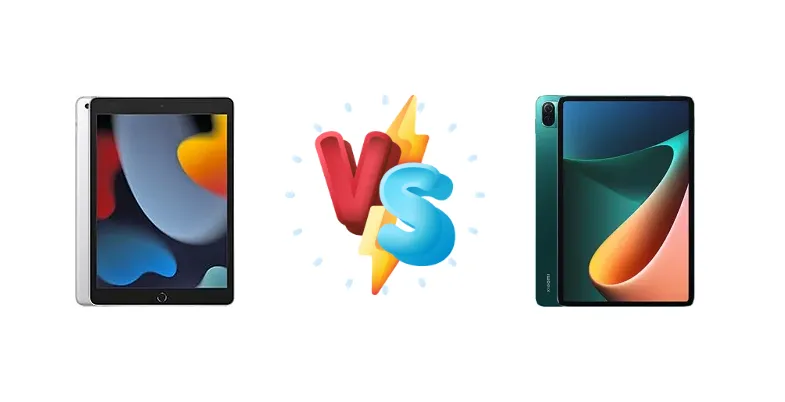
|
🏆 Quick Verdict
The Xiaomi Pad 5 offers significantly more power and faster charging for a lower price. However, the iPad 10.2 benefits from Apple's ecosystem, software support, and a generally smoother user experience, especially for those already invested in Apple products. It's a close call, but the Pad 5 wins on value.
| PHONES | ||
|---|---|---|
| Phone Names | Apple iPad 10.2 (2021) | Xiaomi Pad 5 |
| Network | ||
|---|---|---|
| 2G bands | GSM 850 / 900 / 1800 / 1900 | N/A |
| 3G bands | HSDPA 800 / 850 / 900 / 1700(AWS) / 1900 / 2100 | N/A |
| 4G bands | 1, 2, 3, 4, 5, 7, 8, 11, 12, 13, 14, 17, 18, 19, 20, 21, 25, 26, 29, 30, 34, 38, 39, 40, 41, 66, 71 - A2603 | - |
| EDGE | - | N/A |
| GPRS | - | N/A |
| Speed | HSPA, LTE - cellular model only | - |
| Technology | GSM / HSPA / LTE | No cellular connectivity |
| 1, 2, 3, 4, 5, 7, 8, 11, 12, 13, 14, 17, 18, 19, 20, 21, 25, 26, 28, 29, 30, 34, 38, 39, 40, 41, 66 - A2604 | - | |
| Launch | ||
|---|---|---|
| Announced | 2021, September 14 | 2021, August 10 |
| Status | Available. Released 2021, September 24 | Available. Released 2021, August 10 |
| Body | ||
|---|---|---|
| Build | Glass front, aluminum back, aluminum frame | Glass front, aluminum frame, plastic back |
| Dimensions | 250.6 x 174.1 x 7.5 mm (9.87 x 6.85 x 0.30 in) | 254.7 x 166.3 x 6.9 mm (10.03 x 6.55 x 0.27 in) |
| SIM | Nano-SIM + eSIM (cellular model only) | No |
| Weight | 487 g (Wi-Fi) / 498 g (LTE) (1.07 lb) | 511 g (1.13 lb) |
| Stylus support (1st gen only) | Stylus support (magnetic) | |
| Display | ||
|---|---|---|
| Protection | Scratch-resistant glass, oleophobic coating | - |
| Resolution | 1620 x 2160 pixels, 4:3 ratio (~265 ppi density) | 1600 x 2560 pixels, 16:10 ratio (~274 ppi density) |
| Size | 10.2 inches, 322.2 cm2 (~73.8% screen-to-body ratio) | 11.0 inches, 350.9 cm2 (~82.8% screen-to-body ratio) |
| Type | Retina IPS LCD, 500 nits (typ) | IPS LCD, 1B colors, 120Hz, HDR10, Dolby Vision |
| Platform | ||
|---|---|---|
| CPU | Hexa-core (2x2.65 GHz Lightning + 4x1.8 GHz Thunder) | Octa-core (1x2.96 GHz Kryo 485 Gold & 3x2.42 GHz Kryo 485 Gold & 4x1.78 GHz Kryo 485 Silver) |
| Chipset | Apple A13 Bionic (7 nm+) | Qualcomm Snapdragon 860 (7 nm) |
| GPU | Apple GPU (4-core graphics) | Adreno 640 |
| OS | iPadOS 15, upgradable to iPadOS 26.1 | Android 11, upgradable to Android 13, MIUI 14 |
| Memory | ||
|---|---|---|
| Card slot | No | No |
| Internal | 64GB 3GB RAM, 256GB 3GB RAM | 128GB 6GB RAM, 256GB 6GB RAM |
| - | UFS 3.1 | |
| Main Camera | ||
|---|---|---|
| Features | HDR, panorama | Dual-LED flash, HDR, panorama |
| Single | 8 MP, f/2.4, 31mm (standard), 1.12µm, AF | 13 MP, f/2.0 |
| Video | 1080p@25/30fps, 720p@120fps; gyro-EIS | 4K@30fps, 1080p@30fps |
| Selfie camera | ||
|---|---|---|
| Features | HDR | - |
| Single | 12 MP, f/2.4, 122˚ (ultrawide) | 8 MP, f/2.0 |
| Video | 1080p@25/30/60fps, gyro-EIS | 1080p@30fps |
| Sound | ||
|---|---|---|
| 3.5mm jack | Yes | No |
| 35mm jack | Yes | No |
| Loudspeaker | Yes, with stereo speakers | Yes, with stereo speakers (4 speakers) |
| - | 24-bit/192kHz audio | |
| Comms | ||
|---|---|---|
| Bluetooth | 4.2, A2DP, EDR, LE | 5.0, A2DP, LE |
| NFC | No | No |
| Positioning | GPS, GLONASS - cellular model only | No |
| Radio | No | No |
| USB | Lightning, USB 2.0; magnetic connector | USB Type-C |
| WLAN | Wi-Fi 802.11 a/b/g/n/ac, dual-band, hotspot | Wi-Fi 802.11 a/b/g/n/ac, dual-band, Wi-Fi Direct |
| Features | ||
|---|---|---|
| Sensors | Fingerprint (front-mounted), accelerometer, gyro, compass, barometer | Accelerometer, gyro, proximity, compass |
| Battery | ||
|---|---|---|
| Charging | - | 33W wired, PD3.0 |
| Type | Li-Ion 8557 mAh (32.4 Wh) | Li-Po 8720 mAh |
| Misc | ||
|---|---|---|
| Colors | Silver, Space Gray | Cosmic Gray, Pearl White, Green |
| Models | A2603, A2604, iPad12,1, iPad12,2 | 21051182G, 21051182C |
| Price | About 430 EUR | About 350 EUR |
| Tests | ||
|---|---|---|
| Camera | Photo / Video | - |
| Display | Contrast ratio: 1123:1 (nominal) | Contrast ratio: 1271:1 (nominal) |
| Loudspeaker | -29.4 LUFS (Average) | -24.4 LUFS (Very good) |
| Performance | AnTuTu: 617292(v9) GeekBench: 3124 (v5.1) GFXBench: 44fps (ES 3.1 onscreen) | AnTuTu: 473819 (v8), 555079 (v9) GeekBench: 2583 (v5.1) GFXBench: 24fps (ES 3.1 onscreen) |
Apple iPad 10.2 (2021)
- Excellent software support
- Smooth user experience
- Strong ecosystem integration
- Good video recording
- Older chipset
- Slower charging
- Higher price
- 60Hz display
Xiaomi Pad 5
- Powerful Snapdragon 860
- 120Hz display
- Fast charging (33W)
- More affordable
- Excellent value
- Android ecosystem
- Potentially shorter software support lifespan
- Camera not exceptional
Display Comparison
The Xiaomi Pad 5 boasts a slightly better contrast ratio (1271:1 vs 1123:1) and while the iPad 10.2 has a higher measured brightness (513 nits vs 478 nits), both offer excellent viewing experiences. The Xiaomi Pad 5 also features a 120Hz refresh rate, providing smoother scrolling and animations, a significant advantage over the iPad's standard 60Hz.
Camera Comparison
Camera quality is generally not a primary concern for tablets. Both devices offer basic photo and video capabilities. The iPad's camera is generally considered slightly better for video recording, but the difference is minimal. Neither tablet excels in this area.
Performance
The Xiaomi Pad 5's Snapdragon 860 significantly outperforms the iPad 10.2's A13 Bionic in raw processing power. Expect faster app loading, smoother multitasking, and better gaming performance on the Xiaomi Pad 5. The iPad's A13 is still capable, but it's showing its age.
Battery Life
While both offer all-day battery life under moderate usage, the Xiaomi Pad 5's 33W fast charging provides a significant advantage, allowing for quicker top-ups compared to the iPad's slower charging speeds.
Buying Guide
Who should buy the Apple iPad 10.2 (2021)? Users deeply embedded in the Apple ecosystem, those prioritizing long-term software updates, and those who value a simple, polished user experience. Who should buy the Xiaomi Pad 5? Users seeking high performance, a vibrant display, and fast charging at a more affordable price point, especially those comfortable with Android.