
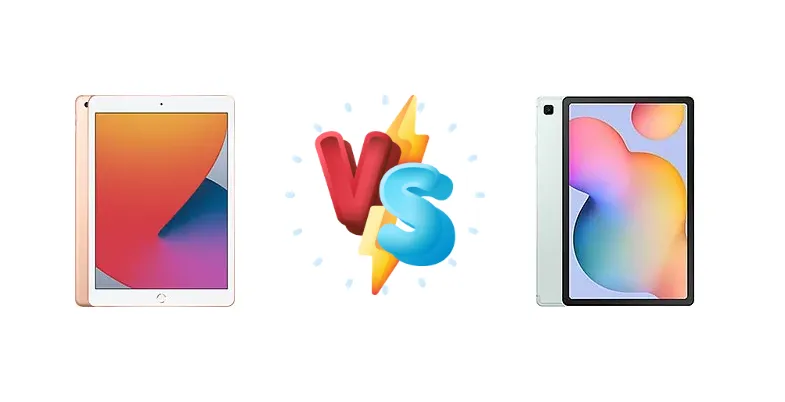
iPad 10.2 (2020) vs. Galaxy Tab S6 Lite (2024): Which Budget Tablet Reigns Supreme?
| Phones Images | |||||
|---|---|---|---|---|---|
|
🏆 Quick Verdict
For most users, the Samsung Galaxy Tab S6 Lite (2024) emerges as the better choice. Its newer Exynos 1280 chipset, fabricated on a more efficient 5nm process, provides a noticeable performance uplift and improved thermal management compared to the iPad 10.2’s aging A12 Bionic. While the iPad benefits from Apple’s ecosystem, the Tab S6 Lite offers a more modern experience at a competitive price.
| PHONES | ||
|---|---|---|
| Phone Names | Apple iPad 10.2 (2020) | Samsung Galaxy Tab S6 Lite (2024) |
| Network | ||
|---|---|---|
| 2G bands | GSM 850 / 900 / 1800 / 1900 | GSM 850 / 900 / 1800 / 1900 |
| 3G bands | HSDPA 800 / 850 / 900 / 1700(AWS) / 1900 / 2100 | HSDPA 850 / 900 / 1700(AWS) / 1900 / 2100 |
| 4G bands | 1, 2, 3, 4, 5, 7, 8, 11, 12, 13, 14, 17, 18, 19, 20, 21, 25, 26, 29, 30, 34, 38, 39, 40, 41, 66, 71 - A2428 | 1, 2, 3, 4, 5, 7, 8, 12, 17, 20, 25, 26, 28, 38, 40, 41, 66 |
| Speed | HSPA, LTE | HSPA, LTE - cellular model only |
| Technology | GSM / HSPA / LTE | GSM / HSPA / LTE |
| 1, 2, 3, 4, 5, 7, 8, 11, 12, 13, 14, 17, 18, 19, 20, 21, 25, 26, 28, 29, 30, 32, 34, 38, 39, 40, 41, 66 - A2429 | - | |
| Launch | ||
|---|---|---|
| Announced | 2020, September 15 | 2024, March 26 |
| Status | Available. Released 2020, September 18 | Available. Released 2024, March 28 |
| Body | ||
|---|---|---|
| Build | Glass front, aluminum back, aluminum frame | Glass front, aluminum back, aluminum frame |
| Dimensions | 250.6 x 174.1 x 7.5 mm (9.87 x 6.85 x 0.30 in) | 244.5 x 154.3 x 7 mm (9.63 x 6.07 x 0.28 in) |
| SIM | Nano-SIM + eSIM | Nano-SIM (cellular model only) |
| Weight | 490 g (Wi-Fi) / 495 g (LTE) (1.08 lb) | 465/467 g (1.03 lb) |
| Stylus support (1st gen only) | - | |
| Display | ||
|---|---|---|
| Protection | Scratch-resistant glass, oleophobic coating | - |
| Resolution | 1620 x 2160 pixels, 4:3 ratio (~264 ppi density) | 1200 x 2000 pixels, 5:3 ratio (~224 ppi density) |
| Size | 10.2 inches, 324.6 cm2 (~74.4% screen-to-body ratio) | 10.4 inches, 307.9 cm2 (~81.6% screen-to-body ratio) |
| Type | Retina IPS LCD, 500 nits (typ) | TFT LCD |
| Platform | ||
|---|---|---|
| CPU | Hexa-core (2x2.5 GHz Vortex + 4x1.6 GHz Tempest) | Octa-core (2x2.4 GHz Cortex-A78 & 6x2.0 GHz Cortex-A55) |
| Chipset | Apple A12 Bionic (7 nm) | Exynos 1280 (5 nm) |
| GPU | Apple GPU (4-core graphics) | Mali-G68 |
| OS | iPadOS 14, upgradable to iPadOS 26.1 | Android 14, upgradable to Android 15, One UI 7 |
| Memory | ||
|---|---|---|
| Card slot | No | microSDXC (dedicated slot) |
| Internal | 32GB 3GB RAM, 128GB 3GB RAM | 64GB 4GB RAM, 128GB 4GB RAM |
| Main Camera | ||
|---|---|---|
| Features | HDR, panorama | HDR, panorama |
| Single | 8 MP, f/2.4, 31mm (standard), 1.12µm, AF | 8 MP, (wide), 1/4.0", 1.12µm, AF |
| Video | 1080p@30fps, 720p@120fps, HDR | 1080p@30fps |
| Selfie camera | ||
|---|---|---|
| Features | HDR | - |
| Single | 1.2 MP, f/2.2, 31mm (standard) | 5 MP, (wide), 1/5.0", 1.12µm |
| Video | 720p@30fps | 1080p@30fps |
| Sound | ||
|---|---|---|
| 3.5mm jack | Yes | - |
| 35mm jack | Yes | Yes |
| Loudspeaker | Yes, with stereo speakers | Yes, with stereo speakers |
| Comms | ||
|---|---|---|
| Bluetooth | 4.2, A2DP, EDR, LE | 5.3, A2DP, LE |
| NFC | No | No |
| Positioning | GPS, GLONASS (Wi‑Fi + Cellular model only) | GPS, GLONASS, BDS, GALILEO, QZSS - cellular model only |
| Radio | No | No |
| USB | Lightning, USB 2.0; magnetic connector | USB Type-C 2.0 |
| WLAN | Wi-Fi 802.11 a/b/g/n/ac, dual-band, hotspot | Wi-Fi 802.11 a/b/g/n/ac, dual-band, Wi-Fi Direct |
| Features | ||
|---|---|---|
| Sensors | Fingerprint (front-mounted), accelerometer, gyro, compass, barometer | Accelerometer, proximity, gyro (wi-fi model only) |
| Battery | ||
|---|---|---|
| Charging | - | 15W wired |
| Type | Li-Ion 8827 mAh (32.4 Wh) | Li-Po 7040 mAh |
| Misc | ||
|---|---|---|
| Colors | Silver, Gold, Space Gray | Gray, Mint, Rose Gold |
| Models | A2428, A2429, A2270, A2430, iPad11,6, iPad11,7 | SM-P620, SM-P625 |
| Price | About 370 EUR | $ 215.00 |
| SAR | - | 0.95 W/kg (body) |
Apple iPad 10.2 (2020)
- Strong Apple ecosystem integration
- Proven reliability and software support
- Familiar iOS interface
- Aging A12 Bionic chipset
- Less efficient 7nm process
- Likely lacks modern display features
Samsung Galaxy Tab S6 Lite (2024)
- More powerful Exynos 1280 chipset
- Efficient 5nm fabrication process
- Included S Pen for enhanced productivity
- Android ecosystem may not appeal to all
- Slower 15W charging
- Camera performance likely basic
Display Comparison
Both tablets feature 10.4-inch displays, but details beyond that are scarce for the iPad. The Tab S6 Lite’s display benefits from Samsung’s display expertise, though specific brightness nits aren’t provided. The iPad’s older display technology likely lacks features like adaptive refresh rates found in higher-end Samsung tablets. Bezels are likely comparable, given both target the budget segment. Color accuracy is an unknown for both, but Samsung generally offers more vibrant and saturated colors.
Camera Comparison
Camera performance is unlikely to be a deciding factor for either tablet. Details are limited, but both are expected to offer basic camera capabilities suitable for casual snapshots. The iPad 10.2’s camera specs are unknown. The Tab S6 Lite’s camera details are also missing, suggesting neither device prioritizes photography. Image processing will likely differ, with Samsung leaning towards more vibrant colors and Apple aiming for more natural tones.
Performance
The core difference lies in the chipsets. The Samsung Galaxy Tab S6 Lite (2024) utilizes the Exynos 1280 (5nm), an octa-core processor with a mix of Cortex-A78 and A55 cores. This contrasts with the Apple iPad 10.2 (2020)’s A12 Bionic (7nm), a hexa-core chip. The 5nm fabrication process of the Exynos 1280 offers superior power efficiency and potentially better sustained performance due to reduced thermal throttling. While the A12 Bionic remains capable, the Exynos 1280’s newer architecture provides a performance edge, particularly in multi-threaded tasks. RAM specifications are not provided, but the Exynos 1280 benefits from modern memory controllers.
Battery Life
Battery capacity is not specified for either device. However, the Exynos 1280’s 5nm process contributes to better power efficiency, potentially offsetting any capacity differences. The Tab S6 Lite supports 15W wired charging, a relatively slow charging speed compared to some modern tablets. The iPad’s charging speed is also likely similar, given its age. Real-world battery life will depend heavily on usage patterns, but the Exynos 1280’s efficiency gives the Tab S6 Lite a potential advantage.
Buying Guide
Buy the Apple iPad 10.2 (2020) if you are deeply entrenched in the Apple ecosystem, prioritize seamless integration with other Apple devices, and require a proven, reliable tablet for basic tasks like web browsing and media consumption. Buy the Samsung Galaxy Tab S6 Lite (2024) if you prefer the flexibility of Android, value a more powerful processor for multitasking and light gaming, and appreciate the included S Pen for note-taking and creative work.