
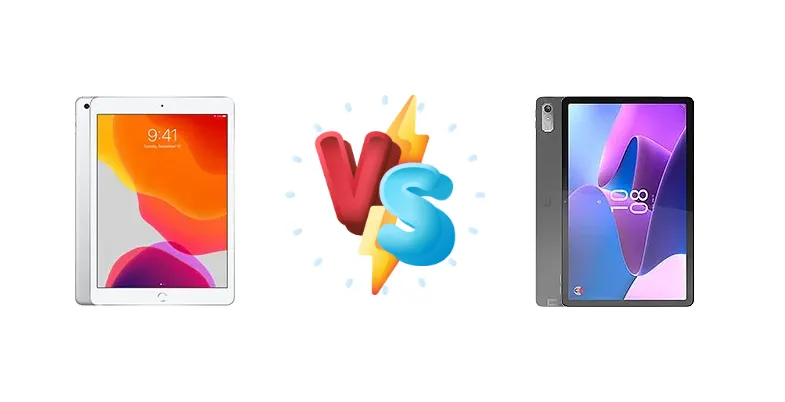
iPad 10.2 (2019) vs. Lenovo Tab P11 Gen 2: A Detailed Comparison
| Phones Images | |||||
|---|---|---|---|---|---|
|
🏆 Quick Verdict
For most users, the Lenovo Tab P11 Gen 2 emerges as the better choice. Its Mediatek Helio G99 chipset, built on a 6nm process, delivers significantly improved CPU and GPU performance compared to the iPad 10.2’s aging A10 Fusion. While the iPad benefits from Apple’s software optimization, the P11 Gen 2’s raw power and efficiency provide a more future-proof experience.
| PHONES | ||
|---|---|---|
| Phone Names | Apple iPad 10.2 (2019) | Lenovo Tab P11 Gen 2 |
| Network | ||
|---|---|---|
| 2G bands | GSM 850 / 900 / 1800 / 1900 | GSM 850 / 900 / 1800 / 1900 |
| 3G bands | HSDPA 800 / 850 / 900 / 1700(AWS) / 1900 / 2100 | HSDPA 800 / 850 / 900 / 1700(AWS) / 1900 / 2100 |
| 4G bands | 1, 2, 3, 4, 5, 7, 8, 11, 12, 13, 14, 17, 18, 19, 20, 21, 25, 26, 29, 30, 34, 38, 39, 40, 41, 66, 71 - A2200 | 1, 2, 3, 4, 5, 7, 8, 12, 13, 18, 19, 20, 25, 26, 28, 38, 40, 41, 66 |
| Speed | HSPA 42.2/5.76 Mbps, LTE Cat16 1024/150 Mbps, EV-DO Rev.A 3.1 Mbps | HSPA, LTE - cellular model only |
| Technology | GSM / CDMA / HSPA / EVDO / LTE | GSM / HSPA / LTE |
| 1, 2, 3, 4, 5, 7, 8, 11, 12, 13, 14, 17, 18, 19, 20, 21, 25, 26, 28, 29, 30, 34, 38, 39, 40, 41, 66 - A2198 | - | |
| Launch | ||
|---|---|---|
| Announced | 2019, September 12. Released 2019, September 21 | 2022, September 01 |
| Status | Discontinued | Available. Released 2023, January |
| Body | ||
|---|---|---|
| Build | Glass front, aluminum back, aluminum frame | - |
| Dimensions | 250.6 x 174.1 x 7.5 mm (9.87 x 6.85 x 0.30 in) | 269.1 x 169.4 x 7.4 mm (10.59 x 6.67 x 0.29 in) |
| Keyboard | QWERTY | - |
| SIM | Nano-SIM + eSIM | Nano-SIM (cellular model only) |
| Weight | 483 g (Wi-Fi) / 493 g (LTE) (1.06 lb) | 520 g (1.15 lb) |
| Stylus support (1st gen only) | Stylus support | |
| Display | ||
|---|---|---|
| Protection | Scratch-resistant glass, oleophobic coating | - |
| Resolution | 1620 x 2160 pixels, 4:3 ratio (~264 ppi density) | 1200 x 2000 pixels, 5:3 ratio (~203 ppi density) |
| Size | 10.2 inches, 324.6 cm2 (~74.4% screen-to-body ratio) | 11.5 inches, 376.4 cm2 (~82.6% screen-to-body ratio) |
| Type | IPS LCD | IPS LCD, 120Hz, 400 nits (typ) |
| Platform | ||
|---|---|---|
| CPU | Quad-core 2.34 GHz (2x Hurricane + 2x Zephyr) | Octa-core (2x2.2 GHz Cortex-A76 & 6x2.0 GHz Cortex-A55) |
| Chipset | Apple A10 Fusion (16 nm) | Mediatek Helio G99 (6 nm) |
| GPU | PowerVR Series7XT Plus (six-core graphics) | Mali-G57 MC2 |
| OS | iOS 13, upgradable to iPadOS 18.7 | Android 12L |
| Memory | ||
|---|---|---|
| Call records | 20 dialed, 20 received, 20 missed calls | - |
| Card slot | No | microSDXC (dedicated slot) |
| Internal | 32GB 3GB RAM, 128GB 3GB RAM | 64GB 4GB RAM, 128GB 4GB RAM, 128GB 6GB RAM |
| Phonebook | 3000 entries | - |
| Main Camera | ||
|---|---|---|
| Features | HDR | LED flash |
| Single | 8 MP, f/2.4, 31mm (standard), 1.12µm, AF | 13 MP, f/2.4, (wide), AF |
| Video | 1080p@30fps, 720p@120fps, HDR | 1080p@30fps |
| Selfie camera | ||
|---|---|---|
| Features | HDR | - |
| Single | 1.2 MP, f/2.2, 31mm (standard) | 8 MP, f/2.0 |
| Video | 720p@30fps | 1080p@30fps |
| Sound | ||
|---|---|---|
| 3.5mm jack | Yes | Yes |
| 35mm jack | Yes | Yes |
| Loudspeaker | Yes, with stereo speakers | Yes, with stereo speakers (4 speakers) |
| Comms | ||
|---|---|---|
| Bluetooth | 4.2, A2DP, EDR, LE | 5.2, A2DP, LE |
| NFC | No | No |
| Positioning | GPS, GLONASS (Wi‑Fi + Cellular model only) | GPS, GLONASS, BDS - cellular model only |
| Radio | No | No |
| USB | Lightning, USB 2.0; magnetic connector | USB Type-C 2.0, OTG, magnetic connector |
| WLAN | Wi-Fi 802.11 a/b/g/n/ac, dual-band, hotspot | Wi-Fi 802.11 a/b/g/n/ac/6e, dual-band, Wi-Fi Direct |
| Features | ||
|---|---|---|
| Browser | WAP 2.0/xHTML | - |
| Games | Downloadable | - |
| Java | Yes | - |
| Messaging | SMS, MMS, Email | - |
| Sensors | Fingerprint (front-mounted), accelerometer, gyro, compass, barometer | Accelerometer, gyro, proximity |
| Battery | ||
|---|---|---|
| Stand-by | Up to 400 h (2G) / Up to 150 h (3G) | - |
| Talk time | Up to 10 h (multimedia) | - |
| Type | Li-Po 8827 mAh, non-removable (32.9 Wh) | Li-Po 7700 mAh |
| Misc | ||
|---|---|---|
| Colors | Silver, Gold, Space Gray | Storm Grey, Sage |
| Models | A2197, A2200, A2198, iPad7,11, iPad7,12 | TB350FU |
| Price | About 350 EUR | About 350 EUR |
Apple iPad 10.2 (2019)
- Strong software ecosystem and long-term support from Apple.
- Reliable performance for basic tasks.
- Good build quality and resale value.
- Aging A10 Fusion chipset struggles with demanding tasks.
- Less efficient 16nm process.
- Limited upgrade path.
Lenovo Tab P11 Gen 2
- More powerful and efficient Mediatek Helio G99 chipset.
- Modern 6nm process for improved performance and battery life.
- Android OS offers greater customization options.
- Software updates may not be as frequent or long-lasting as Apple’s.
- Lenovo’s brand reputation isn’t as strong as Apple’s.
- Potential for bloatware (though often removable).
Display Comparison
Both tablets likely feature LCD panels, though specific details like peak brightness are unavailable. The iPad 10.2 (2019) has a 10.2-inch display, while the P11 Gen 2 boasts an 11-inch screen. The P11 Gen 2’s newer panel technology *may* offer slightly improved color accuracy and viewing angles. However, without detailed display testing, it’s difficult to quantify the difference. Bezels are likely comparable, typical of tablets in this price range.
Camera Comparison
Camera performance is unlikely to be a deciding factor for most tablet buyers. Both devices likely feature basic camera setups. Given the context data, detailed analysis is limited. The P11 Gen 2 *may* benefit from newer image processing algorithms, but the A10 Fusion’s ISP is still capable. Focusing on the CPU/GPU difference is more relevant.
Performance
The core difference lies in the chipsets. The iPad 10.2 (2019) utilizes the Apple A10 Fusion, a 16nm chip with a quad-core CPU. The Lenovo Tab P11 Gen 2, however, is powered by the Mediatek Helio G99, a 6nm octa-core processor. This process node difference is crucial; 6nm allows for greater transistor density and improved power efficiency. The Helio G99’s CPU configuration (2x2.2 GHz Cortex-A76 & 6x2.0 GHz Cortex-A55) provides a significant advantage in multi-core performance compared to the A10 Fusion’s (2x Hurricane + 2x Zephyr). This translates to faster app loading times, smoother multitasking, and better gaming performance on the Lenovo.
Battery Life
Battery capacity details are missing for both devices. However, the Mediatek Helio G99’s 6nm process contributes to better power efficiency. This means the Lenovo Tab P11 Gen 2 is likely to offer comparable or even better battery life than the iPad 10.2 (2019), despite potentially having a similar battery capacity. Charging wattage is also unknown, but the efficiency gains of the G99 could result in faster overall charging times.
Buying Guide
Buy the Apple iPad 10.2 (2019) if you are deeply embedded in the Apple ecosystem, prioritize long-term software support, and require a tablet primarily for basic tasks like web browsing, email, and light productivity. Buy the Lenovo Tab P11 Gen 2 if you prioritize performance for gaming and multitasking, prefer the Android operating system, and seek a more modern chipset for a similar price point.