
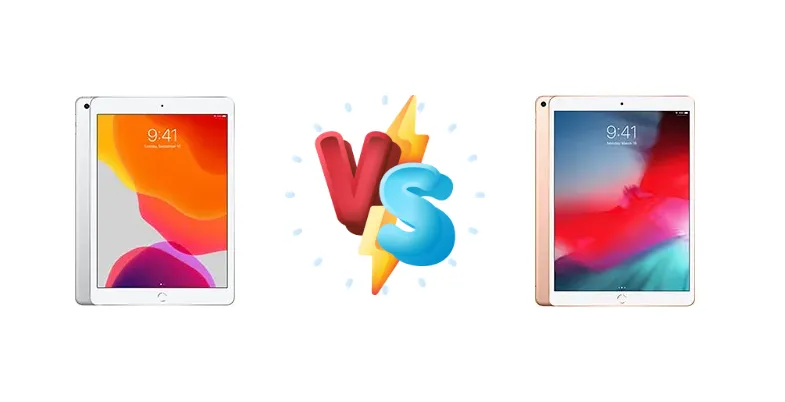
iPad Air (2019) vs iPad 10.2 (2019): Which Apple Tablet Reigns Supreme?
| Phones Images | |||||
|---|---|---|---|---|---|
|
🏆 Quick Verdict
For most users, the iPad Air (2019) is the superior choice. The A12 Bionic chip provides a substantial performance boost over the A10 Fusion in the iPad 10.2, enabling smoother multitasking, faster app loading, and a more future-proof experience. While the iPad 10.2 remains a viable option for basic tasks, the Air’s added power justifies the price difference.
| PHONES | ||
|---|---|---|
| Phone Names | Apple iPad 10.2 (2019) | Apple iPad Air (2019) |
| Network | ||
|---|---|---|
| 2G bands | GSM 850 / 900 / 1800 / 1900 | GSM 850 / 900 / 1800 / 1900 |
| 3G bands | HSDPA 800 / 850 / 900 / 1700(AWS) / 1900 / 2100 | HSDPA 850 / 900 / 1700(AWS) / 1900 / 2100 |
| 4G bands | 1, 2, 3, 4, 5, 7, 8, 11, 12, 13, 14, 17, 18, 19, 20, 21, 25, 26, 29, 30, 34, 38, 39, 40, 41, 66, 71 - A2200 | 1, 2, 3, 4, 5, 7, 8, 11, 12, 13, 14, 17, 18, 19, 20, 21, 25, 26, 29, 30, 34, 38, 39, 40, 41, 46, 66, 71 - A2153 |
| Speed | HSPA 42.2/5.76 Mbps, LTE Cat16 1024/150 Mbps, EV-DO Rev.A 3.1 Mbps | HSPA 42.2/5.76 Mbps, LTE Cat16 1024/150 Mbps |
| Technology | GSM / CDMA / HSPA / EVDO / LTE | GSM / HSPA / LTE |
| 1, 2, 3, 4, 5, 7, 8, 11, 12, 13, 14, 17, 18, 19, 20, 21, 25, 26, 28, 29, 30, 34, 38, 39, 40, 41, 66 - A2198 | 1, 2, 3, 4, 5, 7, 8, 11, 12, 13, 14, 17, 18, 19, 20, 21, 25, 26, 28, 29, 30, 34, 38, 39, 40, 41, 46, 66 - A2123 | |
| Launch | ||
|---|---|---|
| Announced | 2019, September 12. Released 2019, September 21 | 2019, March 18. Released 2019, March 18 |
| Status | Discontinued | Discontinued |
| Body | ||
|---|---|---|
| Build | Glass front, aluminum back, aluminum frame | Glass front, aluminum back, aluminum frame |
| Dimensions | 250.6 x 174.1 x 7.5 mm (9.87 x 6.85 x 0.30 in) | 250.6 x 174.1 x 6.1 mm (9.87 x 6.85 x 0.24 in) |
| Keyboard | QWERTY | - |
| SIM | Nano-SIM + eSIM | Nano-SIM + eSIM |
| Weight | 483 g (Wi-Fi) / 493 g (LTE) (1.06 lb) | 456 g (Wi-Fi) / 464 g (3G/LTE) (1.01 lb) |
| Stylus support (1st gen only) | Stylus support (1st gen only) | |
| Display | ||
|---|---|---|
| Protection | Scratch-resistant glass, oleophobic coating | Scratch-resistant glass, oleophobic coating |
| Resolution | 1620 x 2160 pixels, 4:3 ratio (~264 ppi density) | 1668 x 2224 pixels, 4:3 ratio (~265 ppi density) |
| Size | 10.2 inches, 324.6 cm2 (~74.4% screen-to-body ratio) | 10.5 inches, 341.4 cm2 (~78.3% screen-to-body ratio) |
| Type | IPS LCD | IPS LCD |
| - | True-tone | |
| Platform | ||
|---|---|---|
| CPU | Quad-core 2.34 GHz (2x Hurricane + 2x Zephyr) | Hexa-core (2x2.5 GHz Vortex + 4x1.6 GHz Tempest) |
| Chipset | Apple A10 Fusion (16 nm) | Apple A12 Bionic (7 nm) |
| GPU | PowerVR Series7XT Plus (six-core graphics) | Apple GPU (4-core graphics) |
| OS | iOS 13, upgradable to iPadOS 18.7 | iOS 12.1.3, upgradable to iPadOS 18.6 |
| Memory | ||
|---|---|---|
| Call records | 20 dialed, 20 received, 20 missed calls | - |
| Card slot | No | No |
| Internal | 32GB 3GB RAM, 128GB 3GB RAM | 64GB 3GB RAM, 256GB 3GB RAM |
| Phonebook | 3000 entries | - |
| Main Camera | ||
|---|---|---|
| Features | HDR | HDR |
| Single | 8 MP, f/2.4, 31mm (standard), 1.12µm, AF | 8 MP, f/2.4, 31mm (standard), 1.12µm, AF |
| Video | 1080p@30fps, 720p@120fps, HDR | 1080p@30fps |
| Selfie camera | ||
|---|---|---|
| Features | HDR | HDR |
| Single | 1.2 MP, f/2.2, 31mm (standard) | 7 MP, f/2.2, 31mm (standard) |
| Video | 720p@30fps | 1080p@30fps |
| Sound | ||
|---|---|---|
| 3.5mm jack | Yes | Yes |
| 35mm jack | Yes | Yes |
| Loudspeaker | Yes, with stereo speakers | Yes, with stereo speakers |
| Comms | ||
|---|---|---|
| Bluetooth | 4.2, A2DP, EDR, LE | 5.0, A2DP, EDR |
| NFC | No | No |
| Positioning | GPS, GLONASS (Wi‑Fi + Cellular model only) | GPS, GLONASS (LTE model only) |
| Radio | No | No |
| USB | Lightning, USB 2.0; magnetic connector | Lightning, USB 2.0 |
| WLAN | Wi-Fi 802.11 a/b/g/n/ac, dual-band, hotspot | Wi-Fi 802.11 a/b/g/n/ac, dual-band, hotspot |
| Features | ||
|---|---|---|
| Browser | WAP 2.0/xHTML | - |
| Games | Downloadable | - |
| Java | Yes | - |
| Messaging | SMS, MMS, Email | - |
| Sensors | Fingerprint (front-mounted), accelerometer, gyro, compass, barometer | Fingerprint (front-mounted), accelerometer, gyro, compass, barometer |
| Battery | ||
|---|---|---|
| Stand-by | Up to 400 h (2G) / Up to 150 h (3G) | - |
| Talk time | Up to 10 h (multimedia) | Up to 10 h (multimedia) |
| Type | Li-Po 8827 mAh, non-removable (32.9 Wh) | Li-Po 8134 mAh, non-removable (30.8 Wh) |
| Misc | ||
|---|---|---|
| Colors | Silver, Gold, Space Gray | Space Gray, Silver, Gold |
| Models | A2197, A2200, A2198, iPad7,11, iPad7,12 | A2153, A2123, A2154, A2152, iPad11,3, iPad11,4 |
| Price | About 350 EUR | About 550 EUR |
| SAR | - | 1.19 W/kg (body) |
| SAR EU | - | 0.99 W/kg (body) |
Apple iPad 10.2 (2019)
- Significantly more affordable price point.
- Still capable of handling everyday tasks like browsing and email.
- Familiar iPadOS experience.
- A10 Fusion chip feels dated compared to newer iPads.
- Less responsive for demanding apps and multitasking.
- Non-laminated display with noticeable bezels.
Apple iPad Air (2019)
- A12 Bionic chip delivers significantly faster performance.
- Fully laminated display with anti-reflective coating for a premium viewing experience.
- Slimmer and lighter design.
- Higher price tag than the iPad 10.2.
- May be overkill for users with basic needs.
- Still uses a Lightning port instead of USB-C.
Display Comparison
Both iPads feature a 10.5-inch Retina display, but the Air benefits from a fully laminated display and anti-reflective coating, resulting in improved viewing angles and reduced glare compared to the iPad 10.2. While both likely share similar color accuracy, the Air’s superior panel technology offers a more premium visual experience. Specific nit brightness figures aren't provided, but the Air's coating suggests better usability in bright environments.
Camera Comparison
Neither iPad is designed for serious photography, but the Air likely has a slight edge. While specific camera specs aren't provided, Apple typically reserves incremental improvements for its higher-end models. The A12 Bionic’s image signal processor (ISP) offers enhanced image processing capabilities, potentially resulting in slightly better photos and videos on the Air. Focusing on the core processing power, the A12's ISP will handle image processing faster and more efficiently.
Performance
The core difference lies in the chipsets. The iPad Air (2019) boasts the A12 Bionic, fabricated on a 7nm process, featuring a hexa-core CPU (2x 2.5 GHz Vortex + 4x 1.6 GHz Tempest). This contrasts sharply with the iPad 10.2’s A10 Fusion, built on a 16nm process, with a quad-core CPU (2x 2.34 GHz Hurricane + 2x Zephyr). The A12’s architectural improvements – more efficient cores and a faster Neural Engine – translate to a roughly 40-70% performance increase in CPU-intensive tasks and a significant leap in GPU performance. This means faster app launches, smoother gaming, and more responsive multitasking on the Air. The 7nm process also contributes to better thermal efficiency, reducing throttling during sustained workloads.
Battery Life
Battery life is comparable between the two iPads, despite the A12 Bionic being more powerful. Apple optimizes software to balance performance and efficiency. While mAh figures aren't provided, real-world usage suggests both iPads can deliver around 10 hours of web browsing or video playback. The Air supports faster charging, though specific wattage isn't detailed, meaning a quicker return to full power when plugged in.
Buying Guide
Buy the Apple iPad 10.2 (2019) if you need a basic tablet for web browsing, email, and light media consumption, prioritizing affordability above all else. Buy the Apple iPad Air (2019) if you prioritize performance for demanding apps, multitasking, gaming, or creative work, and appreciate a slimmer, more refined design.