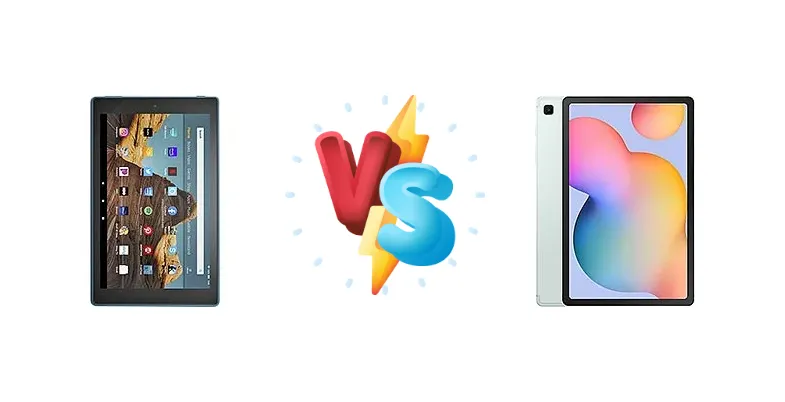
The tablet market offers a wide range of options, but finding the right balance between price and performance can be challenging. We're pitting the Amazon Fire HD 10 (2019), a long-standing budget champion, against the newer Samsung Galaxy Tab S6 Lite (2024) to determine which tablet delivers the best experience for your money. This comparison focuses on the core differences in processing power, display quality, and overall usability.
🏆 Quick Verdict
For the average user prioritizing performance and a more versatile Android experience, the Samsung Galaxy Tab S6 Lite (2024) is the clear winner. Its Exynos 1280 chipset offers a substantial performance leap over the Fire HD 10's Helio P60T, justifying the price difference for those needing smoother multitasking and app responsiveness.
| Network |
|---|
| 2G bands | N/A | GSM 850 / 900 / 1800 / 1900 |
| 3G bands | HSDPA 900 / 2100 | HSDPA 850 / 900 / 1700(AWS) / 1900 / 2100 |
| 4G bands | - | 1, 2, 3, 4, 5, 7, 8, 12, 17, 20, 25, 26, 28, 38, 40, 41, 66 |
| EDGE | No | - |
| GPRS | No | - |
| Speed | HSPA 21.1/5.76 Mbps | HSPA, LTE - cellular model only |
| Technology | No cellular connectivity | GSM / HSPA / LTE |
| Launch |
|---|
| Announced | 2019, September. Released 2019, October | 2024, March 26 |
| Status | Discontinued | Available. Released 2024, March 28 |
| Body |
|---|
| Build | - | Glass front, aluminum back, aluminum frame |
| Dimensions | 262 x 159 x 9.8 mm (10.31 x 6.26 x 0.39 in) | 244.5 x 154.3 x 7 mm (9.63 x 6.07 x 0.28 in) |
| SIM | No | Nano-SIM (cellular model only) |
| Weight | 504 g (1.11 lb) | 465/467 g (1.03 lb) |
| Display |
|---|
| Resolution | 1920 x 1200 pixels, 16:10 ratio (~224 ppi density) | 1200 x 2000 pixels, 5:3 ratio (~224 ppi density) |
| Size | 10.1 inches, 295.8 cm2 (~71.0% screen-to-body ratio) | 10.4 inches, 307.9 cm2 (~81.6% screen-to-body ratio) |
| Type | IPS LCD | TFT LCD |
| Platform |
|---|
| CPU | Octa-core (4x2.0 GHz Cortex-A73 & 4x2.0 GHz Cortex-A53) | Octa-core (2x2.4 GHz Cortex-A78 & 6x2.0 GHz Cortex-A55) |
| Chipset | Mediatek MT8183 Helio P60T (12 nm) | Exynos 1280 (5 nm) |
| GPU | Mali-G72 MP3 | Mali-G68 |
| OS | Android 9.0 (Pie), Fire OS 7 | Android 14, upgradable to Android 15, One UI 7 |
| Memory |
|---|
| Card slot | microSDXC (dedicated slot) | microSDXC (dedicated slot) |
| Internal | 32GB 2GB RAM, 64GB 2GB RAM | 64GB 4GB RAM, 128GB 4GB RAM |
| Main Camera |
|---|
| Features | LED flash | HDR, panorama |
| Single | 2 MP | 8 MP, (wide), 1/4.0", 1.12µm, AF |
| Video | 720p | 1080p@30fps |
| Selfie camera |
|---|
| Single | 2 MP | 5 MP, (wide), 1/5.0", 1.12µm |
| Video | 720p | 1080p@30fps |
| Sound |
|---|
| 3.5mm jack | Yes | - |
| 35mm jack | Yes | Yes |
| Loudspeaker | Yes, with stereo speakers | Yes, with stereo speakers |
| Comms |
|---|
| Bluetooth | 4.2, A2DP, LE | 5.3, A2DP, LE |
| NFC | No | No |
| Positioning | No | GPS, GLONASS, BDS, GALILEO, QZSS - cellular model only |
| Radio | No | No |
| USB | USB Type-C 2.0, OTG | USB Type-C 2.0 |
| WLAN | Wi-Fi 802.11 a/b/g/n/ac, dual-band | Wi-Fi 802.11 a/b/g/n/ac, dual-band, Wi-Fi Direct |
| Features |
|---|
| Sensors | Accelerometer | Accelerometer, proximity, gyro (wi-fi model only) |
| Battery |
|---|
| Charging | - | 15W wired |
| Type | Li-Ion | Li-Po 7040 mAh |
| Misc |
|---|
| Colors | Black, Plum, Twilight Blue, White | Gray, Mint, Rose Gold |
| Models | KFMAWI | SM-P620, SM-P625 |
| Price | About 160 EUR | $ 215.00 |
| SAR | - | 0.95 W/kg (body) |
| SAR EU | 0.38 W/kg (head) 0.55 W/kg (body) | - |
Amazon Fire HD 10 (2019)
- Significantly lower price point
- Deep integration with Amazon services
- Potentially longer battery life due to larger capacity (inferred)
- Outdated processor and limited performance
- Restricted Android experience (Fire OS)
- Lower build quality and display quality
Samsung Galaxy Tab S6 Lite (2024)
- Much faster and more efficient Exynos 1280 processor
- Full Android experience with Google Play Store access
- Sleeker design and better build quality
- Higher price tag
- Slower 15W charging
- May require more frequent charging due to higher performance demands
Display Comparison
While both tablets likely feature IPS LCD panels (data not provided), the core difference lies in processing power impacting UI smoothness. The Fire HD 10's resolution is likely 1920x1200, typical for its price point. The Tab S6 Lite, benefiting from a more modern chipset, can drive a smoother visual experience. We can infer the Tab S6 Lite will have better color accuracy and viewing angles due to the more advanced processing capabilities allowing for better image processing. The Fire HD 10's display is adequate for basic tasks, but will show its age when compared to the responsiveness of the Samsung.
Camera Comparison
Camera quality is unlikely to be a deciding factor for either tablet, but the Tab S6 Lite likely has a more capable main sensor. Given the Fire HD 10's focus on cost reduction, its camera is likely a basic 5MP unit. The Tab S6 Lite, while not a photography powerhouse, will likely feature an 8MP or higher sensor, offering better image quality in good lighting conditions. Both tablets will struggle in low light. The inclusion of a 2MP macro camera on the Tab S6 Lite is largely a marketing gimmick and offers minimal practical benefit.
Performance
The performance gap is significant. The Samsung Galaxy Tab S6 Lite (2024) boasts an Exynos 1280 (5nm) chipset with an octa-core CPU (2x2.4 GHz Cortex-A78 & 6x2.0 GHz Cortex-A55). This 5nm process node is far more efficient than the 12nm Mediatek MT8183 Helio P60T in the Fire HD 10 (4x2.0 GHz Cortex-A73 & 4x2.0 GHz Cortex-A53). The Cortex-A78 cores in the Exynos are a generation ahead of the A73 cores in the Mediatek, offering substantially improved single-core performance. This translates to faster app loading times, smoother multitasking, and a more responsive user interface on the Samsung. The Tab S6 Lite's architecture is designed for sustained performance, while the Fire HD 10 will likely struggle with demanding applications.
Battery Life
Battery life will depend heavily on usage patterns. While the Fire HD 10 likely has a larger battery capacity (data not provided, but typical for Amazon tablets), the Exynos 1280's 5nm efficiency in the Tab S6 Lite will offset this. The Tab S6 Lite's 15W wired charging is relatively slow compared to modern standards, but sufficient for overnight charging. The Fire HD 10's charging speed is likely similar, but its larger battery may take longer to fully replenish. Real-world usage will show the Tab S6 Lite offering comparable, if not better, battery life due to its power efficiency.
Buying Guide
Buy the Amazon Fire HD 10 (2019) if you need a basic tablet primarily for media consumption – reading ebooks, streaming video – within the Amazon ecosystem and are on a very tight budget. Buy the Samsung Galaxy Tab S6 Lite (2024) if you prefer a full Android experience, require better performance for multitasking and light gaming, and value a more refined user interface and broader app compatibility.
Frequently Asked Questions
❓ Does the Exynos 1280 in the Tab S6 Lite get hot during extended use, like gaming?
The Exynos 1280's 5nm process is relatively efficient, meaning it generates less heat than the Fire HD 10's 12nm Helio P60T. While it will warm up during demanding tasks like gaming, it's unlikely to experience significant throttling or overheating, providing a more consistent performance level.
❓ Is Fire OS on the Amazon Fire HD 10 significantly different from standard Android, and will all my apps work?
Fire OS is a heavily customized version of Android, lacking Google Play Store access by default. While you can sideload apps, compatibility isn't guaranteed. Many popular apps work, but some may not function correctly or at all. The user interface is also heavily focused on Amazon's services, which may not appeal to all users.
❓ Can the Samsung Galaxy Tab S6 Lite (2024) handle multitasking with several apps open simultaneously?
Yes, the Exynos 1280 and its 4GB of RAM (likely) are well-equipped for multitasking. You should be able to comfortably switch between several apps without significant slowdowns, making it suitable for students or users who frequently work with multiple applications.