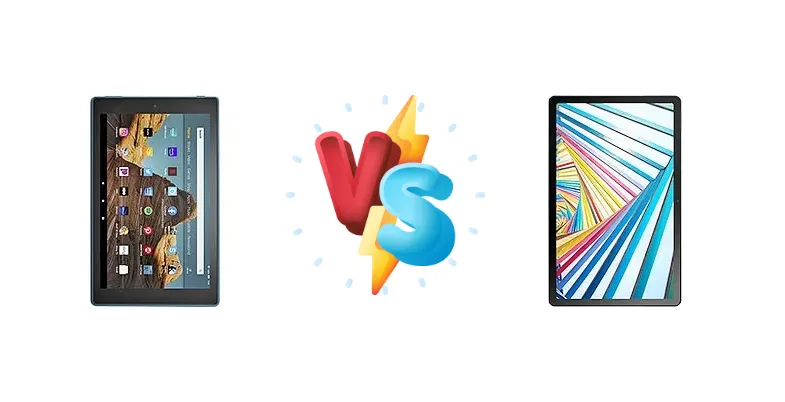
The Amazon Fire HD 10 (2019) and the Lenovo Tab M10 Plus (3rd Gen) represent compelling options in the crowded budget tablet space. The Fire HD 10, a long-standing Amazon staple, prioritizes affordability and integration with Amazon’s ecosystem. The Lenovo Tab M10 Plus (3rd Gen) aims to offer a more standard Android experience with a newer chipset and faster charging, but at a slightly higher price point. This comparison dissects their key differences to determine which tablet best suits your needs.
🏆 Quick Verdict
For the average user prioritizing a modern Android experience and faster performance, the Lenovo Tab M10 Plus (3rd Gen) is the better choice. Its Snapdragon 680 (or Helio G80) chipset, built on a 6nm process, delivers a noticeable performance uplift over the Fire HD 10’s older Mediatek Helio P60T, and the 20W charging is a significant convenience.
| Network |
|---|
| 2G bands | N/A | GSM 850 / 900 / 1800 / 1900 |
| 3G bands | HSDPA 900 / 2100 | HSDPA 800 / 850 / 900 / 1900 / 2100 |
| 4G bands | - | 1, 2, 3, 4, 5, 7, 8, 19, 20, 26, 28, 28, 38, 40, 41 |
| EDGE | No | - |
| GPRS | No | - |
| Speed | HSPA 21.1/5.76 Mbps | HSPA 42.2/5.76 Mbps, LTE Cat13 390/75 Mbps - cellular model only |
| Technology | No cellular connectivity | GSM / HSPA / LTE |
| Launch |
|---|
| Announced | 2019, September. Released 2019, October | 2022, May |
| Status | Discontinued | Available. Released 2022, May |
| Body |
|---|
| Dimensions | 262 x 159 x 9.8 mm (10.31 x 6.26 x 0.39 in) | 251.2 x 158.8 x 7.5 mm (9.89 x 6.25 x 0.30 in) |
| SIM | No | Nano-SIM (cellular model only) |
| Weight | 504 g (1.11 lb) | 465 g (1.03 lb) |
| | - | Stylus support |
| Display |
|---|
| Resolution | 1920 x 1200 pixels, 16:10 ratio (~224 ppi density) | 1200 x 2000 pixels, 5:3 ratio (~220 ppi density) |
| Size | 10.1 inches, 295.8 cm2 (~71.0% screen-to-body ratio) | 10.61 inches, 320.4 cm2 (~80.3% screen-to-body ratio) |
| Type | IPS LCD | IPS LCD, 400 nits (typ) |
| Platform |
|---|
| CPU | Octa-core (4x2.0 GHz Cortex-A73 & 4x2.0 GHz Cortex-A53) | Octa-core (4x2.4 GHz Kryo 265 Gold & 4x1.9 GHz Kryo 265 Silver) - LTE model Octa-core (2x2.0 GHz Cortex-A75 & 6x1.8 GHz Cortex-A55) - Wi-Fi only model |
| Chipset | Mediatek MT8183 Helio P60T (12 nm) | Qualcomm SM6225 Snapdragon 680 4G (6 nm) - LTE model Mediatek MT6769V/CU Helio G80 (12 nm) - Wi-Fi only model |
| GPU | Mali-G72 MP3 | Adreno 610 - LTE model Mali-G52 MC2 - Wi-Fi only model |
| OS | Android 9.0 (Pie), Fire OS 7 | Android 12 |
| Memory |
|---|
| Card slot | microSDXC (dedicated slot) | microSDXC (dedicated slot) |
| Internal | 32GB 2GB RAM, 64GB 2GB RAM | 32GB 3GB RAM, 64GB 4GB RAM, 128GB 4GB RAM, 128GB 6GB RAM |
| | - | eMCP/uMCP |
| Main Camera |
|---|
| Features | LED flash | - |
| Single | 2 MP | 8 MP, AF |
| Video | 720p | 1080p |
| Selfie camera |
|---|
| Single | 2 MP | 8 MP |
| Video | 720p | - |
| Sound |
|---|
| 3.5mm jack | Yes | Yes |
| 35mm jack | Yes | Yes |
| Loudspeaker | Yes, with stereo speakers | Yes, with stereo speakers (4 speakers) |
| Comms |
|---|
| Bluetooth | 4.2, A2DP, LE | 5.0, A2DP, LE |
| NFC | No | No |
| Positioning | No | GPS, GLONASS, BDS - cellular model only |
| Radio | No | FM Radio |
| USB | USB Type-C 2.0, OTG | USB Type-C 2.0 |
| WLAN | Wi-Fi 802.11 a/b/g/n/ac, dual-band | Wi-Fi 802.11 a/b/g/n/ac, dual-band, Wi-Fi Direct |
| Features |
|---|
| Sensors | Accelerometer | Accelerometer, proximity, gyro |
| Battery |
|---|
| Charging | - | 20W wired |
| Type | Li-Ion | Li-Po 7700 mAh |
| Misc |
|---|
| Colors | Black, Plum, Twilight Blue, White | Storm Grey, Frost Blue |
| Models | KFMAWI | - |
| Price | About 160 EUR | About 260 EUR |
| SAR EU | 0.38 W/kg (head) 0.55 W/kg (body) | - |
Amazon Fire HD 10 (2019)
- Lowest price point in the category
- Deep integration with Amazon services
- Good for consuming Amazon content
- Outdated chipset (Helio P60T)
- Slower charging speeds
- Limited Android customization
Lenovo Tab M10 Plus (3rd Gen)
- More powerful chipset (Snapdragon 680 or Helio G80)
- Faster 20W charging
- Standard Android experience
- Slightly higher price
- May include bloatware
- Camera performance is still basic
Display Comparison
Both tablets feature 10.1-inch displays, but details beyond that are scarce for the Fire HD 10. The Lenovo Tab M10 Plus (3rd Gen) benefits from a more modern panel, though specific brightness nits aren't provided. The Fire HD 10's display technology is likely a standard IPS LCD, while the Lenovo Tab M10 Plus may incorporate improvements in color accuracy and viewing angles. Bezels are comparable, typical for this price range, but the Lenovo’s more recent design may offer slightly slimmer borders.
Camera Comparison
Camera performance is unlikely to be a deciding factor for either tablet. Both are equipped with basic camera setups suitable for video calls and casual snapshots. Detailed camera specs are limited, but focusing on the main sensors, the Lenovo Tab M10 Plus likely offers a slight edge due to its newer image processing capabilities. The Fire HD 10’s camera is adequate for its price point, but don’t expect flagship-level image quality.
Performance
The performance gap is the most significant differentiator. The Lenovo Tab M10 Plus (3rd Gen) offers two chipset options: the Qualcomm Snapdragon 680 (6nm) in LTE models and the Mediatek Helio G80 (12nm) in Wi-Fi only models. The Snapdragon 680, with its Kryo 265 Gold cores clocked at 2.4 GHz, provides a substantial performance advantage over the Fire HD 10’s Mediatek MT8183 Helio P60T (12nm) and its 2.0 GHz Cortex-A73 cores. The 6nm process of the Snapdragon 680 also translates to improved thermal efficiency, reducing the likelihood of performance throttling during sustained tasks. The Helio G80 in the Wi-Fi model is still a step up from the P60T, but not as significant as the Snapdragon 680.
Battery Life
Battery capacity isn’t specified for either device, making a direct comparison difficult. However, the Lenovo Tab M10 Plus (3rd Gen) boasts 20W wired charging, a significant advantage over the Fire HD 10’s slower charging speed. This faster charging allows for quicker top-ups, minimizing downtime and improving overall usability. While the Fire HD 10 may offer comparable battery life in typical usage scenarios, the Lenovo’s charging speed provides a more convenient user experience.
Buying Guide
Buy the Amazon Fire HD 10 (2019) if you are deeply embedded in the Amazon ecosystem, primarily consume Amazon content (Kindle books, Prime Video), and require the absolute lowest price point. Buy the Lenovo Tab M10 Plus (3rd Gen) if you prefer a standard Android experience, need better performance for multitasking and light gaming, and value faster charging capabilities.
Frequently Asked Questions
❓ Will the Snapdragon 680 in the Lenovo Tab M10 Plus handle demanding games like PUBG Mobile?
The Snapdragon 680 is capable of running PUBG Mobile at medium settings with acceptable frame rates. While it's not a gaming powerhouse, it offers a significantly smoother experience than the Fire HD 10’s Helio P60T, especially for sustained gaming sessions due to its superior thermal efficiency.
❓ Is the Amazon Fire HD 10 (2019) a good choice for reading ebooks?
The Fire HD 10 is well-suited for reading ebooks, particularly Kindle books, due to its integration with the Amazon ecosystem. The display is adequate for text, and the tablet’s lightweight design makes it comfortable to hold for extended periods. However, the display quality isn't as refined as the Lenovo Tab M10 Plus.
❓ Does the Lenovo Tab M10 Plus (3rd Gen) support Google Kids Space?
Yes, the Lenovo Tab M10 Plus (3rd Gen) runs a standard version of Android, allowing access to Google Kids Space, a dedicated mode for children with curated content and parental controls. The Fire HD 10 uses Amazon Kids+, which is a similar service but tied to the Amazon ecosystem.
❓ What is the difference between the Wi-Fi and LTE versions of the Lenovo Tab M10 Plus (3rd Gen)?
The primary difference is cellular connectivity. The LTE version includes a SIM card slot for mobile data access, allowing you to use the tablet on the go without relying on Wi-Fi. The Wi-Fi only version relies solely on Wi-Fi for internet connectivity and uses the Mediatek Helio G80 chipset, while the LTE version uses the Qualcomm Snapdragon 680.