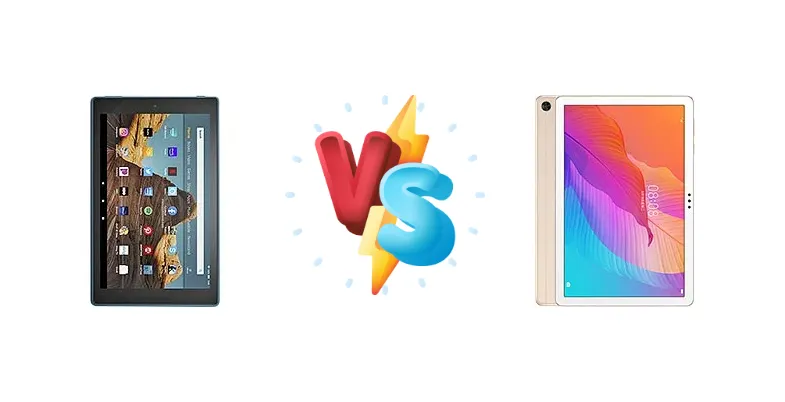
The Amazon Fire HD 10 (2019) and Huawei MatePad T 10s represent compelling options in the sub-$200 tablet market. While both aim to deliver an affordable tablet experience, they diverge in their core philosophies: Amazon prioritizes content consumption within its ecosystem, while Huawei offers a more open Android experience. This comparison dissects their hardware and software to determine which tablet best suits your needs.
🏆 Quick Verdict
For the average user prioritizing a broader Android experience and slightly better efficiency, the Huawei MatePad T 10s edges out the Fire HD 10 (2019). However, Amazon’s tablet remains a strong contender for those deeply invested in the Amazon ecosystem and seeking a dedicated media consumption device.
| Network |
|---|
| 2G bands | N/A | GSM 850 / 900 / 1800 / 1900 |
| 3G bands | HSDPA 900 / 2100 | HSDPA 850 / 900 / 1700(AWS) / 1900 / 2100 |
| 4G bands | - | 1, 3, 5, 7, 8, 18, 19, 20, 26, 28, 38, 40, 41 |
| EDGE | No | - |
| GPRS | No | - |
| Speed | HSPA 21.1/5.76 Mbps | HSPA, LTE - cellular model only |
| Technology | No cellular connectivity | GSM / HSPA / LTE |
| Launch |
|---|
| Announced | 2019, September. Released 2019, October | 2020, September 09. Released 2020, September 09 |
| Status | Discontinued | Discontinued |
| Body |
|---|
| Dimensions | 262 x 159 x 9.8 mm (10.31 x 6.26 x 0.39 in) | 240.2 x 159 x 7.9 mm (9.46 x 6.26 x 0.31 in) |
| SIM | No | Nano-SIM (cellular model only) |
| Weight | 504 g (1.11 lb) | 450 g (0.99 lb) |
| | - | Stylus support |
| Display |
|---|
| Resolution | 1920 x 1200 pixels, 16:10 ratio (~224 ppi density) | 1200 x 1920 pixels, 16:10 ratio (~224 ppi density) |
| Size | 10.1 inches, 295.8 cm2 (~71.0% screen-to-body ratio) | 10.1 inches, 295.8 cm2 (~77.4% screen-to-body ratio) |
| Type | IPS LCD | IPS LCD |
| Platform |
|---|
| CPU | Octa-core (4x2.0 GHz Cortex-A73 & 4x2.0 GHz Cortex-A53) | Octa-core (4x2.0 GHz Cortex-A73 & 4x1.7 GHz Cortex-A53) |
| Chipset | Mediatek MT8183 Helio P60T (12 nm) | Kirin 710A (14 nm) |
| GPU | Mali-G72 MP3 | Mali-G51 MP4 |
| OS | Android 9.0 (Pie), Fire OS 7 | Android 10, EMUI 10.1, no Google Play Services |
| Memory |
|---|
| Card slot | microSDXC (dedicated slot) | microSDXC |
| Internal | 32GB 2GB RAM, 64GB 2GB RAM | 16GB 2GB RAM, 32GB 2GB RAM, 64GB 3GB RAM, 64GB 4GB RAM, 128GB 4GB RAM |
| | - | eMMC 5.1 |
| Main Camera |
|---|
| Features | LED flash | HDR, panorama |
| Single | 2 MP | 5 MP, f/2.2, PDAF |
| Video | 720p | 1080p@30fps |
| Selfie camera |
|---|
| Single | 2 MP | 2 MP, f/2.4 |
| Video | 720p | - |
| Sound |
|---|
| 3.5mm jack | Yes | Yes |
| 35mm jack | Yes | Yes |
| Loudspeaker | Yes, with stereo speakers | Yes, with stereo speakers |
| | - | Tuned by Harman Kardon |
| Comms |
|---|
| Bluetooth | 4.2, A2DP, LE | 5.0, A2DP, LE |
| NFC | No | No |
| Positioning | No | GPS, GLONASS, BDS - cellular model only |
| Radio | No | No |
| USB | USB Type-C 2.0, OTG | USB Type-C 2.0, OTG |
| WLAN | Wi-Fi 802.11 a/b/g/n/ac, dual-band | Wi-Fi 802.11 a/b/g/n/ac, dual-band, Wi-Fi Direct |
| Features |
|---|
| Sensors | Accelerometer | Accelerometer, proximity |
| Battery |
|---|
| Charging | - | 10W wired |
| Type | Li-Ion | Li-Po 5100 mAh |
| Misc |
|---|
| Colors | Black, Plum, Twilight Blue, White | Gold, Deepsea Blue |
| Models | KFMAWI | AGS3-L09, AGS3-W09, AGS3K-W09 |
| Price | About 160 EUR | About 200 EUR |
| SAR EU | 0.38 W/kg (head) 0.55 W/kg (body) | - |
Amazon Fire HD 10 (2019)
- Potentially better thermal efficiency due to 12nm process.
- Deep integration with Amazon’s ecosystem.
- Larger screen size for immersive media consumption.
- Restricted Android experience with Fire OS.
- Limited access to the Google Play Store.
- Performance may be limited by software optimization.
Huawei MatePad T 10s
- Standard Android experience with Google Play Store access.
- Slightly more efficient chipset for potentially longer battery life.
- Wider app compatibility.
- Slower 10W charging.
- Less optimized for Amazon’s content ecosystem.
- Potentially more thermal throttling under sustained load.
Display Comparison
Neither device boasts a particularly impressive display. Both are likely to utilize IPS LCD panels, common in this price bracket. The key difference lies under the hood. While specific display specs are unavailable, the Fire HD 10’s larger screen size (10.1 inches vs. the MatePad T 10s’s 10.1 inches) may offer a more immersive viewing experience. However, the lack of detailed display information prevents a definitive assessment of color accuracy or brightness levels. Bezels are expected to be substantial on both devices, reflecting their budget positioning.
Camera Comparison
Camera performance is unlikely to be a deciding factor for either tablet. Both devices likely feature modest camera setups geared towards basic video calls and occasional snapshots. Given the context data, a detailed comparison is impossible. It's safe to assume both will struggle in low-light conditions and lack advanced features like optical image stabilization (OIS). Focusing on camera quality for these tablets would be a misdirection of expectations.
Performance
The performance battle centers around the Mediatek MT8183 Helio P60T in the Fire HD 10 (2019) versus the Kirin 710A in the MatePad T 10s. Both chipsets feature an octa-core configuration with 4x2.0 GHz Cortex-A73 and 4x2.0 GHz (Fire) / 1.7 GHz (MatePad) Cortex-A53 cores. The Kirin 710A, fabricated on a 14nm process, is slightly less efficient than the Fire HD 10’s 12nm Helio P60T. This suggests the Fire HD 10 may exhibit marginally better thermal management during sustained workloads. However, the 0.3 GHz difference in Cortex-A53 clock speed is unlikely to translate to a noticeable real-world performance gap. Both tablets will handle basic tasks like web browsing and video playback adequately, but demanding games may require reduced graphics settings.
Battery Life
Battery life will depend heavily on usage patterns. While specific battery capacities are not provided, the Kirin 710A’s 14nm process, being less efficient, may result in slightly shorter battery life compared to the Fire HD 10’s 12nm Helio P60T. The MatePad T 10s supports 10W wired charging, a relatively slow charging speed. The Fire HD 10’s charging speed is not specified, but is likely similar. Users should expect several hours to fully charge either device from 0-100%.
Buying Guide
Buy the Amazon Fire HD 10 (2019) if you are a Prime member who heavily utilizes Amazon’s services for streaming video, reading Kindle books, and accessing Amazon Music. Buy the Huawei MatePad T 10s if you prefer a standard Android experience with access to the Google Play Store, and require a tablet for general productivity tasks and a wider range of app compatibility.
Frequently Asked Questions
❓ Will the Huawei MatePad T 10s receive long-term software updates?
Huawei’s update track record for budget tablets is inconsistent. While it runs a full version of Android, expect fewer and potentially shorter-lived updates compared to tablets from Google or Samsung. This is a key consideration for users prioritizing security and feature enhancements.
❓ Can I sideload the Google Play Store onto the Amazon Fire HD 10 (2019)?
Yes, it is possible to sideload the Google Play Store onto the Fire HD 10 (2019), but it requires technical expertise and voids the warranty. The process is not straightforward and may not result in a fully stable or optimized experience. It's generally not recommended for average users.
❓ Is the Kirin 710A prone to overheating during extended gaming sessions?
The Kirin 710A, being fabricated on a 14nm process, is more susceptible to thermal throttling than the Fire HD 10’s 12nm Helio P60T. While it won’t likely overheat catastrophically, expect performance to decrease during prolonged gaming sessions, potentially requiring lower graphics settings.
❓ How well does the Amazon Fire HD 10 (2019) handle multitasking?
The Fire HD 10 (2019) with its Helio P60T and likely 2-3GB of RAM (based on market segment) can handle light multitasking, such as switching between a web browser and a video player. However, running multiple demanding apps simultaneously may result in noticeable slowdowns and lag.