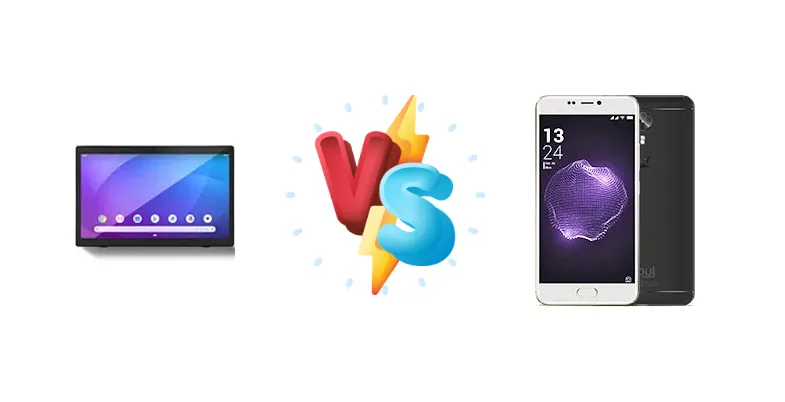
Allview targets the budget-conscious market, and the Viva Home and X4 Soul Style represent different approaches within that segment. The Viva Home prioritizes affordability, while the X4 Soul Style attempts to offer a more robust experience with a more powerful chipset. This comparison dissects the key differences to help you determine which device best fits your needs.
🏆 Quick Verdict
For most users, the Allview X4 Soul Style is the superior choice. Its MediaTek Helio P10 chipset delivers significantly better performance than the Viva Home’s MT8163, making it more capable for multitasking, gaming, and demanding applications. While the Viva Home is cheaper, the performance gap justifies the price difference for anyone beyond very basic usage.
| Network |
|---|
| 2G bands | N/A | GSM 850 / 900 / 1800 / 1900 - SIM 1 & SIM 2 |
| 3G bands | N/A | HSDPA 850 / 900 / 1900 / 2100 |
| 4G bands | N/A | 1, 3, 7, 8, 20, 38, 39, 40, 41 |
| EDGE | No | - |
| GPRS | No | - |
| Speed | - | HSPA 21.1/5.76 Mbps, LTE (2CA) Cat6 300/50 Mbps |
| Technology | No cellular connectivity | GSM / HSPA / LTE |
| Launch |
|---|
| Announced | 2019, July. Released 2019, July | 2017, March. Released 2017, March |
| Status | Discontinued | Discontinued |
| Body |
|---|
| Dimensions | 418.5 x 266.3 x 19.5 mm (16.48 x 10.48 x 0.77 in) | 156.5 x 74.5 x 8.3 mm (6.16 x 2.93 x 0.33 in) |
| SIM | No | Nano-SIM + Micro-SIM |
| Weight | 2018.3 g (4.45 lb) | 181 g (6.38 oz) |
| Display |
|---|
| Protection | - | Corning Gorilla Glass (unspecified version) |
| Resolution | 1080 x 1920 pixels, 16:9 ratio (~127 ppi density) | 1080 x 1920 pixels, 16:9 ratio (~401 ppi density) |
| Size | 17.3 inches, 825.1 cm2 (~74.0% screen-to-body ratio) | 5.5 inches, 83.4 cm2 (~71.5% screen-to-body ratio) |
| Type | IPS LCD | IPS LCD |
| Platform |
|---|
| CPU | Quad-core 1.5 GHz Cortex-A53 | Octa-core (4x2.0 GHz Cortex-A53 & 4x1.0 GHz Cortex-A53) |
| Chipset | Mediatek MT8163 | Mediatek MT6755 Helio P10 (28 nm) |
| GPU | - | Mali-T860MP2 |
| OS | Android 9.0 (Pie) | Android 7.0 (Nougat) |
| Memory |
|---|
| Card slot | microSDXC (dedicated slot) | microSDXC (uses shared SIM slot) |
| Internal | 32GB 2GB RAM | 64GB 4GB RAM |
| | - | eMMC 5.1 |
| Main Camera |
|---|
| No | - |
| Features | - | LED flash, panorama, HDR |
| Single | - | 13 MP, 1/3.1", 1.12µm, PDAF |
| Video | - | 1080p@30fps |
| Selfie camera |
|---|
| Single | 2 MP | 16 MP, f/2.0, 26mm (wide), 1/3.06", 1.0µm |
| Video | 1080p | 1080p@30fps |
| Sound |
|---|
| 3.5mm jack | Yes | Yes |
| 35mm jack | Yes | Yes |
| Loudspeaker | Yes | Yes |
| Comms |
|---|
| Bluetooth | 4.0, A2DP | 4.0, A2DP, EDR, LE |
| NFC | No | No |
| Positioning | GPS | GPS |
| Radio | FM radio | FM radio |
| USB | microUSB 2.0, USB | microUSB 2.0 |
| WLAN | Wi-Fi 802.11 a/b/g/n | Wi-Fi 802.11 a/b/g/n |
| Features |
|---|
| Sensors | Accelerometer | Fingerprint (front-mounted), accelerometer, gyro, proximity, compass |
| Battery |
|---|
| Type | Li-Po 5000 mAh, non-removable | Li-Po 4010 mAh, non-removable |
| Misc |
|---|
| Colors | Black | Black, Gold |
| Price | About 250 EUR | - |
| SAR EU | - | 1.65 W/kg (head) |
Allview Viva Home
- Lower price point makes it highly accessible.
- Sufficient for basic smartphone tasks.
- Potentially longer battery life due to less powerful chipset (depending on capacity).
- Significantly slower performance compared to the X4 Soul Style.
- Struggles with multitasking and demanding applications.
- Likely lower-quality display.
Allview X4 Soul Style
- Much faster performance thanks to the Helio P10 chipset.
- Better gaming capabilities.
- More responsive user interface.
- Higher price point.
- Potentially shorter battery life (depending on capacity).
- May experience more heat under heavy load.
Display Comparison
Unfortunately, display specifications are not provided. However, given the target market, both devices likely utilize IPS LCD panels. The X4 Soul Style, being the higher-tier model, *may* feature a slightly higher resolution or improved color accuracy. The MT8163 in the Viva Home suggests a focus on minimizing cost, potentially resulting in a lower-quality display. Users prioritizing media consumption should lean towards the X4 Soul Style, hoping for a more vibrant and detailed viewing experience.
Camera Comparison
Camera specifications are not detailed, making a direct comparison difficult. However, it’s reasonable to assume the X4 Soul Style benefits from a more advanced image signal processor (ISP) within the Helio P10 chipset. This could result in improved image quality, particularly in low-light conditions. Given Allview’s positioning, both phones likely feature basic camera setups. The presence of a 2MP macro camera on either device is unlikely to significantly impact image quality; its utility is limited. Users prioritizing photography should consider the X4 Soul Style, hoping for better image processing capabilities.
Performance
The core difference lies in the chipsets. The Allview X4 Soul Style’s MediaTek MT6755 Helio P10, built on a 28nm process, is a significant upgrade over the Viva Home’s MT8163. The Helio P10’s octa-core configuration (4x2.0 GHz Cortex-A53 & 4x1.0 GHz Cortex-A53) provides substantially more processing power than the Viva Home’s quad-core 1.5 GHz Cortex-A53. This translates to faster app loading times, smoother multitasking, and a more responsive user interface. The Helio P10 also includes a more capable Mali-T860MP2 GPU, enabling better gaming performance. The MT8163 is adequate for basic tasks, but will struggle with graphically intensive games or demanding applications. The 28nm process of the Helio P10, while not cutting-edge, is more efficient than whatever process node the MT8163 uses, potentially leading to slightly better thermal management under sustained load.
Battery Life
Battery capacity is not specified for either device. However, the more powerful Helio P10 in the X4 Soul Style will likely consume more power than the MT8163. Therefore, battery life will depend on usage patterns. The X4 Soul Style *may* support faster charging due to the more advanced chipset, potentially offsetting the increased power consumption. Without specific battery capacity and charging wattage details, it’s difficult to definitively declare a winner. However, the X4 Soul Style’s potential for faster charging is a notable advantage.
Buying Guide
Buy the Allview Viva Home if you need a functional smartphone for essential tasks like calls, messaging, and light web browsing, and your budget is extremely limited. It’s a suitable option for first-time smartphone users or as a backup device. Buy the Allview X4 Soul Style if you prioritize smoother performance, enjoy occasional gaming, or frequently use multiple apps simultaneously. The X4 Soul Style offers a more future-proof experience and a more responsive user interface.
Frequently Asked Questions
❓ Will the Helio P10 in the X4 Soul Style overheat during prolonged gaming sessions?
While the Helio P10 is more powerful, it's built on a 28nm process. This means it *could* generate more heat than the MT8163. However, Allview's thermal design and the duration/intensity of gaming will be key factors. Expect some warmth, but significant throttling is unlikely for moderate gaming sessions.
❓ Is the performance difference between the MT8163 and Helio P10 noticeable in everyday tasks like browsing and social media?
Yes, the difference is quite noticeable. The Helio P10’s octa-core processor and improved GPU will result in significantly faster app loading times, smoother scrolling, and a more responsive experience when switching between apps. The MT8163 will feel sluggish in comparison.
❓ Does the Allview X4 Soul Style support 4G LTE connectivity?
The MediaTek MT6755 Helio P10 chipset inherently supports 4G LTE connectivity. Therefore, the X4 Soul Style is expected to offer 4G LTE support, providing faster data speeds where available. The MT8163 in the Viva Home may or may not support 4G, depending on Allview's implementation.