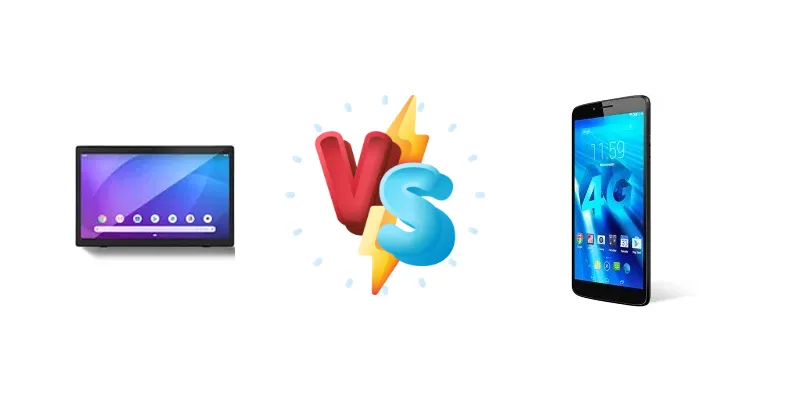
Allview targets the entry-level tablet market with the Viva Home and Viva H8 LTE. While both aim for affordability, a key distinction lies in their chipsets. The Viva Home utilizes the Mediatek MT8163, while the H8 LTE steps up to the MT8732. This comparison dissects the implications of this chipset difference, focusing on performance, connectivity, and overall user experience.
🏆 Quick Verdict
For users prioritizing basic tasks like web browsing and media consumption, the Allview Viva Home offers sufficient performance at a potentially lower price. However, the Allview Viva H8 LTE is the better choice for those needing mobile data connectivity and a slightly more responsive experience thanks to the MT8732 chipset.
| Network |
|---|
| 2G bands | N/A | GSM 900 / 1800 / 1900 |
| 3G bands | N/A | HSDPA 900 / 2100 |
| 4G bands | N/A | 3, 7, 20 |
| EDGE | No | - |
| GPRS | No | - |
| Speed | - | HSPA 42.2/11.5 Mbps, LTE Cat4 150/50 Mbps |
| Technology | No cellular connectivity | GSM / HSPA / LTE |
| Launch |
|---|
| Announced | 2019, July. Released 2019, July | 2014. Released 2014 |
| Status | Discontinued | Discontinued |
| Body |
|---|
| Dimensions | 418.5 x 266.3 x 19.5 mm (16.48 x 10.48 x 0.77 in) | 210 x 122 x 9 mm (8.27 x 4.80 x 0.35 in) |
| SIM | No | Mini-SIM |
| Weight | 2018.3 g (4.45 lb) | 324.4 g (11.43 oz) |
| Display |
|---|
| Resolution | 1080 x 1920 pixels, 16:9 ratio (~127 ppi density) | 800 x 1280 pixels, 16:10 ratio (~189 ppi density) |
| Size | 17.3 inches, 825.1 cm2 (~74.0% screen-to-body ratio) | 8.0 inches, 185.6 cm2 (~72.4% screen-to-body ratio) |
| Type | IPS LCD | IPS LCD |
| Platform |
|---|
| CPU | Quad-core 1.5 GHz Cortex-A53 | Quad-core 1.5 GHz Cortex-A53 |
| Chipset | Mediatek MT8163 | Mediatek MT8732 (28 nm) |
| GPU | - | Mali-T760 |
| OS | Android 9.0 (Pie) | Android 4.4.4 (KitKat) |
| Memory |
|---|
| Card slot | microSDXC (dedicated slot) | microSDHC (dedicated slot) |
| Internal | 32GB 2GB RAM | 8GB 1GB RAM |
| Main Camera |
|---|
| No | - |
| Features | - | LED flash |
| Single | - | 2 MP |
| Video | - | Yes |
| Selfie camera |
|---|
| Single | 2 MP | VGA |
| Video | 1080p | - |
| Sound |
|---|
| 3.5mm jack | Yes | Yes |
| 35mm jack | Yes | Yes |
| Loudspeaker | Yes | Yes |
| Comms |
|---|
| Bluetooth | 4.0, A2DP | 4.0, EDR |
| NFC | No | No |
| Positioning | GPS | GPS |
| Radio | FM radio | FM Radio |
| USB | microUSB 2.0, USB | microUSB 2.0 |
| WLAN | Wi-Fi 802.11 a/b/g/n | Wi-Fi 802.11 b/g/n |
| Features |
|---|
| Sensors | Accelerometer | Accelerometer, proximity |
| Battery |
|---|
| Stand-by | - | Up to 400 h |
| Talk time | - | Up to 6 h |
| Type | Li-Po 5000 mAh, non-removable | Li-Po 4000 mAh, non-removable |
| Misc |
|---|
| Colors | Black | Black |
| Price | About 250 EUR | - |
| SAR EU | - | 1.18 W/kg (body) |
Allview Viva Home
- Potentially lower price point
- Sufficient for basic tasks
- Likely lighter due to simpler components
- Older chipset architecture
- No LTE connectivity
- Potentially slower performance in multitasking
Allview Viva H8 LTE
- 4G LTE connectivity for on-the-go use
- More efficient chipset (MT8732)
- Slightly improved sustained performance
- Likely higher price than the Viva Home
- Battery life may be marginally lower due to LTE usage
- Still limited by the Cortex-A53 architecture
Display Comparison
Unfortunately, detailed display specifications are unavailable. However, given the target market, both tablets likely feature IPS LCD panels. The absence of information regarding resolution or brightness suggests both are geared towards functional viewing rather than a premium visual experience. The H8 LTE’s inclusion of ‘LTE’ in its name doesn’t imply any display improvements. Bezels are likely substantial on both models to minimize production costs.
Camera Comparison
Camera details are sparse. It’s safe to assume both tablets feature basic camera setups geared towards video calls rather than photography. Without sensor size or aperture information, a detailed comparison is impossible. Any cameras included are likely to be of low resolution and image quality. Focusing on camera performance would be misleading given the likely specifications.
Performance
The core difference lies in the chipsets. The Allview Viva Home’s Mediatek MT8163, while a quad-core Cortex-A53 processor clocked at 1.5 GHz, is based on an older architecture. The Allview Viva H8 LTE’s Mediatek MT8732, also a quad-core 1.5 GHz Cortex-A53, benefits from a more efficient 28nm manufacturing process. This smaller node allows for potentially better thermal management and slightly improved sustained performance. While both CPUs share the same core count and clock speed, the MT8732’s fabrication process gives it a marginal edge in real-world responsiveness, particularly during multitasking. RAM specifications are unknown, but likely limited to 1-2GB on both, further emphasizing the focus on basic functionality.
Battery Life
Battery capacity is not specified for either device. However, given the low-power chipsets and likely lower-resolution displays, both tablets should offer reasonable battery life for typical usage scenarios (web browsing, video playback). Charging wattage is also unknown, but likely utilizes a standard 5W charger. The MT8732’s improved efficiency *could* translate to slightly longer battery life on the H8 LTE, but this difference would likely be minimal in practical use.
Buying Guide
Buy the Allview Viva Home if you need a purely Wi-Fi connected tablet for static tasks like reading ebooks, watching streaming video at home, or simple web browsing. It’s ideal for users on a very tight budget. Buy the Allview Viva H8 LTE if you require 4G LTE connectivity for on-the-go use, or if you anticipate needing a slightly smoother experience with multitasking and light gaming. The H8 LTE is for users who value portability and connectivity.
Frequently Asked Questions
❓ Does the Allview Viva H8 LTE's 4G connectivity significantly impact battery life compared to the Viva Home?
Yes, enabling and actively using 4G LTE will consume more power than relying solely on Wi-Fi. While the MT8732 is more efficient, the radio demands of cellular connectivity will reduce overall battery life on the H8 LTE, especially during prolonged use away from a charger.
❓ Can the Allview Viva H8 LTE handle popular mobile games like PUBG or Call of Duty?
While the MT8732 is a step up from the MT8163, both chipsets are entry-level. Expect to be able to run these games at the lowest graphics settings and potentially with reduced frame rates. The experience will likely be choppy and not ideal for competitive gaming. These tablets are better suited for casual gaming.
❓ Is the difference in performance between the MT8163 and MT8732 noticeable for everyday tasks like browsing and email?
The difference will be subtle but present. The MT8732’s 28nm process should result in slightly smoother multitasking and faster app loading times. However, for basic tasks like web browsing and email, the difference may not be immediately apparent to the average user.