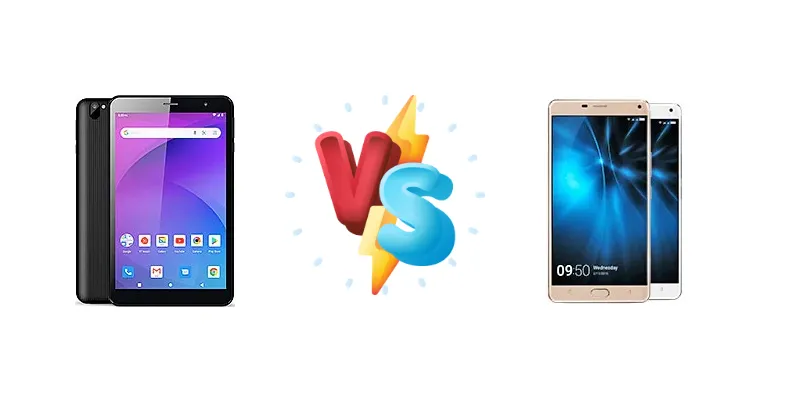
The Allview Viva 803G and P8 Energy Pro represent Allview’s approach to the budget smartphone market. While both devices aim for affordability, they diverge significantly in their core processing power. The Viva 803G utilizes a quad-core Mediatek MT8321, while the P8 Energy Pro boasts an octa-core MT6753. This comparison will dissect these differences to determine which device delivers the best value for users prioritizing performance or efficiency.
🏆 Quick Verdict
For the average user, the Allview P8 Energy Pro is the better choice. Its octa-core MT6753 processor provides a substantial performance advantage over the Viva 803G’s quad-core MT8321, enabling smoother multitasking and a more responsive user experience, despite both being built on the same 28nm process.
| Network |
|---|
| 2G bands | GSM 850 / 900 / 1800 / 1900 | GSM 850 / 900 / 1800 / 1900 - SIM 1 & SIM 2 |
| 3G bands | HSDPA 900 / 1900 / 2100 | HSDPA 900 / 1900 / 2100 |
| 4G bands | - | 1, 3, 7, 38, 39, 40 |
| Speed | HSPA 21.1/5.76 Mbps | HSPA 21.1/5.76 Mbps, LTE Cat4 150/50 Mbps |
| Technology | GSM / HSPA | GSM / HSPA / LTE |
| Launch |
|---|
| Announced | 2020, April. Released 2020, April | 2016, February. Released 2016, February |
| Status | Discontinued | Discontinued |
| Body |
|---|
| Dimensions | 208 x 124 x 9.5 mm (8.19 x 4.88 x 0.37 in) | 160.9 x 81.2 x 8.4 mm (6.33 x 3.20 x 0.33 in) |
| SIM | Micro-SIM | Dual SIM (Micro-SIM, dual stand-by) |
| Weight | 330 g (11.64 oz) | 209.8 g (7.37 oz) |
| Display |
|---|
| Protection | - | Corning Gorilla Glass 3 |
| Resolution | 800 x 1280 pixels, 16:10 ratio (~189 ppi density) | 1080 x 1920 pixels, 16:9 ratio (~367 ppi density) |
| Size | 8.0 inches, 185.6 cm2 (~72.0% screen-to-body ratio) | 6.0 inches, 99.2 cm2 (~76.0% screen-to-body ratio) |
| Type | IPS LCD | AMOLED |
| Platform |
|---|
| CPU | Quad-core 1.3 GHz Cortex-A7 | Octa-core 1.3 GHz Cortex-A53 |
| Chipset | Mediatek MT8321 (28 nm) | Mediatek MT6753 (28 nm) |
| GPU | Mali-400 | Mali-T720MP2 |
| OS | Android 9.0 Pie (Go edition) | Android 5.1 (Lollipop) |
| Memory |
|---|
| Card slot | microSDHC | microSDXC |
| Internal | 16GB 1GB RAM | 64GB 3GB RAM |
| | eMMC 5.1 | - |
| Main Camera |
|---|
| Features | LED flash | LED flash, HDR, panorama |
| Single | VGA | 13 MP, f/2.0, AF |
| Video | 720p | 1080p@30fps |
| Selfie camera |
|---|
| Single | 2 MP | 5 MP |
| Sound |
|---|
| 3.5mm jack | Yes | Yes |
| 35mm jack | Yes | Yes |
| Loudspeaker | Yes | Yes |
| Comms |
|---|
| Bluetooth | 4.0, A2DP | 4.0, A2DP, EDR |
| NFC | No | No |
| Positioning | GPS | GPS |
| Radio | FM radio | FM radio |
| USB | microUSB 2.0 | USB Type-C 3.0 |
| WLAN | Wi-Fi 802.11 b/g/n | Wi-Fi 802.11 b/g/n |
| Features |
|---|
| Sensors | Accelerometer | Fingerprint (front-mounted), accelerometer, proximity, compass |
| Battery |
|---|
| Stand-by | - | Up to 450 h |
| Talk time | - | Up to 22 h 30 min |
| Type | Li-Po 3600 mAh | Li-Po 5020 mAh, non-removable |
| Misc |
|---|
| Colors | Black | Gold/Silver |
| Price | About 90 EUR | About 420 EUR |
| SAR EU | 1.59 W/kg (body) | 0.40 W/kg (head) |
Allview Viva 803G
- Potentially longer battery life due to less demanding processor.
- Simpler processor may result in lower heat generation.
- Likely more affordable price point.
- Significantly slower performance compared to the P8 Energy Pro.
- Struggles with multitasking and demanding applications.
- Outdated Cortex-A7 architecture.
Allview P8 Energy Pro
- Faster and more responsive performance thanks to the octa-core MT6753.
- Better multitasking capabilities.
- More modern Cortex-A53 architecture.
- Potentially shorter battery life compared to the Viva 803G.
- May generate more heat under heavy load.
- Likely a slightly higher price point.
Display Comparison
Unfortunately, display specifications are not provided. However, given the budget nature of both devices, it’s reasonable to expect both utilize IPS LCD panels with resolutions around 720p. The lack of information prevents a detailed comparison of brightness, color accuracy, or viewing angles. Users should expect a standard, rather than premium, display experience on both models.
Camera Comparison
Camera specifications are not provided beyond the devices themselves. Given the market segment, it’s likely both phones feature modest camera setups. Without sensor size, aperture, or image processing details, a meaningful comparison is impossible. Users should not expect flagship-level image quality from either device. The presence of a 2MP macro camera on either device is unlikely to provide significant photographic value.
Performance
The core difference lies in the processors. The Allview P8 Energy Pro’s Mediatek MT6753, featuring an octa-core Cortex-A53 CPU, offers a significant architectural advantage over the Viva 803G’s quad-core Cortex-A7. While both are built on a 28nm process, the Cortex-A53 is a more modern and efficient design. The A53’s eight cores allow for better parallel processing, resulting in faster app loading times and smoother multitasking. The Cortex-A7 in the Viva 803G, while adequate for basic tasks, will struggle with more demanding applications. The MT6753 also benefits from potentially more capable integrated graphics, improving gaming performance.
Battery Life
Battery capacity is not specified. However, the MT8321 in the Viva 803G is a less power-hungry processor than the MT6753. This suggests the Viva 803G *could* offer slightly longer battery life under similar usage conditions. However, the P8 Energy Pro’s more efficient processor architecture might mitigate this difference. Charging wattage is also unknown, making it impossible to assess 0-100% charging times.
Buying Guide
Buy the Allview Viva 803G if you need a basic smartphone for essential tasks like calls, messaging, and light web browsing, and prioritize a potentially longer battery life due to the less demanding processor. Buy the Allview P8 Energy Pro if you prefer a more fluid experience with multitasking, occasional gaming, and demand a more capable processor for running modern applications, even if it means slightly reduced battery longevity.
Frequently Asked Questions
❓ Will the Allview P8 Energy Pro struggle with graphically intensive games like PUBG Mobile?
While the MT6753 is capable of running PUBG Mobile, users should expect to play at lower graphics settings to maintain a stable frame rate. The integrated GPU is not a high-end solution, and demanding games will push its limits. The Viva 803G would likely struggle even more significantly.
❓ Is the difference in processor speed between the MT8321 and MT6753 noticeable in everyday tasks like browsing and social media?
Yes, the difference is noticeable. The P8 Energy Pro’s octa-core processor will result in faster app loading times, smoother scrolling, and a more responsive overall experience when browsing the web or using social media apps. The Viva 803G may exhibit occasional lag or stuttering.
❓ Which phone is better for someone who primarily uses their phone for calls, texts, and basic internet browsing?
The Allview Viva 803G is sufficient for these basic tasks. Its quad-core processor is adequate for handling calls, texts, and light web browsing without significant performance issues. The P8 Energy Pro offers more power than needed for these use cases.