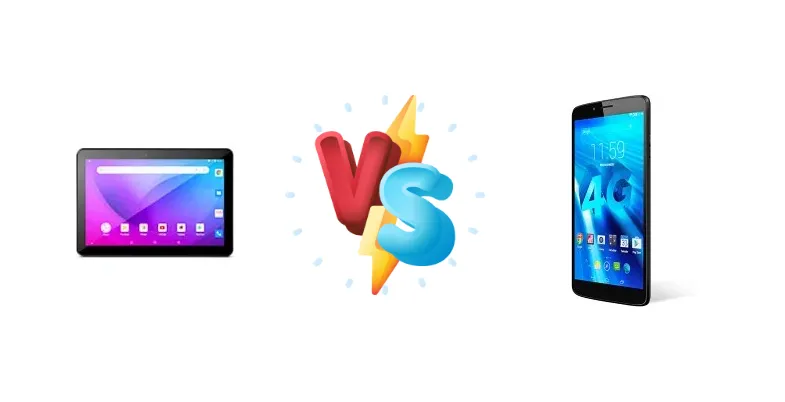
The Allview Viva 1003G Lite and H8 LTE represent Allview's approach to the entry-level smartphone market. While both devices share a similar aesthetic and target budget-conscious consumers, they differ significantly in their underlying hardware, particularly in their chipsets. This comparison will dissect those differences to determine which device offers the best value for your money.
🏆 Quick Verdict
For most users, the Allview Viva H8 LTE is the superior choice. Its Mediatek MT8732 chipset, featuring Cortex-A53 cores clocked at 1.5 GHz, provides a noticeable performance boost over the 1003G Lite’s MT8321A and Cortex-A7 cores. This translates to smoother multitasking and a more responsive user experience, justifying the likely price difference.
| Network |
|---|
| 2G bands | GSM 900 / 1800 / 1900 | GSM 900 / 1800 / 1900 |
| 3G bands | HSDPA 900 / 2100 | HSDPA 900 / 2100 |
| 4G bands | - | 3, 7, 20 |
| Speed | HSPA 21.1/5.76 Mbps | HSPA 42.2/11.5 Mbps, LTE Cat4 150/50 Mbps |
| Technology | GSM / HSPA | GSM / HSPA / LTE |
| Launch |
|---|
| Announced | 2019, September. Released 2019, September | 2014. Released 2014 |
| Status | Discontinued | Discontinued |
| Body |
|---|
| Dimensions | 246.2 x 171.7 x 10.7 mm (9.69 x 6.76 x 0.42 in) | 210 x 122 x 9 mm (8.27 x 4.80 x 0.35 in) |
| SIM | Mini-SIM | Mini-SIM |
| Weight | 505.2 g (1.11 lb) | 324.4 g (11.43 oz) |
| Display |
|---|
| Resolution | 800 x 1280 pixels, 16:10 ratio (~149 ppi density) | 800 x 1280 pixels, 16:10 ratio (~189 ppi density) |
| Size | 10.1 inches, 295.8 cm2 (~70.0% screen-to-body ratio) | 8.0 inches, 185.6 cm2 (~72.4% screen-to-body ratio) |
| Type | IPS LCD | IPS LCD |
| Platform |
|---|
| CPU | Quad-core 1.3 GHz Cortex-A7 | Quad-core 1.5 GHz Cortex-A53 |
| Chipset | Mediatek MT8321A (28 nm) | Mediatek MT8732 (28 nm) |
| GPU | Mali-400 | Mali-T760 |
| OS | Android 8.1 Oreo (Go edition) | Android 4.4.4 (KitKat) |
| Memory |
|---|
| Card slot | microSDXC (dedicated slot) | microSDHC (dedicated slot) |
| Internal | 16GB 1GB RAM | 8GB 1GB RAM |
| Main Camera |
|---|
| Features | LED flash | LED flash |
| Single | 0.3 MP | 2 MP |
| Video | 720p@30fps | Yes |
| Selfie camera |
|---|
| Single | 2 MP | VGA |
| Sound |
|---|
| 3.5mm jack | Yes | Yes |
| 35mm jack | Yes | Yes |
| Loudspeaker | Yes | Yes |
| Comms |
|---|
| Bluetooth | 4.0, A2DP | 4.0, EDR |
| NFC | No | No |
| Positioning | GPS | GPS |
| Radio | FM radio | FM Radio |
| USB | microUSB 2.0 | microUSB 2.0 |
| WLAN | Wi-Fi 802.11 b/g/n | Wi-Fi 802.11 b/g/n |
| Features |
|---|
| Sensors | Accelerometer | Accelerometer, proximity |
| Battery |
|---|
| Charging | 10W wired | - |
| Stand-by | Up to 400 h | Up to 400 h |
| Talk time | Up to 8 h 20 min | Up to 6 h |
| Type | Li-Po 4000 mAh, non-removable | Li-Po 4000 mAh, non-removable |
| Misc |
|---|
| Colors | Black | Black |
| Price | About 100 EUR | - |
| SAR EU | 1.05 W/kg (body) | 1.18 W/kg (body) |
Allview Viva 1003G Lite
- Potentially lower price point
- Sufficient for basic smartphone tasks
- Likely lighter due to simpler components
- Significantly slower performance
- Less responsive user interface
- Limited multitasking capabilities
Allview Viva H8 LTE
- Faster and more efficient processor
- Smoother multitasking experience
- Better performance for apps and games
- Likely slightly higher price
- Potentially shorter battery life under heavy load (though offset by efficiency)
- May be slightly heavier
Display Comparison
Neither Allview provides detailed display specifications. Given the target market, both likely utilize IPS LCD panels. However, the chipset difference suggests the H8 LTE *could* support a slightly higher resolution or refresh rate, though this is speculative. The 28nm process node of both chipsets doesn't directly impact display quality, but a more powerful GPU in the H8 LTE might allow for more efficient display rendering.
Camera Comparison
Without specific camera sensor details, a direct comparison is difficult. Both phones likely feature basic camera setups geared towards casual photography. The chipset's image signal processor (ISP) plays a role, and the MT8732 in the H8 LTE likely has a more capable ISP, potentially resulting in slightly better image processing and noise reduction. Any differences in camera quality will likely be marginal, however, and heavily reliant on software optimization.
Performance
The core difference lies in the chipsets. The Allview Viva 1003G Lite’s Mediatek MT8321A, with its quad-core 1.3 GHz Cortex-A7 CPU, is an older architecture. The Cortex-A7 is less efficient and offers lower per-clock performance compared to the Cortex-A53 found in the H8 LTE’s MT8732 (1.5 GHz). This means the H8 LTE will handle demanding apps and multitasking with significantly less lag. While both are 28nm, the A53 architecture is a substantial upgrade, offering better performance per watt. The H8 LTE will be noticeably faster in almost all scenarios.
Battery Life
Both devices feature 10W wired charging. The battery capacity isn't specified, but given the budget nature of these phones, they likely have similar capacities (around 2000-3000 mAh). The MT8732’s improved efficiency in the H8 LTE could translate to slightly longer battery life under similar usage conditions, despite the higher clock speed. The 10W charging will be slow on both devices, requiring several hours for a full charge.
Buying Guide
Buy the Allview Viva 1003G Lite if you prioritize absolute affordability and only need a phone for basic tasks like calls, texts, and light web browsing. Its lower processing power is sufficient for these simple functions. Buy the Allview Viva H8 LTE if you value a more fluid user experience, occasional gaming, or running multiple apps simultaneously. The MT8732 chipset offers a tangible improvement in performance, making it a better long-term investment.
Frequently Asked Questions
❓ Will the Allview Viva H8 LTE handle popular games like PUBG Mobile?
While the MT8732 isn't a gaming powerhouse, it's capable of running PUBG Mobile at lower settings. Expect frame rate drops during intense action, but it will be playable. The 1003G Lite would struggle significantly with this title.
❓ Is the difference in performance between the MT8321A and MT8732 noticeable in everyday use?
Yes, the difference is quite noticeable. Simple tasks like opening apps, browsing the web, and switching between apps will feel significantly snappier on the H8 LTE. The Cortex-A53 architecture provides a substantial improvement over the older Cortex-A7.
❓ How long will it take to fully charge both phones with the 10W charger?
Expect a full charge to take approximately 3-4 hours for both devices, given their likely battery capacities and the slow 10W charging speed. Neither phone offers fast charging capabilities.